
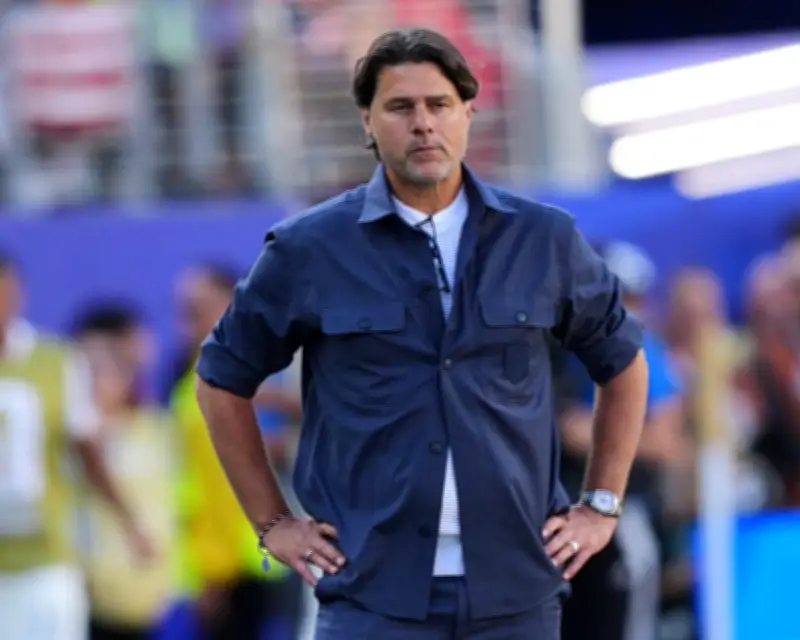
Mauricio Pochettino has agreed to stay on as head coach of the US men's national team through the 2030 World Cup, a decision that many see as risky, expensive, and largely unnecessary. The Argentine, who led the US to the last 16 at the 2026 World Cup before a 4-1 defeat to Belgium, accepted a contract extension that was offered before the tournament and remained on the table after elimination.
A successful but brief tenure
Pochettino took over in September 2024 and delivered broadly what was asked: he energized a stagnant squad, implemented a system fitting a generation of unprecedented talent, and produced two excellent World Cup performances, including a 4-1 thrashing of Paraguay that many called the best US showing ever. However, the campaign ended in disappointment against Belgium, with distractions like the Folarin Balogun suspension controversy undermining momentum.
Despite the success, the decision to extend his contract is a gamble. The inclination to build on his foundations is understandable, but it assumes he will stay the full four years. With top club jobs perpetually opening up, Pochettino—who has coached Tottenham, PSG, and Chelsea—may leave early, forcing another mid-cycle reset. Before the World Cup, he was in talks with Milan, who ultimately hired Ruben Amorim.
The second-cycle curse
History is not kind to USMNT coaches who stay for a second World Cup cycle. Bruce Arena's second stint ended in group-stage exit in 2006 after a strong 2002. Bob Bradley was sacked a year after 2010. Jurgen Klinsmann's second cycle led to failure to qualify for 2018. Gregg Berhalter's return after 2022 was marred by scandal and ended in humiliation at the 2024 Copa America. Each second-term failure shared a common thread: coaches struggled to keep the program fresh when the process reset.
Pochettino had less time in his first cycle than his predecessors—less than two years before the World Cup—but the challenge of maintaining freshness remains. The squad is young but injury-prone; core players like Christian Pulisic, Tyler Adams, Weston McKennie, Antonee Robinson, Sergino Dest, and Chris Richards have faced repeated fitness issues. Pulisic did not play a full 90 minutes all tournament, and Richards had a late scare before the World Cup.
High cost, low stakes
The financial burden is another concern. Tax filings show Pochettino earned over $5 million in his first seven months, with billionaire Ken Griffin supplementing his salary. His new deal keeps him among the highest-paid international coaches. Yet the upcoming schedule offers little to justify the expense: World Cup qualifiers for 2030 do not start until November 2027, with only Nations League, Gold Cup, and friendlies before then—mostly against weaker Concacaf opposition. With Concacaf now guaranteed at least six spots at the expanded 2030 World Cup, the stakes are far lower than in previous cycles.
As one analyst put it, "You wouldn't buy a supercar just to drive it to the grocery store and back." The USMNT will be making school runs, not highway driving, in the next few years. Pochettino's return may be a comfort, but it is a costly one with uncertain rewards.




