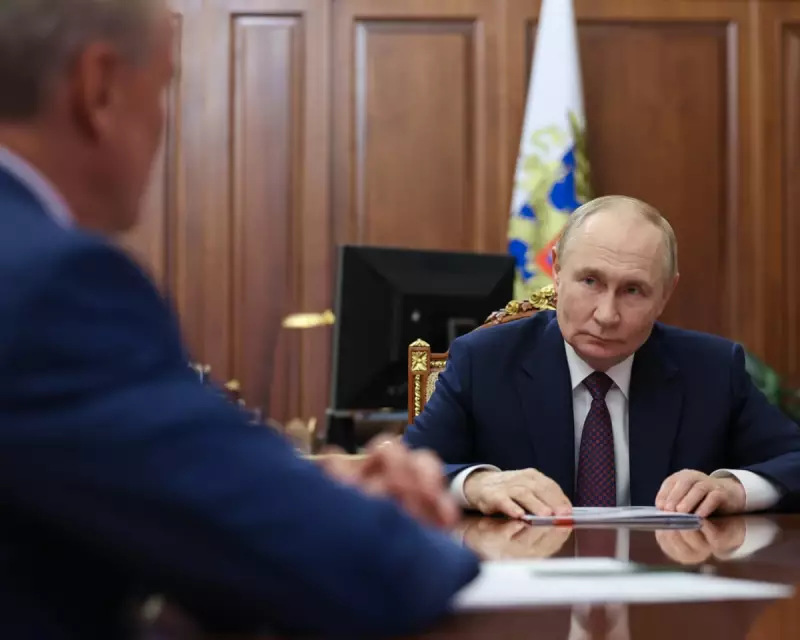
The chief executive of Russia's largest bank, Sberbank, has delivered an unusually candid assessment of the country's economic struggles in a direct address to President Vladimir Putin. German Gref stated the financial giant is facing 'challenging macroeconomic conditions', leading to only "very modest" growth and a worse-than-expected outlook for 2025.
Military and Economic Fronts Intensify
This stark admission from a key Russian business leader coincides with a reported deterioration in the military situation for Ukraine. General Oleksandr Syrskyi, Ukraine's top military commander, stated that the army's position had 'significantly worsened' in parts of the Zaporizhzhia region. He reported that Russian forces, using their numerical superiority, had advanced and captured three settlements near Oleksandrivka and Huliapole.
On the economic warfare front, Ukraine's military claimed a successful strike on a Russian oil refinery in the city of Orsk, located in the Orenburg region. They stated that explosions and a fire were observed, with preliminary information suggesting one of the primary oil processing units was hit.
Further amplifying international tensions, NATO member Romania reported finding drone fragments on its territory following Russian strikes on Ukrainian Danube River ports. The Romanian defence ministry detected drones near its airspace, with Foreign Minister Oana Toiu labelling the incidents as part of Russia's 'systematic provocations against the EU and Nato'.
Diplomatic and Energy Fallout
In diplomatic developments, Russia's Foreign Minister Sergei Lavrov stated that Moscow is 'ready' to discuss accusations from the United States, echoed by Donald Trump, that Russia has conducted secret underground nuclear tests. Lavrov denied the allegations and suggested the US could use the global seismic monitoring system to verify his claims.
The knock-on effects of international sanctions continue to disrupt Russian business interests abroad. Serbia's energy minister revealed that Russian interests are negotiating their withdrawal from the key Serbian oil company, NIS, which now faces US sanctions. This move is driven by Serbian fears that continued Russian control could harm its economy, given that NIS runs the country's main refinery, supplying about 80% of Serbia's needs.
In a significant policy move, the British government announced plans to ban companies from providing services such as shipping and insurance for Russian liquefied natural gas (LNG) exports. A Foreign Office statement said the ban will be phased in over 2026, going further than EU sanctions which ban Russian LNG imports from 1 January 2027.
Internal Challenges in Ukraine
Ukraine is confronting its own internal challenges. The head of Ukraine's delegation for talks with Russia, Rustem Umerov, is in Istanbul attempting to 'unblock' the process of prisoner swaps. Meanwhile, the country's energy sector is grappling with both external attacks and internal corruption allegations.
Vitaliy Zaichenko, head of Ukraine's state grid operator, announced plans to increase power import capacity from neighbouring countries to a total of 2,300MW in December to bolster the war-torn energy system.
Concurrently, Prime Minister Yulia Svyrydenko confirmed the government had dismissed the supervisory board of Energoatom, the nuclear agency generating more than half of Ukraine's energy. This move came as anti-corruption authorities charged seven individuals over an alleged $100m kickback scheme involving state enterprises. Energoatom assured the public that the probe has not disrupted production or operational safety.