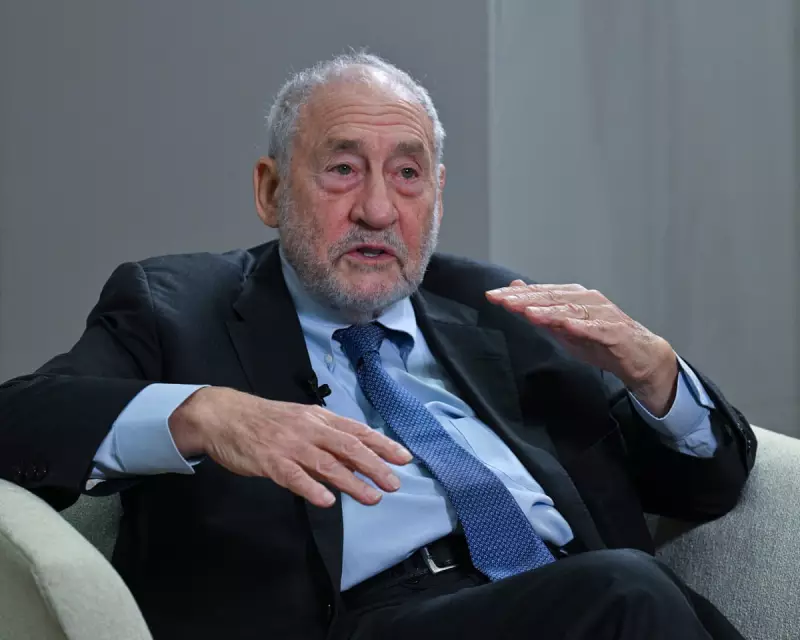
When Swiss billionaires presented Donald Trump with luxury gifts including a gold bar and Rolex watch - followed promptly by reductions in US tariffs - it demonstrated how concentrated wealth can purchase political influence and reshape policy. According to Nobel Prize-winning economist Joseph Stiglitz, such concerning scenarios risk becoming commonplace unless the world addresses what he terms the global "inequality emergency".
The Scale of the Crisis
Professor Stiglitz identifies the rapidly expanding chasm between the ultra-wealthy and everyone else as a human-made catastrophe that's progressively damaging political systems, social cohesion and planetary health. This isn't a problem confined to struggling nations anymore. The World Bank classifies 90% of the world's population as living under conditions of "high income inequality", with the United States hovering just below that threshold and ranking as the most unequal G7 nation, closely followed by the United Kingdom.
The economist's crucial insight reveals that defenders of the current economic framework can no longer rationalise its accumulating irregularities. This realisation has prompted him to develop a comprehensive alternative framework, detailed in the first-ever G20 inequality report, which has already gained endorsement from key European, African and middle-income nations.
Shocking Wealth Disparities Revealed
The statistics presented in the report paint a stark picture of global economic division. Since the year 2000, the wealthiest 1% captured 41% of all new wealth created globally, while the entire bottom half of humanity gained merely 1%. To put this in perspective, the average individual within the global top 1% saw their wealth increase by $1.3 million, whereas someone in the poorest half gained just $585 over the same period.
Meanwhile, the report documents that 2.3 billion people now experience moderate or severe food insecurity - a devastating increase of 335 million people since 2019. Perhaps most shockingly, billionaire wealth accumulation is rising in near lockstep with growing global food insecurity. The concentration of wealth dramatically outpaces income concentration, with billionaire assets now worth approximately one-sixth of global GDP.
Political Consequences and Climate Impacts
The report firmly establishes that extreme inequality represents a policy choice rather than an inevitable outcome of globalisation or technological advancement. Specific decisions including financial deregulation, weakened labour protections, privatisation of public assets, and reductions in corporate and top income tax rates have all contributed to widening disparities.
The most dangerous consequences extend beyond economics into the political realm. The analysis reveals that highly unequal countries become seven times more likely to experience democratic backsliding or drift toward authoritarianism. Additionally, Professor Stiglitz highlights how the super-rich account for a disproportionately large share of carbon emissions, thereby worsening climate risks that predominantly affect poorer populations.
The Nobel laureate explicitly rejects the pro-market argument that inequality benefits economic growth, instead proposing a comprehensive redesign of global economic governance reminiscent of the 1944 Bretton Woods agreement. His blueprint calls for rewriting intellectual property rules, reforming trade and investment treaties, overhauling global lending institutions, updating tax systems, and restructuring sovereign debt arrangements.
Professor Stiglitz argues that creating a fairer global order must begin with establishing authoritative knowledge, similar to how the Intergovernmental Panel on Climate Change transformed climate politics after its 1988 creation. He proposes establishing an International Panel on Inequality, an initiative already supported by hundreds of experts. Endorsing this panel doesn't represent a radical step, but rather the essential first move toward creating a more rational and equitable world order.