Mexico's Extreme Wealth Inequality: 1% Controls 40% of National Assets
A recent Oxfam Mexico report has exposed staggering wealth inequality in the country, revealing that the richest 1% of Mexicans now own 40% of the nation's total wealth. This concentration of resources occurs alongside unprecedented growth in billionaire fortunes, with Mexico's 22 wealthiest individuals doubling their collective wealth to $219 billion over the past five years.
The Stark Reality of Santa Fe's Divided Landscape
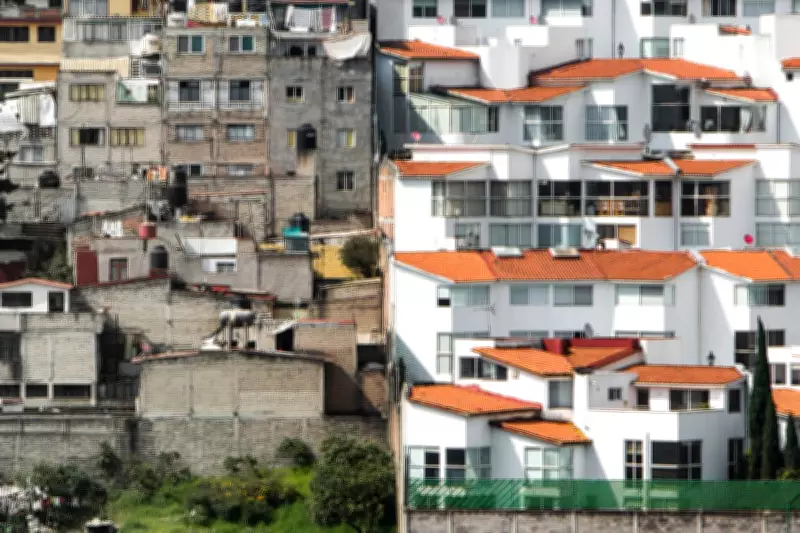
In Mexico City's Santa Fe neighborhood, the contrast between extreme wealth and working-class struggle manifests physically. The working-class community of Santa Lucía Reacomodo, with its cinder-block houses and tangled electrical wires, exists just meters away from luxury apartment towers and gated communities with manicured hedges and glass balconies.
María del Socorro Corona, a 79-year-old resident who built her turquoise two-bedroom home decades ago, described the transformation. "I have to make money," she explained while selling clothes and knick-knacks at a weekly market, "or I won't eat." She noted that about twenty years ago, when the government constructed a bridge connecting to the high-end Santa Fe business district, foreigners began attempting to buy local land. "So now the rich are over there," she said, pointing toward luxury developments, "and the poor are over here."
Centuries of Inequality in Modern Mexico
Public policy expert Viri Ríos, director of Mexico Decoded, characterized the situation as "unbelievably unequal – it's almost inconceivable." She explained that "inequality in our country has been around for centuries: we've just grown accustomed to living this way."
The Oxfam report details how extreme wealth concentration has become entrenched over the past thirty years. Carlos Slim, Latin America's richest individual, has seen his wealth increase more than eightfold between 1996 and 2025, while other billionaires experienced quadruple growth. "Ultra-rich Mexicans have never been so numerous or so wealthy as they are today," the report concludes.
Progress Amid Persistent Disparity
Despite these alarming figures, Mexico has made significant progress in poverty reduction. During former president Andrés Manuel López Obrador's six-year term, the number of people living in poverty decreased by 13.4 million – a reduction of nearly 26%. Extreme poverty also declined from approximately 9 million to 7 million individuals.
According to the World Inequality Database, Mexican inequality reached its lowest point since 2006 by 2024. Ríos described these developments as "historic reductions in Mexico's inequality," noting that "many policies, especially labor policies, are changing income distribution in ways we haven't seen in decades."
The Physical and Social Barriers of Wealth Segregation
The Santa Lucía neighborhood exemplifies how physical barriers reinforce social divisions. A ten-foot wall separates the community from the Bugamvillas gated complex, with security guards restricting access to outsiders. Sebastián Cejalugo, a 36-year-old garbage collector who has lived in Santa Lucía his entire life, described how the neighborhood has changed from his childhood when children played outside until 10 PM. "Now it's filled with lots of thieves and lots of drugs," he said. "After 8 or 9 PM you're done for."
Francisco González, 59, lamented the transformation: "It used to smell like forest. Now it smells of cats, dogs and marijuana." He also complained about noise pollution from nearby traffic and wealthy residents' sports cars roaring early in the morning.
Complex Economic Relationships Across the Divide
Despite the visible disparities, some economic connections exist between the communities. Cejalugo previously worked as a carpenter repairing doors and windows in Bugamvillas, noting that "the houses are luxurious. Even their kitchens are pretty." However, he prefers living in Santa Lucía, where community traditions thrive. "Here we have parties, Christmas celebrations, feasts celebrating the Virgin," he explained. "Over there, there's none of that."
Ríos observed that wealthy Mexicans have effectively isolated themselves through exclusive neighborhoods and avoidance of public services like healthcare and education. This separation maintains what remains a substantial gap between rich and poor, even as overall inequality metrics show improvement.
The report highlights both Mexico's progress in poverty reduction and the persistent challenge of extreme wealth concentration that continues to shape the nation's social and economic landscape.