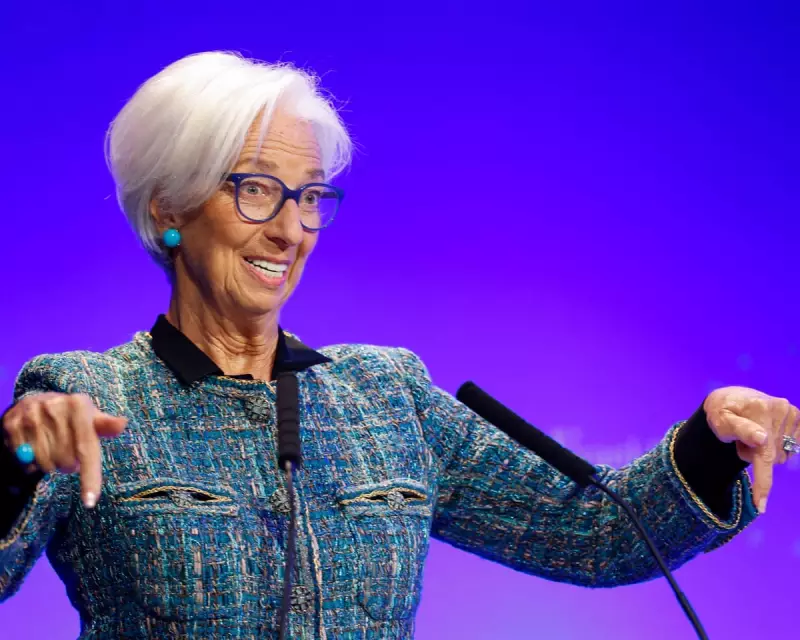
Christine Lagarde, President of the European Central Bank (ECB), has issued a stark warning that Europe's economic model is fundamentally misaligned with modern global realities, leaving it dangerously exposed.
Speaking at the European Banking Congress in Frankfurt, she declared that the EU economy is 'geared towards a world that is gradually disappearing', a world of open global trade that previously enriched its exporters.
Vulnerabilities in a Shifting Global Landscape
Lagarde pinpointed Europe's deep-seated dependence on international trade as a core weakness. She highlighted how this reliance has become a liability as major partners pivot away from globalisation.
She cited the protectionist policies championed by former US President Donald Trump, who imposed steep tariffs, and China's strategic use of its dominance in critical supply chains to exert pressure.
Europe's specific vulnerabilities include a 'dependency on third countries for our security and the supply of critical raw materials'. Lagarde gave concrete examples, such as China's control over rare earth metals essential for electric motors and wind turbines, and the potential 'choke point' of power chips made by Nexperia in China that threatened global car production.
Internal Stagnation and a 'Vicious Circle'
The ECB chief was equally critical of Europe's internal failures. She accused policymakers of allowing fundamental weaknesses to 'erode growth quietly, as each new shock nudges us onto a slightly lower trajectory'.
She lamented that the EU's internal market has 'stood still', particularly in future-defining sectors like digital technology and artificial intelligence, as well as in the capital markets needed to finance such innovation.
Compounding this, Lagarde described a 'vicious circle' where European savers invest in US stocks, thereby accelerating American economic advancement while leaving the EU with 'stagnating productivity at home and growing dependence on others'.
A Prescription for European Recovery
Despite the challenges, Lagarde highlighted some European strengths, including a resilient labour market, rising digital investment, and counter-cyclical government defence spending following Russia's invasion of Ukraine.
Her prescription for recovery focused on bold internal reforms. A central proposal is tearing down trade barriers between EU member states. According to ECB analysis, these barriers are equivalent to a 100% tariff on services and 65% on goods.
She argued that lowering these to the level of a relatively open economy like the Netherlands would fully offset the economic damage caused by US tariffs.
Other key recommendations included:
- Mutual recognition of regulated companies, allowing firms authorised in one member state to operate across the entire EU.
- Adopting qualified majority voting on tax matters to prevent single countries from vetoing progress.
- Harmonising VAT to ease the burden on smaller companies navigating 27 different tax regimes.
Lagarde's speech serves as a powerful call to action, urging Europe to modernise its economic foundations or risk falling further behind in a rapidly changing world.