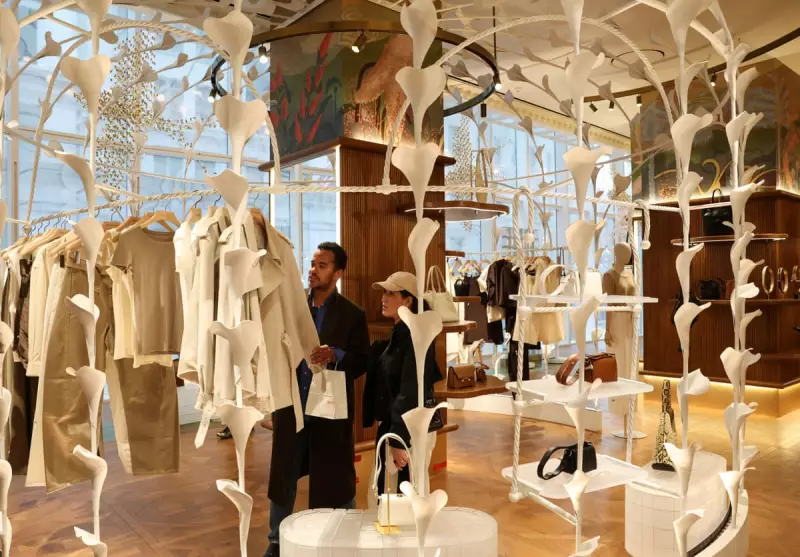
This festive season in New York City presents a jarring portrait of economic reality. On one side of Broadway, the newly opened French luxury emporium Printemps offers a world of comfortable opulence, complete with an in-store ice rink and a roaming champagne cart. Across the street, hundreds queue at Trinity Church for free food and essentials. This contrast encapsulates what economists call a 'K-shaped' economic recovery, where fortunes diverge sharply along the lines of existing wealth.
A Tale of Two New Yorks: Luxury and Line-ups
Entering the Printemps store in lower Manhattan is designed to feel like stepping into a chic Parisian apartment. Shoppers are encouraged to sip drinks while browsing plush, Wes Anderson-inspired dressing rooms. Here, a $600 fur coat or $1,450 leather boots are framed as reasonable investments. Julien, a custom stylist shopping for a Secret Santa gift, remarked that the high prices were 'normal' for the brands on offer, noting his business is thriving because 'rich people are still rich.'
Just a stone's throw away, the scene is starkly different. The poverty rate in New York City has hit 25% this year, nearly double the national rate, according to the Robin Hood Foundation. This surge is driven by rising costs, wage stagnation for low-income workers, and cuts to key anti-poverty programmes under the Trump administration, including tightened food stamp enrolment and reduced housing assistance.
The Engine of Disparity: Soaring Markets and Stagnant Wages
The primary driver of this widening gap is the booming stock market, concentrated in the hands of the few. The S&P 500 has soared nearly 86% over five years, fuelled partly by the AI boom. Federal Reserve data reveals the extreme concentration of this wealth: the top 1% of Americans own nearly 50% of stocks, while the bottom 50% own just 1.1%.
Meanwhile, for most, the economic picture is bleak. Inflation, after cooling to 2.3% in April 2025, has climbed back to 3% by September. The Yale Budget Lab estimates Trump's tariffs will cause a further short-term price rise of 1.2%, costing the average household around $1,700. Crucially, inflation's burden is not shared equally. Wage growth for lower-income households has dropped to just 1%, compared to 3.7% for higher-income groups.
This split is reflected directly in consumer behaviour. Bank of America data shows spending by low-income households grew only 0.7% over the past year, versus 2.7% for high-income earners. Major corporations see the divide clearly: Delta reports strong growth from premium flyers, Coca-Cola from its luxury products, while McDonald's notes middle- and low-income consumers are 'feeling under a lot of pressure' and skipping meals out.
Political Reckoning for a Divided Economy
The economic chasm presents a severe political challenge for President Donald Trump. Despite promising to fix prices, his approval ratings on the economy have plummeted. On inflation, his net approval in YouGov/Economist polls has crashed from +5% in January to -35% by early November. With tough midterm elections ahead, Axios reports Trump is planning a nationwide tour to confront criticism that he has overlooked domestic pocketbook issues.
Economist Peter Atwater, who coined the 'K-shaped' term during the pandemic, explains the phenomenon began after the 2008 financial crisis. 'Those at the top appear to have everything in oversupply,' he said, 'while those at the bottom feel scarcity in everything that matters – affordability of food, healthcare, education, job opportunity.' The Covid-19 pandemic, he notes, 'poured gasoline on that fire.'
As the holiday season unfolds, the 'K-shaped' economy is defining two very different experiences of Christmas 2025. For a small elite, it is a time of comfortable luxury and investment shopping. For a growing number, it is a season of pulling back, where the dream of festive abundance is replaced by the reality of economic strain.