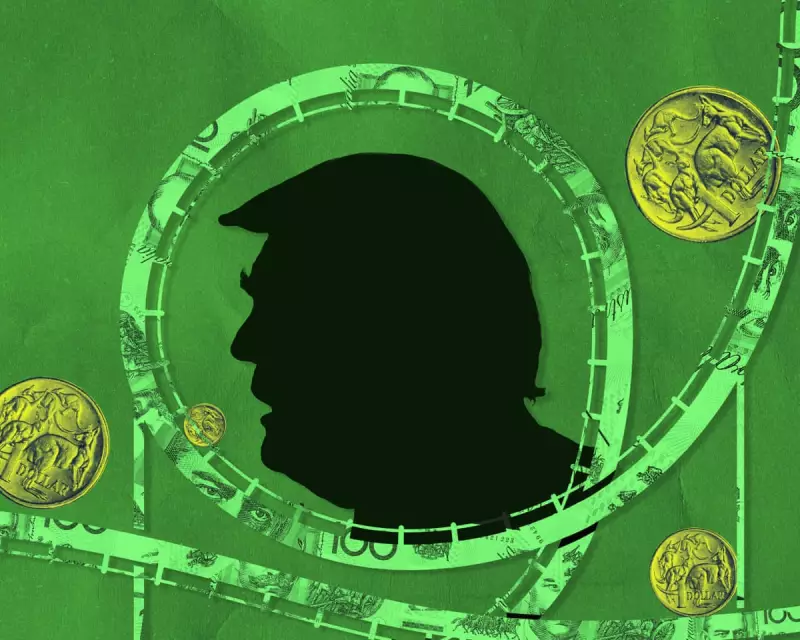
Trump's Economic Revolution: Australia's Surprising Position One Year On
As Donald Trump's presidency reaches its first anniversary, economists and policymakers across Australia are assessing the profound impact of his unorthodox economic policies. The world has witnessed a dramatic shift away from decades of globalisation, with Trump aggressively challenging established norms and institutions. This new era, characterised by rising protectionism and populist rhetoric, has left many nations grappling with uncertainty. Yet, against all expectations, Australia has emerged as an unlikely beneficiary in this turbulent landscape.
The Fear Versus Reality of Trump's Trade Policies
When Trump implemented his "liberation day" tariffs in April last year, panic swept through global financial markets. Experts predicted catastrophic consequences, with the Reserve Bank of Australia even considering emergency double rate cuts to cushion the anticipated blow. The Economic Society of Australia's survey revealed that nearly 60% of economists expected Trump's presidency to harm Australian economic growth, with only 8% anticipating benefits. The spectre of a global trade war threatening to wipe $27bn from Australia's economy loomed large.
However, the reality has proven remarkably different. The global economy has not collapsed into the predicted abyss, and Australia has demonstrated unexpected resilience. Luke Yeaman, Commonwealth Bank's chief economist and former Treasury deputy secretary, acknowledges this surprising outcome. "It is a bit of a puzzle: why hasn't the world been hit harder by tariffs?" he questions, highlighting the gap between theoretical predictions and actual economic performance.
Australia's Counterintuitive Export Boom
Contrary to expectations that a medium-sized, open economy like Australia's would suffer disproportionately from protectionist policies, the opposite has occurred. Australia has become one of the clear winners in this new economic order. Goods exports to the United States have doubled, surging from $16.8bn in the first ten months of 2024 to $33.2bn during the equivalent period in 2025.
This remarkable growth stems from two primary sources:
- Beef exports have jumped from less than $3bn to $4.2bn, benefiting from Australia's competitive advantage as American producers struggle with drought conditions
- Gold exports have experienced an extraordinary surge from $1.2bn to $14.6bn, driven by safe-haven demand as investors seek protection from policy uncertainty
The precious metal's price increased nearly 70% last year, reaching record highs as fears about Trump's unpredictable policies turbocharged demand for traditional stores of value.
Understanding the Global Economic Resilience
Richard Yetsenga, ANZ's chief economist, identifies a crucial analytical oversight in early predictions. "Perhaps the most fundamental analytical failure this year was not recognising that much of the impact of the US tariffs was to redistribute trade and production, rather than to destroy demand," he observes. This redistribution has allowed economies to adapt rather than collapse.
Warwick McKibbin, ANU economics professor and leading macroeconomic modeller, points to two key factors explaining the world's relative stability:
- The tariff measures have proven "all show and no substance" in their economic impact
- Artificial intelligence investment has created an unprecedented boom, particularly in the US economy
However, McKibbin sounds a cautionary note about the AI sector, warning that "the AI boom is a bubble and pretty close to bursting." This potential correction represents a significant risk to continued economic stability.
Institutional Challenges and Long-Term Concerns
Beyond immediate economic impacts, Trump's presidency has fundamentally challenged global institutions and norms. His attacks on Federal Reserve independence, combined with geopolitical adventures including renewed interest in Greenland and brief Venezuelan intervention, have created unprecedented uncertainty. Andrew Hauser, RBA deputy governor, draws parallels with Brexit's economic impact, suggesting that while immediate catastrophe was avoided, profound long-term consequences may gradually emerge.
Jenny Gordon, former chief economist at the Department of Foreign Affairs and Trade, expresses cautious optimism tempered with concern. "The world has weathered Trump's reckless policymaking fairly well so far," she acknowledges, before adding, "But 2026 could be very, very interesting."
Australia's Economic Outlook and Future Risks
The Australian economy concludes this turbulent year with projected growth improvements from 1.3% in 2024 to 2.3% in 2025, with 2.2% anticipated for 2026. While higher interest rates may be necessary to combat rising inflation, unemployment remains stable and immediate fears have subsided.
Yeaman offers a cautiously optimistic perspective for 2026, suggesting "a bit more of a positive outlook, led by the US." Potential further tax cuts could provide short-term stimulus, though their long-term affordability remains questionable given America's structural budget deficits.
Nevertheless, significant risks persist that could derail this fragile stability:
- Escalating tensions in the South China Sea
- Potential AI investment bubble correction
- Trump's attempts to install sympathetic leadership at the Federal Reserve
- China's management of its export surpluses
As RBA governor Michele Bullock aptly described, the experience has been "a complete rollercoaster." The global economy navigates uncharted waters where established rules no longer apply, and Australia's surprising resilience offers both hope and lessons for this new economic era. The coming years will determine whether this stability proves durable or merely represents a temporary respite before more dramatic economic shifts.