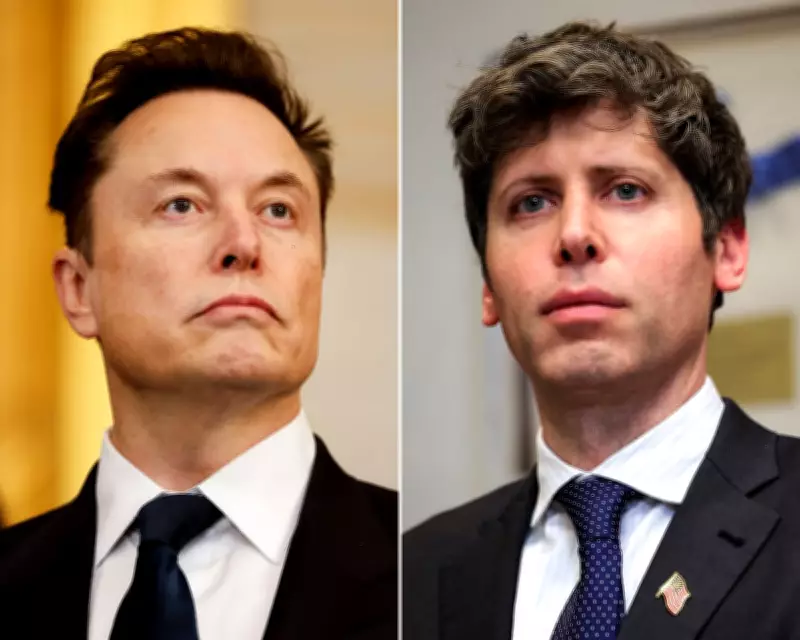
Elon Musk and Sam Altman are locked in a high-stakes rivalry over artificial intelligence, with their respective companies, SpaceX and OpenAI, racing toward initial public offerings (IPOs) that could reshape the tech landscape. The tension reached a boiling point last week, marked by legal battles, financial disclosures, and competing announcements.
Legal Showdown and IPO Plans
On Monday, a federal jury in Oakland, California, rejected Musk's lawsuit against Altman, OpenAI, and its president Greg Brockman. Musk had accused them of unjust enrichment and breaching a founding contract from 2015. The verdict, delivered in under two hours, clears the path for OpenAI to pursue an IPO later this year at a valuation of approximately $1 trillion.
However, SpaceX is set to go public first. On Wednesday, Musk revealed plans for a $1.75 trillion IPO on the Nasdaq exchange under the symbol SPCX, likely on June 12. The company seeks up to $80 billion in investment, disclosing its secretive finances for the first time. SpaceX is investing heavily in its AI subsidiary, xAI, with capital expenditures exceeding $20 billion last year against $18.7 billion in revenue for 2025. The company reported a loss of over $4.2 billion in the first quarter of 2026.

SpaceX's investor prospectus lists OpenAI and Anthropic as key competitors. On Thursday, the Wall Street Journal reported that OpenAI is hurtling toward its own IPO, possibly as soon as Friday, though no filing occurred that day. The news shortened excitement over SpaceX's IPO, highlighting the intense one-upmanship between Musk and Altman.
Concentration of AI Power
The rivalry underscores a broader concern: control over AI is concentrated in a tiny circle of tech leaders. With OpenAI, SpaceX, and Anthropic all planning IPOs this year at valuations in the hundreds of billions or trillions, this period marks one of the most blockbuster public offering cycles in history. Experts question what the rest of us can do while these men obsess over each other.
Visiting San Francisco during Google's I/O conference, I found that conversations with AI insiders focused on potential and success, while those outside the bubble worried about job security. The question of whether non-CEO roles will remain safe is on everyone's mind except Altman's and Musk's.
Google's Bid for AI Dominance
Meanwhile, Google made a bold move to own the "whole tech person" at its I/O conference in Mountain View. The company unveiled Gemini Spark, a 24/7 personal AI agent designed to proactively manage tasks across calendar, email, Docs, and more. The demo showed the bot organizing a party by pulling from various Google services. Other potential uses include reviewing credit card statements, checking inboxes for school action items, and translating meeting notes.
Gemini Spark represents a shift from smartphone-centric to AI-centric living. Google also announced that Search results will now default to a chatbot interface, summarizing answers rather than displaying blue links. This change reduces user effort but raises concerns about control and privacy.
The move follows attempts by Apple and Amazon to dominate daily life, but Google's integration with existing services gives it an edge. As The Washington Post noted, "AI is just another technology Americans don't like but can't stop using."
What the Future Holds
The race between Musk and Altman, combined with Google's AI push, signals a future where AI agents orchestrate our lives. Whether this is convenient or sinister depends on the user. As social media users complain about algorithmic feeds but engage with them more, the same dynamic may apply to AI assistants. The choice between control and ease will define the next decade of technology.