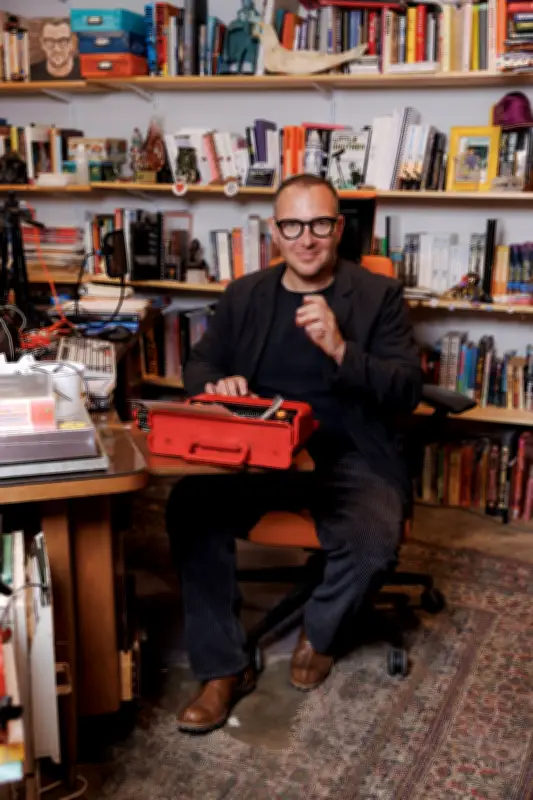
Cory Doctorow, the writer who coined the term 'enshittification,' has a new book, The Reverse Centaur's Guide to Life After AI, and a stark warning: artificial intelligence will never render humans obsolete, but the hype around it is a dangerous bubble. In an interview, he explains why AI appeals to those in power and why the $1.4tn investment in it is a threat to the economy.
Doctorow describes a 'reverse centaur' as a human forced to assist a machine, like warehouse workers meeting algorithm-set targets or lawyers checking AI's work for lower pay. He dismisses claims that AI will replace jobs, calling them a 'conjuring trick.' 'AI cannot and will never render us obsolete,' he says. 'It's a conjuring trick. That's probably the most important thing to get across.'
The AI bubble and its economic risks
Doctorow highlights the scale of the AI investment bubble. 'When I wrote this book [last year], it was a $700bn bubble. It's a $1.4tn bubble now. The only thing worse than a $1.4tn bubble is a $2.4tn bubble, which we're headed for,' he says. Nine US tech companies account for 35% of the entire stock market valuation, insulating the US from global shocks like the war in Iran, but this insulation is fragile.

He references two financial laws: Stein's Law ('anything that can't go on for ever eventually stops') and Keynes ('the market can remain irrational longer than you can remain solvent'). 'It's hard to predict when bubbles are gonna pop. But it's easy to predict that bubbles will pop,' he adds.
Why bosses love AI
Doctorow argues that the appeal of AI to bosses is not just about money but about control. 'The one thing a boss does not want is co-determination. Bosses are haunted by the knowledge that even though they fancy that they're driving the car, if they don't show up, everything continues to work. Whereas if the workers don't show up, everything shuts down.' AI promises to eliminate this dependency, creating 'products without product designers, workplaces without workers.'
He cites examples like Amazon's staff-less grocery stores, which required three people per shopper watching CCTV, yet failures don't dent investor enthusiasm. 'You don't have to believe that a face cream is gonna make women look younger to believe that there will be women who will buy a face cream marketed to make them look younger. It doesn't have to work.'
Criti-hype and apocalyptic claims
Doctorow warns against 'criti-hype,' where critique feeds hype, making doomsday scenarios more plausible. He recalls past promises: 'Do you not remember when they said cryptocurrency would replace all of the world's financial systems? They told us that the metaverse would be the default, that we wouldn't have tourism or sex any more.' He adds, 'We have such poor object permanence!'
He also addresses the veiled threats behind AI claims, as journalist Karen Hao argued: 'Let us experiment as we wish, have our datacentres, because otherwise Chinese companies will get there first.' Doctorow agrees, saying, 'You don't want a Confucian God. You want an Old Testament God. Different smiting.'
Musk, billionaires, and the human cost
Doctorow criticizes Elon Musk's Grok AI, which was found capable of generating child porn. 'I think it's very important to be critical of things like Elon Musk's Grok AI that allow users to turn out child porn,' he says. But he notes that investors aren't motivated by such features: 'If we want to actually target the harm that Musk is doing, we have to make his investors think he can't make money.'
He reflects on the solipsism of billionaires: 'You cannot make billions of dollars without hurting lots of people. And you can't hurt lots of people without, in some sense, believing that they're not really people.' He links Musk's ketamine use to his view of dissenters as 'NPCs' (non-player characters). 'I don't think it's a coincidence that Elon Musk calls the people who disagree with him NPCs, because he doesn't think they're really real.'

The coming crash and austerity
Doctorow warns that the AI bubble's burst will cause widespread economic harm, not to capital allocators but to everyone else. 'We have a quarter of a century's experience now with popped bubbles, and we use them as an excuse to do the austerity that our politicians dream of doing anyway.' He concludes that worrying about robot overlords is a fever dream; the real threat is the bubble itself.