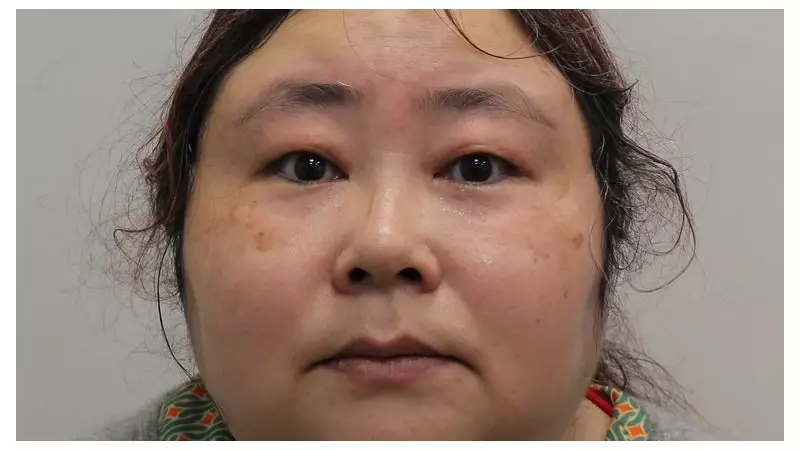
A woman who styled herself as the 'Goddess of Wealth' has been sentenced to 11 years and eight months imprisonment for her role in what police describe as Britain's highest-value money laundering investigation involving £5 billion in Bitcoin.
The Rise and Fall of a Crypto Criminal
Zhimin Qian, 47, who also used the alias Yadi Zhang, was finally brought to justice after nearly five years on the run. Her dramatic capture came when police kicked open the bedroom door of a York Airbnb on 22 April last year, finding her in bed looking stunned behind her thick glasses.
The Metropolitan Police's investigation began when Qian attempted to purchase a £24 million Hampstead mansion with £800,000 converted from Bitcoin. This suspicious activity triggered raids on her rented £5 million home adjacent to Hampstead Heath in October 2018, where officers made the country's largest cryptocurrency seizure - 61,279 Bitcoin then valued at £1.4 billion.

An Elaborate International Fraud
Between 2014 and 2017, Qian orchestrated a gigantic investment fraud in China, conning more than 128,000 victims from every province out of 40 billion Yuan (approximately £4.6 billion). She promoted her 'Britain Nice Life Insurance' scheme at luxury hotel conferences across China, where her sales teams promised investors 300% returns.
In a slick promotional video shown to potential victims, footage of British landmarks including the Houses of Parliament, Oxford University, and Buckingham Palace was accompanied by narration describing Britain as 'a nation of glories and dreams'. Qian, who wore imperial robes during these presentations, was already wanted in China for two other scams when she masterminded this operation.
After converting some of the fraud proceeds into more than 70,000 Bitcoin, Qian fled China in 2017, crossing into Myanmar on a moped before arriving at Heathrow Airport using a false St Kitts and Nevis passport under the name Yadi Zhang.
Lavish Lifestyle and Grandiose Ambitions
In Britain, Qian recruited Jian Wen, who left her job in a south London Chinese takeaway, and together they posed as bosses of an international jewellery business. They moved into a £17,000-a-month rented house in Hampstead and travelled extensively across Europe, spending tens of thousands of pounds on designer clothes at Harrods.
Qian's extensive notes revealed what the sentencing judge, Sally-Ann Hales KC, described as 'grandiose' plans to elevate her social standing. These included ambitions to meet a royal duke, be anointed as a reincarnated Goddess by the Dalai Lama, and rule the unrecognised micronation of Liberland as Queen.
While on the run, Qian maintained a rotating entourage of staff including cooks, drivers and security guards who were made to sign strict confidentiality agreements. These contracts prohibited them from using Chinese devices or apps and from photographing anything indoors or outdoors, with breaches resulting in dismissal and fines up to $30,000.
The Manhunt and Final Capture
Police believed Qian had left the country until Detective Constable Joe Ryan detected activity on a cryptocurrency exchange from a wallet linked to her in March last year. This led investigators to Seng Hok Ling, a Malaysian national with a previous fraud conviction, who was helping Qian remain undetected.
Ling provided false documents, money laundering services, and rented Airbnb properties including a Glasgow house and a remote Scottish Highlands farmhouse. He attempted to obtain a passport in the name of deceased Hong Kong actress Dianxia Shen.
When officers finally located Qian in York, they found a ledger and passwords sewn inside a purpose-made concealed pocket in her jogging bottoms, leading to the discovery of additional cryptocurrency worth approximately £67 million.
Justice Served and Compensation Battle
Qian pleaded guilty to two money laundering offences at Southwark Crown Court, while Ling admitted one money laundering charge and was jailed for four years and eleven months. Jian Wen, previously convicted of money laundering, received a six-year, eight-month sentence last year.

During sentencing, Judge Hales told Qian: 'You were the architect of this offending from its inception to its conclusion. The scale of your money laundering is unprecedented. Your motive was one of pure greed.'
The £5 billion Bitcoin fortune is now subject to a High Court battle between the UK government and thousands of Chinese victims. Prosecutors have established a compensation scheme, though lawyers representing investors argue it should reflect Bitcoin's massive appreciation rather than just their original investments.
Metropolitan Police officers travelled to Beijing and Tianjin to speak with fraud victims, some of whom had lost life savings, seen family relationships collapse, or been unable to pay for medical care. Chinese police officers were prepared to become the first in history to give evidence in a UK court, though Qian's guilty plea made this unnecessary.
Since being imprisoned, Qian has had poetry published and her artwork displayed at an exhibition. Her lawyer, Roger Sahota, described her as a 'Bitcoin pioneer' and former 'world's largest female Bitcoin holder' who 'never set out to commit fraud but recognises her investment schemes were fraudulent'.