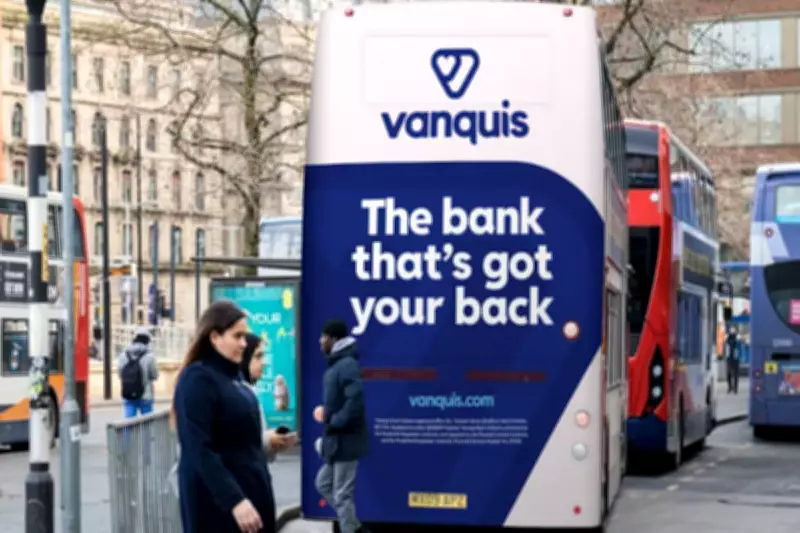
Vanquis Bank Returns to Profitability as CEO Defends Conservative Dividend Strategy
Vanquis Bank has swung back to profitability after a challenging period, with CEO Ian McLaughlin launching a staunch defense of the institution's decision to scrap its dividend for the second consecutive year. The FTSE 250 bank reported a profit of £8.3 million for the last twelve months, marking a significant turnaround from the previous year's £138 million loss.
Financial Performance and Strategic Priorities
The bank's income edged up two percent to £455 million while operating costs were dramatically reduced by 33 percent to £266 million. This resulted in a substantial improvement in the cost-to-income ratio, a crucial profitability metric, which decreased by 31 percentage points to 58.4 percent.
Despite this positive financial performance, Vanquis has chosen to maintain its dividend suspension for the second year running. McLaughlin emphasized that the bank's "number one priority" remains returning to capital-generative trading and building sustainable results.
"If that looks a bit conservative in the early stage, I'm fine with that," McLaughlin stated. "Getting back to being predictable and sustainable in your results is a very, very important part of running a bank so you'll never have me apologize."
The CEO explained that the bank expects to deploy capital for growth initiatives in the near term and will revisit its distribution policy when announcing 2026 results. He acknowledged that investors have endured a "turbulent time" and emphasized that restoring confidence remains a key priority for the coming year.
Legacy Challenges and Operational Shifts
Vanquis, formerly known as Provident Financial, has faced significant challenges over the past decade. The bank's difficulties trace back to a 2017 scandal when it attempted to replace its 130-year-old model of self-employed agents with full-time staff in its doorstep lending division.
This transition proved disastrous as debt collections plummeted, leading to then-CEO Peter Crook's resignation and a nearly 70 percent single-day share price crash. The bank ultimately exited doorstep lending in May 2021 after 141 years of operation in that sector.
More recently, the bank's 2024 results suffered from a £71.2 million write-off of its car finance business, Moneybarn. Complaint costs also surged 66 percent to £47.4 million, with fees to the Financial Ombudsman Service (FOS) rising to £24.8 million due to what the bank described as "unmerited claims management company claims weighing on performance."
Regulatory Developments and Business Transformation
In September 2025, Vanquis received High Court permission to sue a UK law firm operating a claims management business model, seeking damages for losses caused by unlawful means. Following revised FOS fee structures introduced through Treasury crackdowns, the bank recorded a significant reduction in complaint costs to £26.6 million and FOS fees dropping to £6.4 million.
The bank's net interest margin, a critical measure of profitability from lending activities, contracted to 16.5 percent from 18.5 percent the previous year. McLaughlin attributed this decrease entirely to the "dilution effect" from the rapidly expanding second charge mortgage division, which grew nearly 300 percent last year.
This lower-yielding but lower-risk business has dramatically altered Vanquis's traditionally high-interest lending mix, with the bank's risk margin decreasing to 11 percent from 11.8 percent.
"We're making sure that we're delivering good outcomes for customers, and we're lending them on the basis of affordability being in the right place," McLaughlin explained. "Could we do more going forward? Maybe – but for now, it's steady as she goes."
The bank's strategic shift toward more conservative lending practices and its focus on sustainable growth reflect a broader transformation following years of operational challenges and regulatory scrutiny.