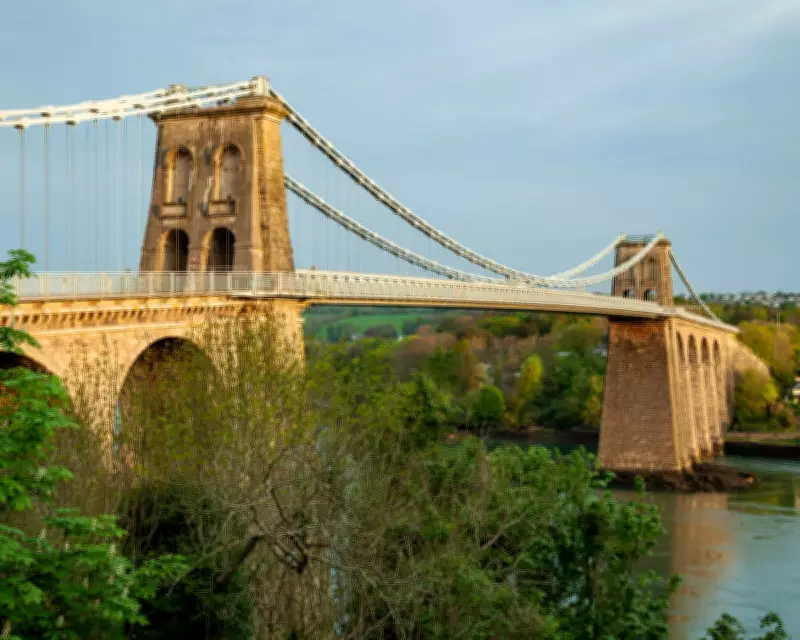
As dawn breaks over Bangor on the Welsh mainland, the silhouette of the Menai Bridge emerges against the sunrise, a timeless symbol linking the island of Anglesey to the rest of Wales. This vital artery has served residents for two centuries, standing as a testament to innovative engineering and community resilience.
A Legacy of Innovation and Community Impact
When Ian Evans's grandfather established a hardware shop on Anglesey in the 1930s, the Menai Bridge played a crucial role in its prosperity. Following upgrades that replaced wrought-iron chains with tensile steel, the bridge became stronger and wider, enabling heavier freight transport. This allowed the Evans family to secure deliveries of bottled gas from the newly formed Calor Gas company, bringing modern energy access to rural areas of Ynys Môn.
"My grandfather and his brother collected the first delivery from Bangor or Treborth station, and we continue to sell it today," Evans, now 61, recalls. "I view the bridge daily from my living room window, and visitors from afar often park nearby to admire it. It's an integral part of our local heritage and social fabric."
Engineering Mastery and Historical Significance
Friday marked the exact 200th anniversary of the bridge's official opening, a milestone for a structure that transformed north Wales's economic and social dynamics. Designed by Thomas Telford, the inaugural president of the Institution of Civil Engineers, the Menai Bridge debuted on 30 January 1826 as the world's first major suspension bridge.
William Day, an engineer involved in significant repairs in 1999, explains that Telford overcame challenges by selecting a narrow point over the treacherous Menai Strait, allowing tall warships to pass underneath. "It's an icon of civil engineering," Day notes. "Telford's precision, quality control, and forward-thinking on maintenance and sustainability were groundbreaking. He devised methods like hanging iron cable chains from rafts and using pulleys to hoist them, techniques that influenced future projects and remain relevant today."
Construction Feats and Lasting Influence
Spanning 579 feet (176 metres) and constructed between 1819 and 1826, the bridge replaced earlier temporary structures, such as a pontoon bridge built by Edward I in 1282. Telford's approach involved meticulous measurements to produce uniform iron cables, a novel practice at the time, with adjusting links to accommodate imperfections. The project utilised tunnels, rock chambers, and scaffolding to assemble the chains, showcasing unparalleled ingenuity.
As the final segment of the new London-Holyhead road, the bridge drastically reduced travel times to Ireland and enhanced safety, earning Telford the moniker "the Colossus of Roads." Born into poverty in Dumfriesshire, Telford left a lasting legacy across Britain through his contributions to infrastructure, including roads, bridges, and canals.
Modern Challenges and Future Prospects
Despite its revered status among Anglesey residents, the bridge has faced ongoing safety concerns, leading to traffic disruptions. Recently, the Welsh government announced the discovery of additional defects, with repair works now projected to extend until February next year.
Ken Skates, the Welsh government's cabinet secretary for transport, emphasised in a statement: "Our priority remains safeguarding the bridge for future generations. We are committed to ongoing investment in maintenance and preservation, with extensive inspections and refurbishments to ensure long-term safety and performance."
Bicentenary celebrations include the unveiling of a commemorative plaque and educational events hosted by Bangor University, highlighting the bridge's historical and cultural importance.
Optimism for Centuries to Come
Looking ahead, Day expresses confidence in the bridge's durability. "The masonry appears as fresh as if laid yesterday," he observes. "It's astonishing how well it has endured, and with proper care, it could easily serve for another 200 years." This sentiment underscores the Menai Bridge's role not just as a transport link, but as a cherished landmark poised to inspire future generations.