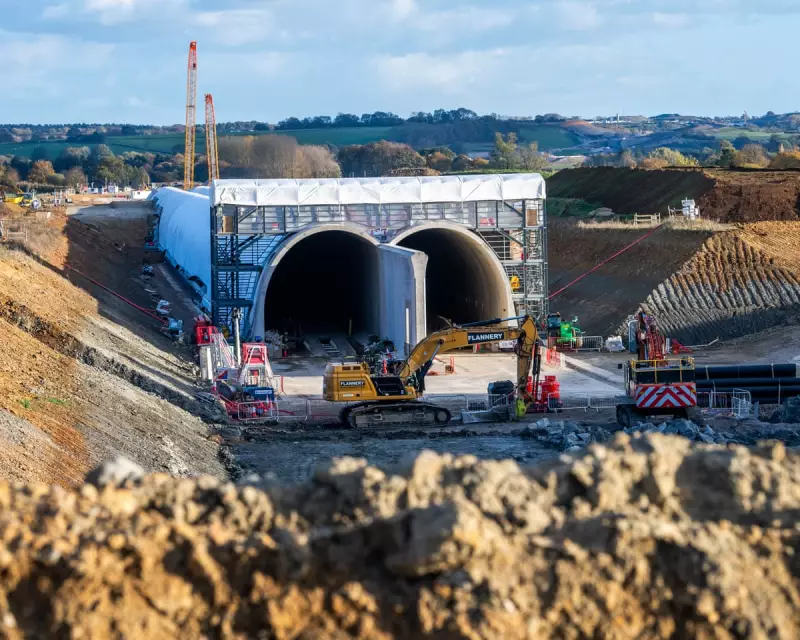
A decade after its initial proposal, the HS2 high-speed railway line from London to Birmingham remains a colossal project mired in controversy, delay, and eye-watering expense. Originally slated for completion by 2026, the official finish date has now been pushed to at least 2033, with some estimates suggesting it may not open until the 2040s. Its budget has ballooned catastrophically, potentially reaching close to £1 billion per mile, making it on track to be the world's most expensive railway.
A Landscape Transformed: From Promise to Reality
Walking the 140-mile route today reveals a world utterly changed from ten years ago. What was once a line on a map, feared by residents and fought by campaigners, is now a vast, linear construction site. The soundtrack is universal: clank-clank-clank, jugga-jugga-jugga, beep-beep-beep. For over half a decade, those living beside the path of HS2 have endured this relentless noise, alongside thousands of lorries, endless road diversions, and the permanent transformation of their local environment.
The project, conceived under the last Labour government and championed by former Conservative Prime Minister David Cameron, has seen its grand vision severely truncated. The proposed legs to Leeds and Manchester have been scrapped, undermining its original high-speed rationale. The focus has shifted to boosting rail capacity, but public support remains low, and not a single resident encountered along the route during an eight-day walk expressed a positive view.
Community Despair and Environmental Paradox
The human cost is profound. From Buckinghamshire to Warwickshire, stories of blight and frustration are common. Sarah Turner in Buckinghamshire branded those behind the project "criminals," while Christy Shrimp in Northamptonshire called it "desecration." Farmers like Jazzy Banister describe being buried under mountains of HS2 paperwork, with their best land taken, fields divided, and operations constantly disrupted.
Yet, HS2 presents a stark environmental paradox. It is simultaneously criticised for extravagant mitigation measures and for modest biodiversity targets. At the Colne valley viaduct—the longest rail bridge built in Britain since 1887—and near the Chilterns tunnel, HS2 has created new chalk grasslands, ponds, and woodlands. Ecologists point to "enhancements" like artificial otter holts, kingfisher nesting banks, and water vole breeding sites, arguing they go beyond legal obligations.
Conversely, the project's need for arrow-straight alignment has led to what critics see as absurdities, such as the infamous "bat tunnel" at Sheephouse Wood in Buckinghamshire. Built to protect rare barbastelle bats, campaigners like Caroline Thomson-Smith note the irony: "They cut down bat roosts to build the bat tunnel."
A Litany of Grievances and Glimmers of Compromise
The relationship between HS2 Ltd and those it affects is often characterised by a sense of profound imbalance. Residents speak of negotiators refusing market rates for properties and slow, inadequate compensation. Falconer Bob Edwards, now 80, won a parliamentary petition in 2016 but feels HS2 has since done "precisely nothing" to properly settle his claim for loss of livelihood, leaving him in limbo.
However, there are instances of reluctant compromise. In Burton Green, the only village physically bisected by the line, HS2 built a new £2.5 million village hall. While villagers like Cheryl Wall acknowledge the disruption, they also appreciate the unexpected facility. The company even provides a minibus for schoolchildren circumvented by a closed road and buys the village a Christmas tree annually.
Near Steeple Claydon, farmer Maggie Higgins secured a minibus service from HS2 after it refused to open a new bridge, a gesture the company defended as evidence of taking community impact seriously.
The Staggering Financial and Political Legacy
The causes of HS2's spiralling costs are widely acknowledged. Mark Wild, the current chief executive, admits construction began too early, before proper surveying and planning. The initial "costs plus" contracts were disastrous, effectively incentivising contractors to overspend. A major "reset" is now under way, aiming to cut corporate roles and secure better deals with suppliers.
Despite the chaos, HS2 has retained cross-party political backing. As the landscape around Birmingham is torn up for the new Interchange station, the scene resembles an enormous economic boom. Yet, as one observer noted, this is "a different stage of capitalism: all this striving mess for … virtually no economic growth."
For every story of anger, there is a flicker of resilience. Darren Harding, renovating his late aunt's cottage in the shadow of the Birmingham Interchange site, has found his own peace. "Although we’re in the middle of a building site, we’re maintaining a bit of heaven," he says, representing a rare note of optimism along a route forever marked by the world's most expensive, and most divisive, railway.