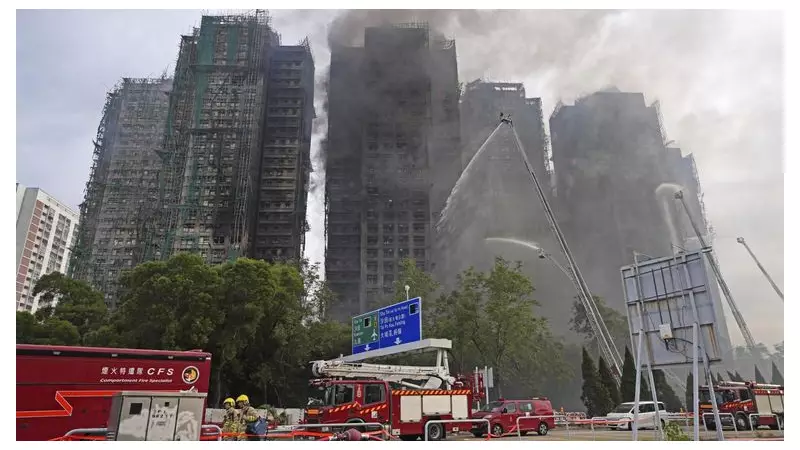
Hong Kong authorities have confirmed a devastating fire at a residential high-rise complex has left at least 44 people dead and approximately 279 others missing in what has become the city's deadliest blaze since the Second World War.
Mass Casualties and Emergency Response
The catastrophic fire broke out at 2.51pm local time on Wednesday at Wang Fuk Court in Tai Po, a suburban district in northern Hong Kong near the border with mainland China. The complex consists of eight blocks housing around 4,800 residents across nearly 2,000 flats, many of them elderly.
Fire crews battled through the night to bring the inferno under control, with the blaze finally being contained across four affected blocks by Thursday morning. Disturbing footage from the scene showed flames continuing to leap from at least two of the 32-storey towers that had been undergoing maintenance work.
Hong Kong leader John Lee addressed the tragedy during an early morning news conference, stating: "The priority is to extinguish the fire and rescue the residents who are trapped. The second is to support the injured. The third is to support and recover. Then, we'll launch a thorough investigation."
Construction Safety Failures Under Scrutiny
Police have revealed that three individuals have been arrested on suspicion of manslaughter in connection with the disaster. Those detained include two directors and one engineering consultant from the construction company responsible for maintenance work at the complex.
Investigators believe the fire spread rapidly through bamboo scaffolding and protective mesh sheets installed around the building, with windy conditions potentially accelerating the blaze. Superintendent Eileen Chung stated: "We have reason to believe that the company's responsible parties were grossly negligent, which led to this accident and caused the fire to spread uncontrollably, resulting in major casualties."
Authorities also discovered that some windows on an unaffected building were sealed with foam material installed by the same construction firm, further complicating rescue efforts and potentially violating safety regulations.
Historical Context and International Response
This tragedy has now surpassed the previous deadliest fire in Hong Kong's modern history, which killed 41 people in a Kowloon commercial building in November 1996. That incident prompted sweeping updates to building standards and fire safety regulations throughout the city.
The bamboo scaffolding and mesh sheets involved in the current disaster have been subject to a phase-out in Hong Kong since March due to longstanding safety concerns. According to Hong Kong's Association for the Rights of Industrial Accident Victims, there have been at least three fires involving bamboo scaffolding this year alone.
International leaders have expressed their condolences, with both the US and British Consulate Generals for Hong Kong sending messages of support to those affected. Taiwan's president has also offered sympathy, while China's state broadcaster CCTV reported that President Xi Jinping has urged an "all-out effort" to extinguish the fire and minimise casualties.
The human cost continues to mount, with 45 people remaining in hospital in critical condition and approximately 900 residents taking shelter in emergency accommodation. Rescue operations continue as authorities work to account for the hundreds still missing in one of Hong Kong's worst peacetime disasters.