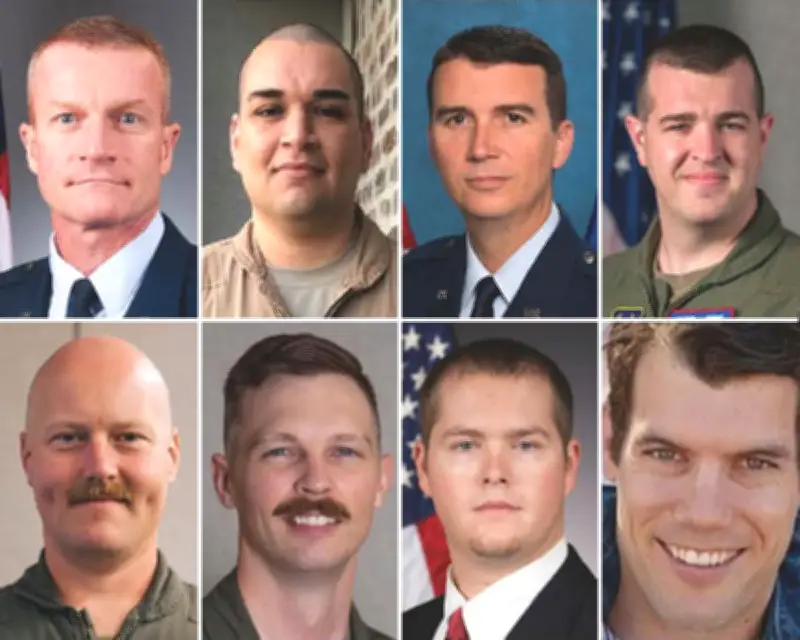
The United States Air Force has identified the eight individuals who lost their lives in the fiery crash of a Boeing B-52 Stratofortress during a test flight at Edwards Air Force Base in southern California earlier this week. The deceased include four active-duty airmen, one reservist, and three civilians, military officials confirmed on Wednesday.
The names of the victims, previously withheld pending notification of next of kin, are: Colonel Gregory Watson, 53; Lieutenant Colonel Gabriel Estrella, 40; retired Lieutenant Colonel Miles Middleton, 50; Major Alexander Davis, 34; Major Robert Dee, 40; Major Brad Hovey, 35; Jeromy Smith, 32; and Christopher Rischar, 41.
Crash Investigation Underway
The airfield where the B-52 crashed shortly after takeoff on Monday remains closed, though other base operations have resumed, according to a base spokesperson. The cause of the crash has not yet been determined, and officials anticipate the investigation could take up to six months.

Colonel Thomas Tauer, commander of the 412th Test Wing at Edwards, expressed condolences in a statement, describing the victims as "dedicated professionals, beloved family members and irreplaceable teammates."
Victims Remembered
Watson and Middleton were employees of Boeing. The company stated that their loss "is deeply felt across our teams, and our hearts remain with their families, loved ones and those who worked with them."
Jeromy Smith, a civilian flight test engineer for the Department of Defense, had become a father to his second child just four months before the crash. According to NBC News, he had returned to work only a week prior to the accident. His widow, Lauren Smith, told Eyewitness News KBAK-CBS and Fox58 that he died doing what he loved, adding, "It is such a horrible hurt, and I'm still processing everything that happened."
Details of the Test Mission
The B-52 Stratofortress was participating in a test mission as part of a program to extend the service life of one of the oldest aircraft in the US fleet. The bomber had arrived at Edwards in December after receiving a modernized radar system installed at Boeing's facility in San Antonio, according to an Air Force press release.
The Air Force planned to use the bomber as a testbed through 2026 to evaluate the B-52 radar modernization program, which aims to keep the 65-year-old bombers operational until at least 2050. "Some of these airplanes are literally twice the age of the pilots who fly them," said Ross Aimer, a retired United Airlines pilot and CEO of Aero Consulting Experts, speaking to the Los Angeles Times. "If you take care of an airplane, you can fly them forever, basically."
Crash Sequence and Initial Speculation
The aircraft took off shortly before noon on a clear day, heading southwest into prevailing winds. It flew straight and crashed on the same 15,000-foot runway. The compact wreckage indicates the plane dropped sharply.
Aviation safety experts suggest that initial thoughts about possible causes include a malfunction in flight controls or engines, but it is too early to draw conclusions. Investigators will examine factors such as the aircraft's age and maintenance history. Aerial footage showed virtually nothing remaining of the aircraft that went down in the Mojave Desert, about 100 miles northeast of Los Angeles.
Background on the B-52
The B-52, a long-range bomber that entered service in 1955, is designed to carry both conventional and nuclear weapons. It has been used in US military conflicts from Vietnam to Iran.
Edwards Air Force Base is home to the 412th Test Wing, which conducts regular developmental testing of all Air Force aircraft, weapons systems, software, and components throughout their lifespan. Test missions occur daily at the base, which is also where test pilot Chuck Yeager broke the sound barrier in 1947.
The Associated Press contributed reporting.