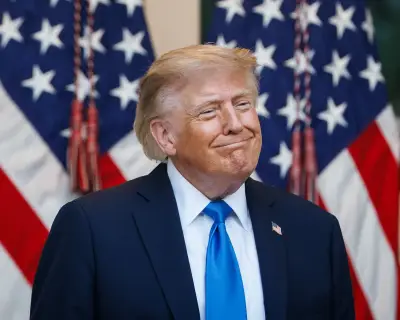
President Donald Trump announced that a peace deal with Iran, including the reopening of the strategically vital Strait of Hormuz, has been 'largely negotiated' following discussions with Israel and other regional allies. In a statement, Trump declared: 'Final aspects and details of the Deal are currently being discussed, and will be announced shortly.'
Diplomatic Outreach
Trump revealed that he had spoken with leaders from Saudi Arabia, the United Arab Emirates, Qatar, Pakistan, Turkey, Egypt, Jordan, and Bahrain, as well as separately with Israel. He characterized the emerging agreement as a 'Memorandum of Understanding pertaining to PEACE' that still requires finalization by the United States, Iran, and other nations involved in Saturday's talks. Notably, there was no mention of Iran's nuclear program or its stockpile of highly enriched uranium, which Tehran has sought to address in later discussions.
No Immediate Reactions
Neither Iran nor Israel offered immediate comment. Trump stated that his conversation with Israeli Prime Minister Benjamin Netanyahu, who had previously pressed the US to take military action, went 'very well'.

Mediation Efforts
A regional official with direct knowledge of Pakistan-led mediation efforts indicated earlier on Saturday that the US and Iran were nearing a deal to end the war, even as the US weighed a new round of attacks against Iran. The official, speaking on condition of anonymity, cautioned that 'last-minute disputes' could still derail the progress. This is not the first time in recent weeks that a deal has been described as imminent.
The potential agreement, according to the official, would include an official declaration ending the war, followed by two months of negotiations on Iran's nuclear program. The Strait of Hormuz would be reopened, and the US would lift its blockade of Iranian ports.
Signals of Progress
Iran has indicated 'narrowing differences' in negotiations with the US after Pakistan's army chief held further talks in Tehran. US Secretary of State Marco Rubio told journalists in India that 'there's been some progress made' and that 'there may be news later today'. Both sides have reiterated their key positions and warned of the risks of resuming hostilities and disrupting the current ceasefire.
Rubio repeated the US stance that Iran must never possess a nuclear weapon, must surrender its highly enriched uranium, and must ensure the Strait of Hormuz remains open. Iranian Foreign Ministry spokesperson Esmail Baghaei stated: 'We want this to include the main issues required for ending the imposed war and other issues of essential importance to us. Then, over a reasonable time span, between 30 and 60 days, details are discussed and ultimately a final agreement is reached.' He confirmed that the Strait of Hormuz is among the topics under discussion.
Nuclear Issues Excluded for Now
Baghaei told Iran's official IRNA news agency: 'Over the past week, the trend has been toward narrowing differences.' He added that nuclear issues are not part of the current negotiations. 'Our focus at this stage is on ending the war on all fronts, including Lebanon,' he said. A fragile, US-brokered ceasefire is in place for the Israel-Hezbollah conflict in Lebanon, which began two days after the Iran war started.
Iran's Military Posture
Iran's parliament speaker, Mohammad Bagher Qalibaf, who led historic face-to-face talks with the US last month in Islamabad, warned that Iran has rebuilt its military assets. He stated that if Trump resumes attacks, the result would be 'more crushing and more bitter' than at the start of the war. Trump previously indicated he was holding off on a military strike because 'serious negotiations' were underway and at the request of Middle Eastern allies. The US President has repeatedly set deadlines for Tehran, only to back off.
The US and Israel initiated the war with attacks on February 28, cutting short nuclear talks with Iran. In retaliation, Tehran effectively closed the Strait of Hormuz, a critical waterway for the region's oil, natural gas, and fertilizer exports, causing global economic disruption.