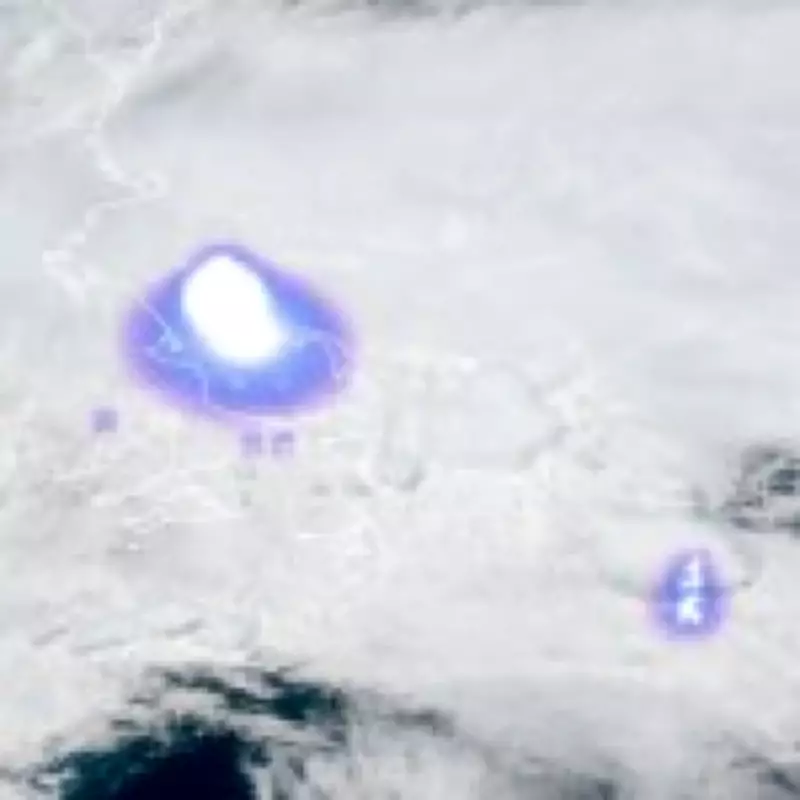
A meteor exploded over the northeastern United States on Saturday, producing a sonic boom that rattled homes and startled residents across Massachusetts. The space rock, traveling at approximately 75,000 miles per hour, disintegrated in the atmosphere, releasing energy equivalent to 300 tonnes of TNT, according to preliminary reports.
Details of the Event
The American Meteor Society reported that the meteor entered Earth's atmosphere around 2:00 p.m. Eastern Time, with the explosion occurring at 2:11 p.m. ET. The resulting sonic boom was heard across the state, with many residents describing a sudden bang that shook windows and frightened pets. Satellite lightning data from the National Oceanic and Atmospheric Administration indicated that the meteor likely entered the atmosphere over Massachusetts' South Shore, near Boston.
NASA confirmed that the meteor fragmented at an altitude of approximately 40 miles above the border between northeastern Massachusetts and southeastern New Hampshire. Meteors typically travel at speeds between 25,000 and 160,000 miles per hour when entering Earth's atmosphere, but most are no larger than a pebble and burn up completely. However, larger objects can survive deeper into the atmosphere, creating shock waves that produce sonic booms.

Witness Accounts and Social Media Theories
While scientists attribute the boom to a natural meteor event, social media users have proposed alternative explanations. Some speculated that the boom was caused by the Galactic Federation, a hypothetical union of extraterrestrial beings, though there is no scientific evidence to support this. Others suggested a missile interception, but authorities have confirmed no such activity occurred.
Shauna Edson, an astronomy educator at the Smithsonian National Air and Space Museum, told WBZ-TV that the event provides valuable data. "How bright it was, how fast it was moving, the angle it was coming from, and how long it stayed bright gives us a lot of information," she said. "Maybe it's part of a broken-off piece of a lone asteroid, or just one of these smaller space objects that has been floating around."
Context and Similar Events
This incident follows a series of similar sonic booms reported across the United States in 2026. In March, a meteor exploded over Ohio, producing a loud bang heard in multiple states. Days later, another meteor exploded over Texas, sending meteorites across the Houston area, with one reportedly crashing into a house roof.
The American Meteor Society is investigating an unusual increase in large fireball events and sonic booms during the first months of 2026. Scientists emphasize that such events, while rare, are natural occurrences that offer insights into the solar system's composition.