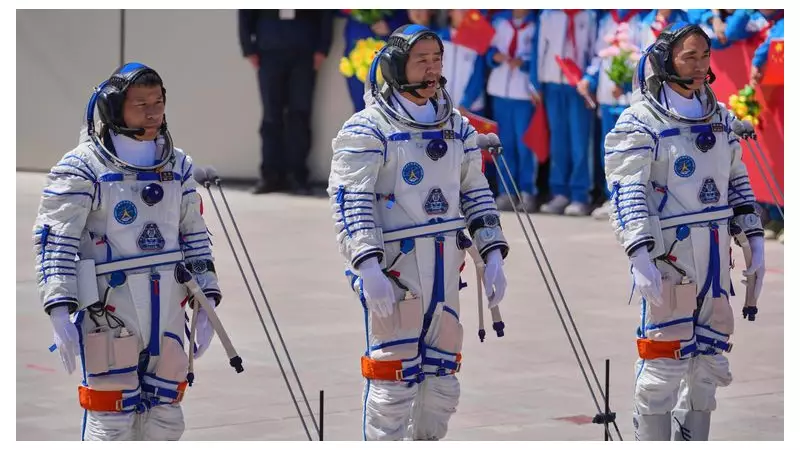
Three Chinese astronauts have made a successful return to Earth following an unexpected nine-day delay caused by damage to their spacecraft from space debris.
Emergency Landing in Gobi Desert
The trio, consisting of Chen Dong, Chen Zhongrui and Wang Jie, touched down safely in a remote area of the Gobi Desert on Friday, 14th November 2025. Their descent was marked by the deployment of a distinctive red and white striped parachute, bringing their extended space mission to a dramatic conclusion.
Originally scheduled to return on 5th November after completing their six-month rotation at China's Tiangong space station, the astronauts faced an unexpected extension to their stay in orbit. The delay occurred when inspection revealed tiny cracks in the Shenzhou-20 return capsule that was supposed to transport them back to Earth.

Space Debris Threat Revealed
According to China's space agency, the damage was most likely caused by impact with space debris. These microscopic particles, numbering in the millions and orbiting Earth at speeds exceeding that of a bullet, pose significant risks to satellites, space stations, and astronauts conducting spacewalks.
The space debris problem has become increasingly concerning for space agencies worldwide. These fragments can originate from various sources including:
- Previous rocket launches
- Satellite collisions
- Decommissioned space equipment
With the primary return vehicle compromised, mission controllers implemented an alternative plan using the Shenzhou-21 spacecraft, which had recently delivered a replacement crew to the space station in October.
Successful Rescue Mission
The stranded crew, who had been aboard the Tiangong station since April 2025, remained in good health throughout the extended mission and subsequent return journey. Chinese space officials confirmed that the astronauts, referred to as taikonauts in Chinese terminology, maintained excellent physical and mental condition despite the unexpected circumstances.
The Tiangong space station, whose name translates to Heavenly Palace, represents China's growing ambitions in space exploration. The station's first module launched in 2021 and, while smaller than the International Space Station, demonstrates China's independent capabilities in space after being excluded from international collaborations due to US national security concerns.
China's space programme continues to advance steadily since its first crewed mission in 2003. The nation has outlined ambitious future plans including a manned moon landing by 2030 and has already successfully deployed a robotic rover on Mars.
The most recent mission also included scientific experiments involving four mice, studying the effects of weightlessness and confinement on small mammals. Researchers from the Chinese Academy of Sciences indicated this research will help develop crucial technologies for breeding and monitoring animals in space environments.