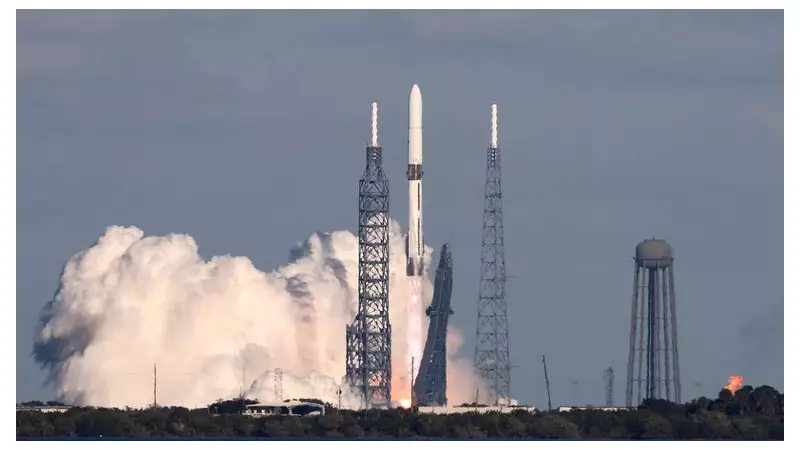
In a landmark achievement for private space exploration, Jeff Bezos's Blue Origin has successfully launched two NASA spacecraft towards Mars and, for the first time, recovered its massive reusable rocket booster. The historic launch of the New Glenn rocket from Cape Canaveral, Florida, marks a significant step forward in the intensifying billionaire space race with Elon Musk's SpaceX.
A Triumphant Launch After Days of Delay
The launch, which had been stalled for four days by adverse weather conditions, finally proceeded on Thursday after suffering two further delays earlier in the day. Crowds gathered at Florida's Cape Canaveral Space Force Station cheered as the colossal rocket, named after American astronaut John Glenn, roared to life and ascended through the Earth's atmosphere.
On board were the two identical Mars orbiters that comprise NASA's Escapade mission (Escape and Plasma Acceleration and Dynamics Explorers). The probes, named Blue and Gold, are now on their way to the Red Planet and are scheduled to arrive in 2027 to study how solar wind interacts with Mars's magnetic field. This research is vital for understanding the planet's climate and for protecting future human crews.

The Crucial Booster Landing
While delivering the Mars orbiters was a primary goal, the mission's most critical success was the recovery of the rocket's first-stage booster. In a moment of wild celebration among Blue Origin staff, the booster completed a controlled descent and landed perfectly upright on its offshore platform in the Atlantic Ocean, located 375 miles (600km) from the launch site.
This was only the second flight for the New Glenn rocket, and the company had never before managed to land a booster of this size. The inaugural test flight in January successfully delivered a prototype satellite but failed in its booster recovery attempt. The ability to reuse the booster is essential for slashing the immense costs of space missions, a feat already routinely achieved by competitor SpaceX with its large rockets.
Heating Up the Billionaire Space Race
This successful mission dramatically heats up the commercial space race. Blue Origin, owned by Amazon founder Jeff Bezos, has largely focused on space tourism with its smaller New Shepard rocket until now. The deployment of a NASA science mission to Mars and the mastery of booster recovery with the powerful New Glenn rocket positions the company as a more direct competitor to Elon Musk's SpaceX.
In a public show of sportsmanship, Mr Musk posted his congratulations to Blue Origin on his social media platform, X. The New Glenn rocket is a behemoth, weighing roughly the same as 20 trucks and standing at 98 metres tall and 7 metres wide. It is capable of carrying a payload of 45 metric tonnes into space, making it larger than most rockets, though not as big as SpaceX's Starship.
With this dual success of a complex interplanetary launch and a crucial technological milestone, Blue Origin has firmly signalled its ambitions to be a leading force in the new era of space exploration.