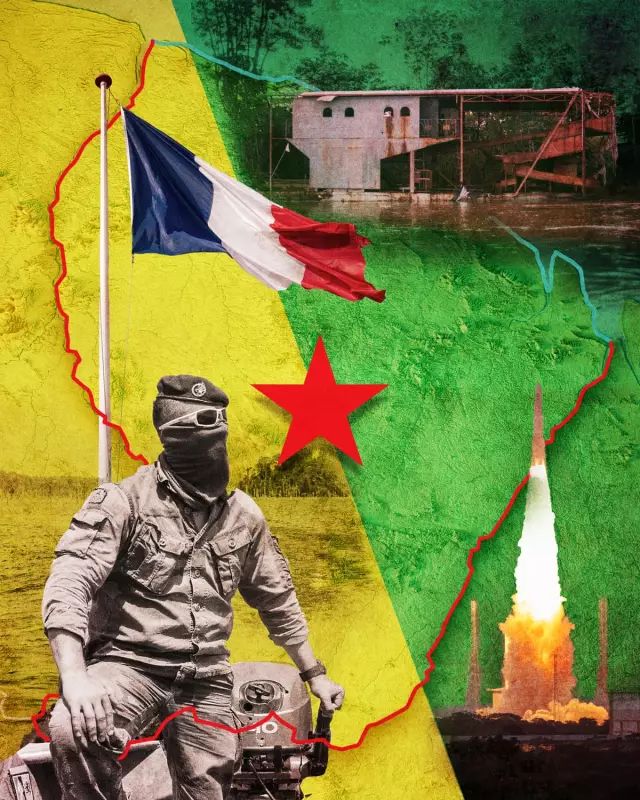
In a bold move that reshapes the global space race, tech giant Amazon is constructing its own rocket launch complex on the edge of the Amazon rainforest. The location is not in the United States, but in the European territory of French Guiana, home to the established European spaceport at Kourou.
A New Space Power Emerges in the Jungle
The project, spearheaded by Amazon's satellite venture, Project Kuiper, represents a massive strategic investment. The company is building a dedicated launch site at the Centre Spatial Guyanais (CSG), the historic home of the European Space Agency (ESA) and Arianespace. This facility is designed to host up to 10 launches per year of its prototype satellite internet constellations.
To bring this vision to life, Amazon has assembled what industry insiders are calling a modern "Foreign Legion." This is a large, international cadre of aerospace engineers, technicians, and specialists recruited from across Europe and beyond. Their mission is singular: to establish Amazon as a dominant force in satellite launch capability and challenge the current supremacy of Elon Musk's SpaceX.

The scale of construction is immense. The new launch complex requires 120,000 cubic metres of concrete and will feature a mobile gantry taller than the Statue of Liberty. This infrastructure is critical for launching the rockets that will carry Amazon's Kuiper satellites, which aim to provide global broadband internet, directly competing with SpaceX's Starlink network.
Geopolitical Shifts and Local Impact
Amazon's choice of French Guiana is highly strategic. By embedding itself within a European space hub, the company gains access to established infrastructure, a favourable equatorial launch location, and the political stability of an EU territory. However, this move also signals a significant shift. For decades, the CSG has been a symbol of European governmental space collaboration. Now, a powerful American private corporation is becoming a central tenant.
This development has profound implications for the local economy and community in French Guiana. The influx of hundreds of highly skilled foreign workers and their families is creating a micro-economy, boosting local businesses but also raising questions about long-term integration and the distribution of economic benefits. The project is a double-edged sword, bringing investment and high-tech jobs while testing the social fabric of this unique South American department of France.
The Race for the Sky Heats Up
The core driver of this billion-dollar endeavour is the fiercely competitive low-Earth orbit satellite internet market. Project Kuiper has a Federal Communications Commission (FCC) licence requiring it to deploy half of its planned 3,236-satellite constellation by 2026. With SpaceX's Starlink already boasting thousands of active satellites, Amazon is under immense pressure to catch up. Building its own dedicated launch capacity in French Guiana is seen as a crucial step to gain control over its launch schedule and reduce reliance on third-party providers.
This private space race, playing out from the jungles of South America, underscores a new era. The final frontier is no longer the sole preserve of superpower governments. Instead, it is being carved up by tech titans with vast resources. Amazon's "Foreign Legion" in French Guiana is on the front line of this commercial conquest, building the literal and figurative launchpad for the company's extraterrestrial ambitions.
The success or failure of this venture will not only determine the future of global internet connectivity but also redraw the map of space power, proving that the next great leap may be funded from Seattle and launched from the European rainforest.