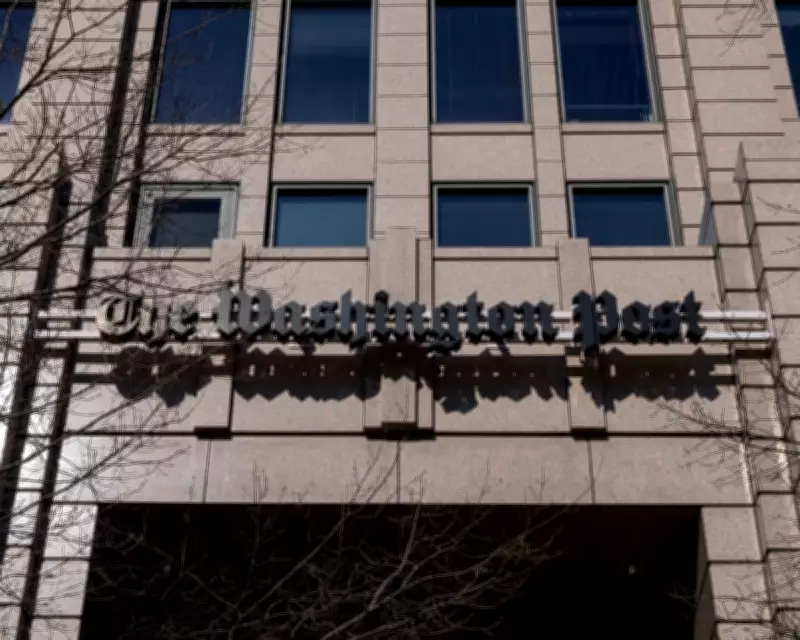
Washington Post Publisher Abruptly Resigns Following Controversial Staff Cuts
The Washington Post has experienced a dramatic leadership shakeup as publisher and chief executive Will Lewis announced his abrupt resignation on Saturday evening. This development comes just three days after the prestigious newspaper implemented one of the largest rounds of layoffs in American media history, cutting nearly one-third of its entire workforce.
Sudden Departure Amidst Staff Reduction Fallout
Lewis, a Murdoch media veteran who assumed leadership of the Washington Post in early 2024, communicated his decision through an untitled email to staff members. "After two years of transformation at The Washington Post, now is the right time for me to step aside," Lewis wrote in the message obtained by media outlets. His departure follows intense criticism regarding his absence during the all-staff meeting where the massive layoffs were announced.
The staff reductions have been particularly devastating for the newspaper's journalistic core, with at least 300 journalists losing their positions in what represents a significant contraction of the Post's newsroom capabilities. Lewis addressed this difficult period in his farewell message, stating: "During my tenure, difficult decisions have been taken in order to ensure the sustainable future of The Post so it can for many years ahead publish high-quality nonpartisan news to millions of customers each day."

Leadership Transition and Industry Challenges
Jeff D'Onofrio, who joined the Washington Post as chief financial officer in June, will now serve as acting publisher and chief executive during this transitional period. In a memo to staff, D'Onofrio acknowledged the difficult circumstances facing media organizations: "This is a challenging time across all media organizations, and The Post is unfortunately no exception." He expressed confidence in the newspaper's ability to navigate these challenges, adding: "I'm honored to take the helm as acting Publisher and CEO to lead us into a sustainable, successful future with the strength of our journalism as our north star."
Owner Jeff Bezos, who has faced considerable criticism for his stewardship of the publication since acquiring it in 2013, released a statement focusing on the Post's future direction rather than Lewis's tenure. "The Post has an essential journalistic mission and an extraordinary opportunity," Bezos stated. "Each and every day our readers give us a roadmap to success. The data tells us what is valuable and where to focus."
Controversial Leadership and Industry Backlash
Lewis's leadership had attracted increasing scrutiny in recent weeks, particularly following revelations that he attended Super Bowl festivities while the newspaper was dismantling its sports section through layoffs. This perception disconnect between executive activities and staff reductions further fueled criticism from both current and former employees.
Executive editor Matt Murray defended Lewis during a recent interview, explaining: "Look, Will has been engaged with me very closely on this for a long time. And there were a lot of things that the company did and Will was engaged with all across the company, and I wasn't. He had a lot of things to tend to today."
Some journalists expressed relief at Lewis's departure. Glenn Kessler, a former Post journalist critical of the paper's recent leadership, commented: "Will can put on British charm and knows how to manage up but eventually results matter. Every initiative he launched failed and he never found a way to boost readers for the Post."
Media Veteran's Complex Legacy
Lewis brought extensive media experience to the Washington Post, having previously served as chief executive officer and publisher of the Wall Street Journal for six years before departing in 2020. His career began in journalism at the Financial Times, followed by editorial leadership positions at the Sunday Times and Telegraph between 2005 and 2010.

Notably, Lewis played a significant role in managing the aftermath of the phone-hacking scandal that affected Murdoch's UK media properties, serving on the company-created management and standards committee that handled interactions with police investigators. Upon joining the Washington Post, Lewis indicated he did not intend to discuss this chapter of his career further.
The media industry continues to face substantial economic pressures, with traditional newspaper models struggling to adapt to digital transformation and changing reader habits. The Washington Post's recent staff reductions and leadership change represent another significant development in this ongoing industry evolution, raising questions about sustainable journalism models in the contemporary media landscape.