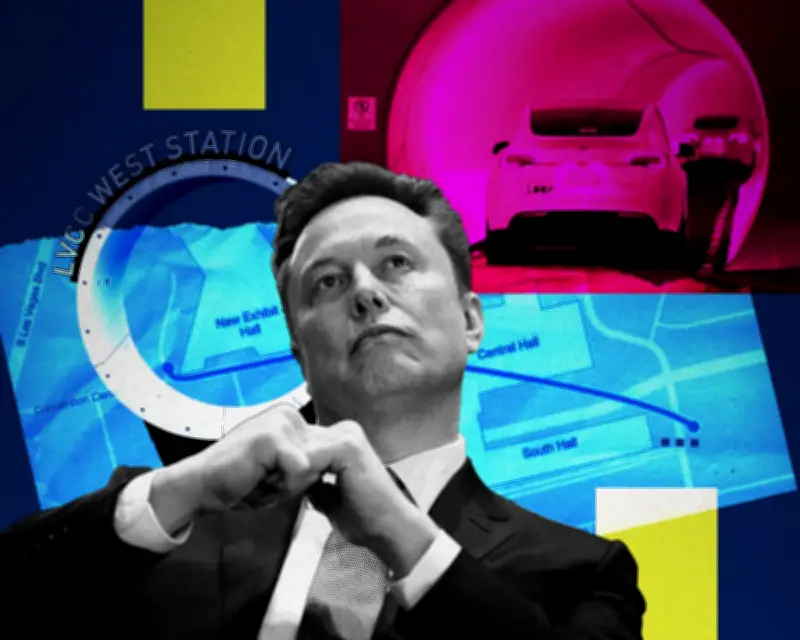
It's another blindingly bright day in Las Vegas, but I'm 30 feet underground, strapped into a Tesla for what was promised as a rocket ride to the future. Instead, it's a slow, brief trundle through a white-walled tunnel, illuminated by color-changing LED strips. The speed limit is a mere 30 mph, and the journey ends in minutes. I'm the only passenger, highlighting the underwhelming reality of the Vegas Loop.
Musk's Grand Vision vs. Reality
When Elon Musk announced the Boring Company in 2017, he envisioned cars descending on elevator platforms into a network of tunnels, zipping along at 124 mph on electric skates. He claimed it could solve urban congestion. Fast forward to today, and the Vegas Loop—a 1-mile tunnel connecting convention center halls—falls short. The system uses standard Teslas driven by humans, not autonomous vehicles. Tickets cost $4.25 per ride or $12.50 for a day pass, but the experience is far from revolutionary.
Overpromises and Underdelivery
Musk's pattern of overpromising is well-documented, from self-driving Teslas to Mars missions. The Boring Company is no exception. Despite raising $10 million from flamethrower sales and reaching a $5.7 billion valuation by 2022, projects in Los Angeles, Chicago, and elsewhere fizzled. Only Las Vegas embraced the concept, though expansion plans are underway.
Critics call the Loop a "neoliberal nightmare." Ray Delahanty, a former traffic engineer, notes its limited utility, especially as tourism dips in Vegas. The system's maximum capacity is 2,400 passengers per hour, a fraction of what a metro can handle. Ben Leffel, a public policy professor, labels it "the biggest, most absurd transit scam," arguing it physically cannot outperform rail.
Private Funding and Regulatory Avoidance
The Loop's private funding appeals to legislators, but it means stops are determined by developers, not city needs. The Boring Company has also faced allegations of environmental violations, including digging without approval and spilling wastewater. In Nashville, a similar project—the Music City Loop—faced protests and accusations of opaque decision-making.
Musk's Symbiosis with Government
Quinn Slobodian, co-author of Muskism, argues Musk profits from minimal regulations and state support. SpaceX and Tesla have benefited from government contracts and credits. The Boring Company, meanwhile, seeks to dominate underground spaces, but physical and regulatory hurdles remain. As Musk focuses on SpaceX's $2 trillion valuation, the Vegas Loop serves as a cautionary tale of hype over substance.