The British media landscape has lost one of its most influential figures with the death of Sir Andreas Whittam Smith at age 88. As the founding editor of The Independent newspaper, he achieved what few journalists ever manage - launching a successful national broadsheet that challenged the establishment and transformed British journalism.
The Birth of a Groundbreaking Newspaper
In October 1986, Whittam Smith achieved the near-impossible by launching The Independent, the first new national broadsheet in over a century. What made this achievement even more remarkable was his background as an unlikely revolutionary. With the appearance of a high-ranking cleric rather than a hard-nosed editor, he nevertheless possessed the vision and financial acumen to create a newspaper that would quickly become essential reading for Britain's liberal middle classes.
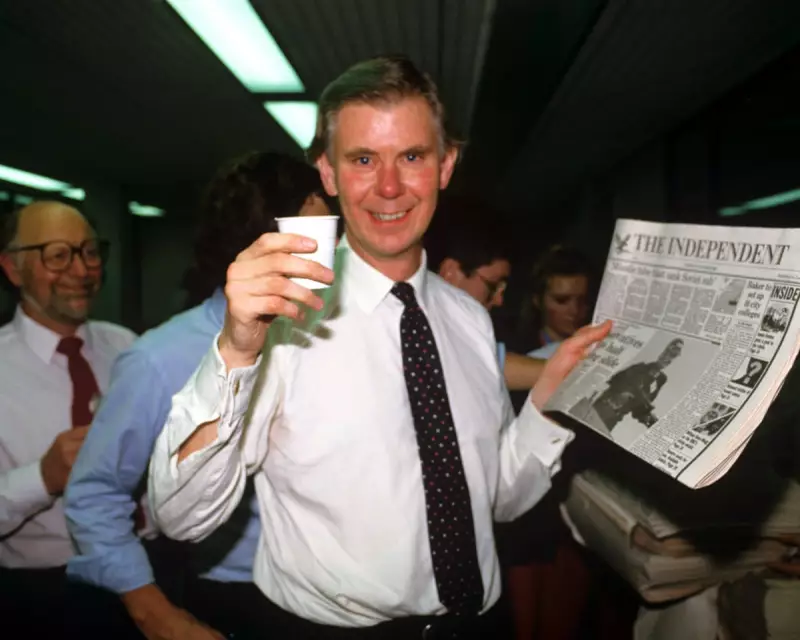
The newspaper's success owed much to perfect timing. Rupert Murdoch's breaking of the print unions' stranglehold over Fleet Street created an opportunity that Whittam Smith and two Telegraph colleagues, Matthew Symonds and Stephen Glover, seized upon. They secretly plotted their new venture while raising City money and recruiting over 100 experienced journalists, mainly from the Telegraph but also including refuseniks from The Times and Guardian.

Revolutionising Newspaper Design and Content
When The Independent launched on 7 October 1986 - coinciding with the Conservative party conference - it represented a breath of fresh air in the stale world of British broadsheets. The paper featured clean typefaces, spacious layouts and bold, large-scale pictures that made its competitors look dreary by comparison. Its journalism was equally innovative - well-written, challenging and free from the kneejerk politics that characterised other newspapers.
One area where the paper notably differed was in its coverage of the royal family, which it largely ignored. Whittam Smith later admitted to 'a tinge of republicanism' in their approach, stating they wanted to avoid fawning coverage and preferred the concept of a 'bicycling monarchy' like the Netherlands.
The formula proved spectacularly successful, with circulation quickly reaching 400,000 copies daily. The paper particularly challenged The Guardian and The Times, both of which had grown complacent. The Independent's famous slogan 'It Is. Are You?' captured its appeal to readers seeking something different from the established titles.
Challenges and Eventual Departure
Success bred ambition, and in 1990 Whittam Smith and his colleagues launched The Independent on Sunday into an already crowded market dominated by the Sunday Times. As Stephen Glover later admitted, 'The success of the daily went to all our heads.' This expansion coincided with economic turbulence and brutal price wars initiated by Murdoch and other proprietors, leaving the paper struggling financially.
The situation deteriorated further when other media organisations began circling. Both the Mirror Group and Irish businessman Tony O'Reilly's media company bought large stakes, meaning the paper lost its major selling point: it was no longer independent. In August 1994, Whittam Smith was forced out in a boardroom coup, ending his eight-year leadership of the newspaper he had created from nothing.
Life Beyond The Independent
Whittam Smith's career took several surprising turns after his departure from The Independent. In 1998, Home Secretary Jack Straw appointed him to head the British Board of Film Classification, an appointment many expected would lead to a more conservative approach. Instead, his four-year tenure proved surprisingly liberal, allowing the release of previously banned films like The Exorcist and The Texas Chainsaw Massacre on video.
He stated: 'One of my weaknesses as a censor is I can't take horror seriously. Adults should be able to make their own viewing decisions... In my deepest heart I object to notions of paternalism.'

In 2003, he became First Church Estates Commissioner for the Church of England, responsible for managing its £6bn portfolio. His tenure saw him rebuild church finances after previous property speculation losses of £500m, while navigating complex ethical investment issues. He stood down in 2017, having been knighted two years earlier.
Born in Macclesfield, Cheshire on 13 June 1937, Whittam Smith was the son of a Church of England vicar and a piano teacher. He was educated at Birkenhead School and Keble College, Oxford, where he obtained a third in PPE. After national service, during which the Army concluded he was 'unfit to lead men', he moved into financial journalism, working for the Financial Times, The Times, Daily Telegraph and Guardian before his groundbreaking Independent venture.
Sir Andreas Whittam Smith is survived by his wife Valerie, whom he married in 1964, their sons Benedict and Mark, and three grandsons. His legacy as the founder of one of Britain's most important modern newspapers ensures his place in journalism history.