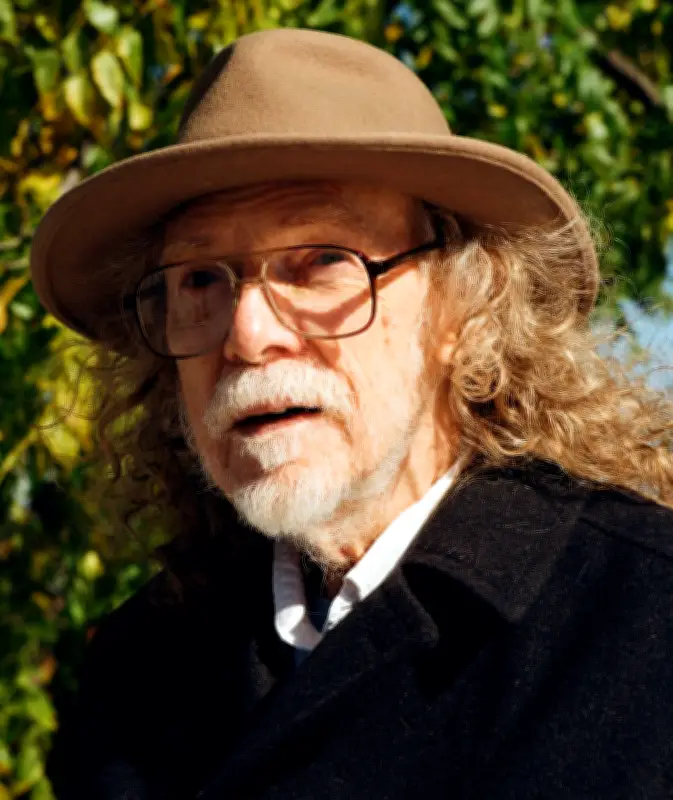
In a grainy 1986 television clip, a flame-haired troubadour with a neckerchief plays a lute-like instrument, harmonica under chin, his gentle ripples giving way to a voice full of longing. This performance, uploaded to YouTube in 2010, has drawn few comments, but those that exist—'Ed the Great!', 'pure gold'—reveal the passion Ed Askew inspired. The US poet, artist, and musician, who died at 84 a year ago, left behind around 50 albums and a legacy that continues to grow with the posthumous release of The Final Painting this month.
A Singular Voice from Folk's Fringes
Askew's collaborator Jerry David DeCicca describes him as living 'in a world that was for people who didn't fit in.' His musical journey began as a teenager in the 1950s when he discovered the 10-stringed tiple. DeCicca first fell for Askew's 'singularity' in the early 2000s. In recent years, Askew captured the hearts of contemporary acts like Sharon Van Etten and Bill Callahan, both of whom appear on The Final Painting, as well as Glasgow's Trembling Bells, who brought him to London's Cafe Oto in 2017, and Steve Gunn, who accompanied him in the early 2010s.
Bill Callahan notes a 'primordial' element in Askew's music, making it feel 'like the world is evolving right before your eyes when his song is playing. There's a holy aspect to it—those piano chords constructed like sheets of diamond ice.' Callahan adds, 'I got to tour with him in 2011 and felt his Jesus-y vibes. Jesus with a little scamp mixed in.'

Observations of the Quotidian and Tremendous
Askew's songwriting stands out for its flâneur-like observations, evoking everything from the scent of a marigold to the death of a Kennedy. In 2011, he cited early influences such as Kurt Weill, John Cage, and Erik Satie. Comparisons to Robert Wyatt, Gaslight-era Bob Dylan, or the Incredible String Band fall short; his baroque style more closely resembles the multiple-angled paintings of Cézanne or the writing of Joe Brainard mixed with Lorca's poetry.
Askew's song 'Moon in the Mind' appeared on the soundtrack of Netflix's Baby Reindeer in 2024, a welcome inclusion in his final year, according to DeCicca. But Askew was largely unconcerned with commercial success. 'He just wasn't wired that way,' DeCicca says, focusing instead on writing his fine-spun songs daily.
Early Life and Beatnik Roots
Born in Connecticut in 1940, Askew studied painting at Yale School of Art in the early 1960s before moving to New York in 1967, where he played for tips in East Village 'basket house' folk venues. There, he caught the attention of ESP-Disk, a label known for free jazz giants like Sun Ra and Pharoah Sanders. They released his 1968 self-titled debut (later retitled Ask the Unicorn) but shelved his follow-up Little Eyes, which was not released until 2002.
Over his life, Askew released approximately 50 albums through labels, archival releases, live albums, and self-releases, 'with more still unreleased in his vault,' DeCicca says. These were mostly home-recorded and self-published, funded by house painting and art teaching, plus welfare assistance for a time, before he returned to the studio in 2011.
Pioneering Gay Love Songs
Askew's friend and collaborator Jay Pluck highlights how pioneering Askew's psych-folk was in the 1960s. 'It was quite brave for him to be writing openly gay love songs so early on,' Pluck says. Yet he notes that 'over the years, I noticed that no one really knew that he was gay and I don't know why—there are gay love songs on Ask the Unicorn and Little Eyes.' Pluck mentions a later song called 'Lamar', recorded on cassette in the late 1990s, where Askew professes his love 'in a Greek paean kind of way.'
When asked if Askew would describe himself as a gay songwriter, Pluck answers, 'I think he would. Although he could be a contrarian. If you asked him if he thought he was a great gay artist, he'd say no. But if you left off 'gay' he'd be like, why?' For Askew, his sexuality was simply part of who he was.

A Legacy Beyond the Algorithm
Unlike many obscure musicians, Askew never had a 'Searching for Sugar Man' moment, DeCicca says. 'What allowed Ed to gradually find a global audience was not one event shining a spotlight; it was that he lived, day in and day out, as a true artist, sharing meaningful breadcrumbs for more and more people to discover.' This slow-burn tale is fitting for a musician who lived on his own terms, once singing, 'I play music for you to feel.'
'There is no trying in his music,' Callahan says. 'It just is.' The Final Painting is released on 31 July via Drag City.