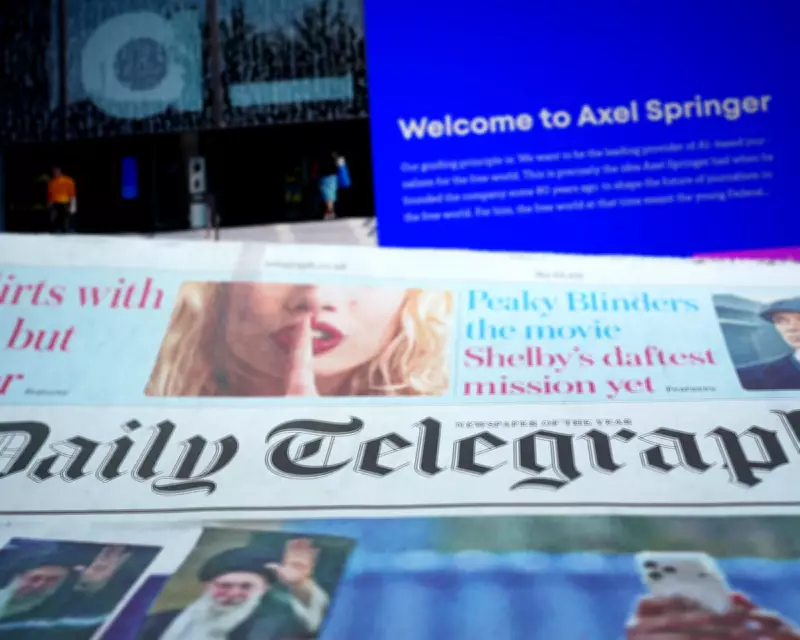
Axel Springer's Mathias Döpfner Pledges to Elevate Telegraph as Premier Centre-Right Media Powerhouse
In a stunning turn of events, Axel Springer's chief executive, Mathias Döpfner, has committed to transforming the Telegraph into the foremost centre-right media outlet across the English-speaking world. This bold declaration follows a dramatic last-minute acquisition that outmaneuvered Daily Mail owner Lord Rothermere, who had been poised to secure the title after a nearly three-decade pursuit.
Surprise Victory Shakes Up Media Landscape
The day after Lord Rothermere was gazumped by Axel Springer's knockout £575 million offer, the media mogul was spotted at Rupert Murdoch's 95th birthday celebration in New York. As guests enjoyed performances by Hollywood actor Hugh Jackman, Rothermere likely pondered how his long-held dream of uniting the Telegraph with his right-leaning stable had collapsed at the final hurdle.
Rothermere, who assumed leadership of the Daily Mail and General Trust group in 1998, first eyed the Telegraph in 2004, when the Barclay family secured it with a then-astounding £665 million takeover. By early March, after three other prospective buyers—including Abu Dhabi-backed RedBird IMI and a consortium led by New York Sun owner Dovid Efune—were thwarted, Rothermere's team was ready to finalize a £500 million deal, pending regulatory approval.

Instead, Germany's Axel Springer swooped in, completing its own lengthy quest for a British crown jewel to bolster its transatlantic empire. The company had previously lost bids for the Telegraph in 2004 and the Financial Times a decade later.
Döpfner's Vision and Potential Frictions
Standing at 6 feet 7 inches, Mathias Döpfner made an imposing impression during visits to the Telegraph's London office, where he met with management and staff, including editor Chris Evans. The 63-year-old CEO has assured editorial independence, yet speculation persists about potential leadership changes.
However, concerns arise from the track record of Bild, Europe's top-selling newspaper, which Axel Springer founded in 1952. Bild has a history of promoting rightwing populism, often facing penalties from German press regulators for ethical violations. Since the late 1960s, Axel Springer employees have been required to sign a pledge supporting corporate principles, known as The Essentials, which include backing Israel's right to exist, a free-market economy, and the Germany-US alliance.
This requirement to endorse a united Europe could clash with the Telegraph's staunchly anti-Brussels staff and readership, particularly if calls for a Brexit referendum re-emerge. Andrew Neil, former chair of the Spectator, noted on social media the irony of the very English and Eurosceptic Telegraph being owned by the German and very Europhile Springer.
Digital Strategy and Internal Reactions
Under Döpfner's leadership, a digital-first approach and artificial intelligence have become central focuses. Last year, he warned employees to embrace AI or die, signaling a tech-driven future for the Telegraph. Insiders report a generational split among staff, with younger employees welcoming Axel Springer's victory and older ones, many with Mail titles experience, preferring the predictability of a DMGT takeover.
One Telegraph source remarked, No one saw this coming, but all things considered it feels like a good outcome. Springer's promises of investment are more credible than DMGT's. Döpfner's AI fixation is a bit concerning, so we'll have to see his plans.
Döpfner, who serves on the boards of Netflix and Warner Music and has been likened to a blend of Rupert Murdoch and Elon Musk, plans to digitally turbocharge the Telegraph's expansion into the US, leveraging assets like Politico and Business Insider.
Commercial Ramifications and Future Outlook
Following the acquisition, Döpfner celebrated with senior executives in Berlin, popping champagne, while Rothermere's camp issued a statement claiming the Telegraph would have thrived under DMGT and criticizing UK regulatory disadvantages for domestic proprietors.

Media analysts warn that Rothermere's failure could have long-term commercial consequences, especially in the AI era. One analyst noted, An asset like the Telegraph only becomes available once every generation. He needed this deal, and now it's gone. The Mail's revenue streams are precarious, lacking a strong digital subscription business and vulnerable to AI changes. Axel Springer's resources may threaten the Mail's market share online.
For RedBird IMI, the bidding war proved lucrative, exceeding its goal of recouping the £600 million advanced to control the Telegraph and Spectator in 2023. After legislation blocked foreign state ownership, the investment vehicle sold the Spectator to GB News investor Sir Paul Marshall for £100 million in 2024, with Axel Springer's offer bringing the total for the Telegraph titles to £675 million.
After nearly three years of instability and multiple ownership changes, the Telegraph's approximately 900 staff seek stability. One source expressed hope that the deal concludes without further drama, marking an end to the tumultuous period.