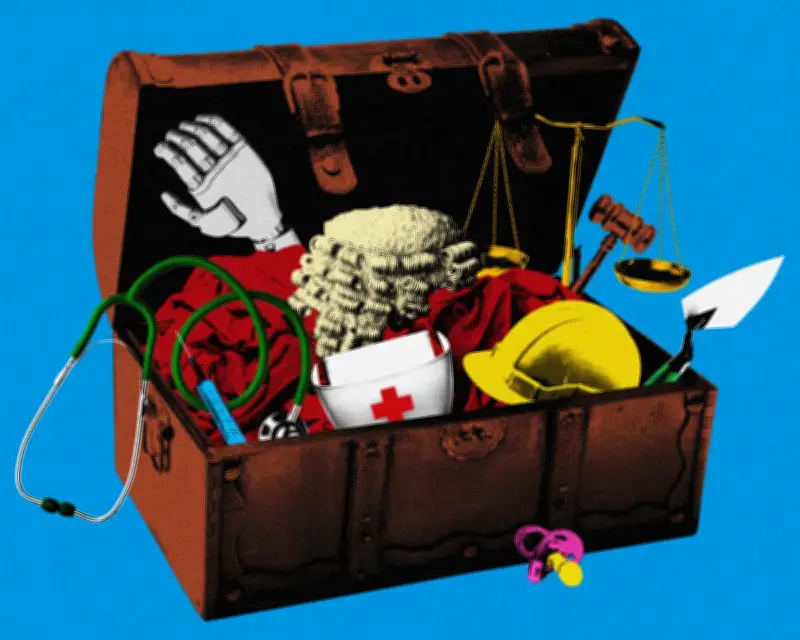
As artificial intelligence reshapes the workforce, experts across industries weigh in on which careers offer resilience and growth. While AI threatens many administrative and routine roles, opportunities persist in fields requiring human judgment, creativity, and personal interaction.
Medicine: Clinical Roles Remain Secure
Healthcare jobs most vulnerable to AI disruption include medical secretaries, pharmacy support staff, and call handling teams, according to Hira Malik, superintendent pharmacist and co-founder of Oushk Pharmacy. These roles involve set forms, records, or patient queries rather than clinical decisions. However, pharmacists, doctors, nurses, and prescribing clinicians are far less susceptible because they carry responsibility for patient safety and treatment decisions. “AI can help organise information and flag risks, but it cannot decide whether treatment is safe or appropriate,” Malik says.
Consultant plastic and reconstructive surgeon Dr Riaz Agha notes that plastic surgery is “too bespoke and too individualised” for AI replacement, but radiology is “particularly vulnerable” as studies show AI can interpret scans with high accuracy. He advises future doctors to learn how to use AI “properly and understand both its strengths and limitations.”
Education and Early Years: Human Connection Is Key
In education, AI is most likely to affect administrative and routine teaching support roles rather than fully replacing teachers. “Teaching is an excellent one,” says Sharath Jeevan, founder of Oxford University’s Generational Success Lab. “Students will always need trusted adult relationships to help them learn.”
Brett Wigdortz, founder and chief executive of childcare agency Tiney, says childminding is unlikely to be taken over by technology because “people want a human being to take care of their children.” Demand for childcare remains strong, with places filling quickly, and related jobs include managing nurseries, high-end nannying, or tutoring.
Law: Routine Tasks Automate, Judgment Endures
Paralegal and junior lawyer roles are most affected by AI due to routine work like document reviews and drafting, says Pierre Proner, chief executive of Lawhive. However, entry-level legal jobs will change rather than disappear. “The roles will remain but they will just change,” he says, with junior lawyers focusing earlier on legal judgment and client interaction. “AI still needs oversight,” Proner adds.
Brett Dixon, vice-president of the Law Society of England and Wales, says automating routine tasks could create “more time and opportunities for junior lawyers to think more deeply about complex legal issues.” Less routine areas like family law or litigation are less directly affected. Proner advises graduates to develop AI skills, noting that firms increasingly ask candidates: “How are you using AI? Are you creating vibe-coded apps?” He believes as AI lowers the cost of delivering legal services, more jobs could become available.
Hospitality: Customer-Facing Roles Thrive
Prof Graham Miller, academic director of the Westmont Institute of Tourism and Hospitality, says AI could shift employment in hotels from back-office to front-office, customer-facing roles. “There is no way AI is doing that kind of job,” he says, referring to warm, human interactions. “That sort of human-to-human connection … should not be replaced by AI.” Creative roles like chefs are less vulnerable, though routine culinary tasks like “flipping burgers or making pizza” could be automated.
Trades: Hands-On Skills Offer Stability
Brian Berry, chief executive of the Federation of Master Builders, says AI’s impact on construction will be uneven. “Hands-on trades such as bricklaying, carpentry and plastering are less exposed to AI and continue to offer strong, long-term career opportunities,” particularly with small local firms. White-collar roles in planning and estimating are more affected. However, perception remains a challenge: only 47% of parents would recommend a construction career, according to federation research. “That has to change,” Berry says.
Banking and Finance: High-Judgment Roles Resilient
Tomasz Noetzel, senior banking analyst at Bloomberg Intelligence, says jobs most affected by AI include call centre, customer service, middle-office operations, retail branch employees, and IT support. “Demand should rise for data scientists, AI engineers, software developers,” he says. In a survey of European banks by Bloomberg Intelligence, respondents viewed research analysts, compliance and surveillance analysts, risk-modelling specialists, and internal auditors as among the least exposed. “Few banking jobs will be untouched, but high-judgment, specialist roles appear relatively resilient,” Noetzel concludes.