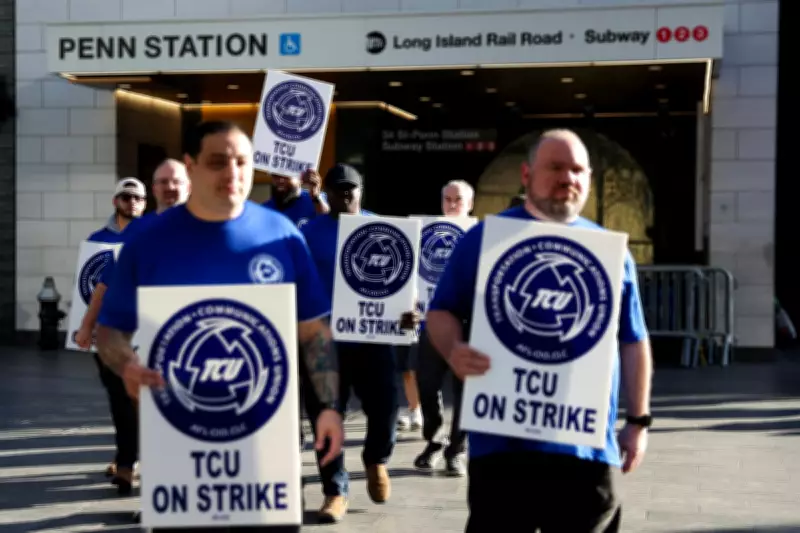
The Long Island Rail Road (LIRR), North America's largest commuter rail system, was shut down on Saturday after unionized workers went on strike, halting service for the eastern New York metropolitan area.
The strike began early Saturday morning when five unions representing about half of the LIRR's workforce walked off the job. The two sides had been negotiating for months on a new contract, with the Trump administration even attempting to broker a deal. However, unions were legally permitted to strike starting at 12:01 a.m. on Saturday.
Kevin Sexton, national vice-president of the Brotherhood of Locomotive Engineers and Trainmen, stated that no new negotiations have been scheduled. "We’re far apart at this point," Sexton said early Saturday. "We are truly sorry that we are in this situation."
Janno Lieber, chairman of the Metropolitan Transportation Authority (MTA), said the agency "gave the union everything they said they wanted in terms of pay" and that it appeared the unions always intended to walk out.
This is the first LIRR walkout since a two-day strike in 1994. The shutdown is expected to cause significant disruptions for sports fans planning to attend games between the New York Yankees and Mets, or the NBA's New York Knicks playoff run at Madison Square Garden, both of which have dedicated LIRR stops.
If the shutdown continues beyond the weekend, the roughly 250,000 daily riders will need to find alternative routes from Long Island suburbs into New York City. Many will likely face the region's notoriously congested roads.
"People are still going to commute, but if everybody starts driving now, the traffic is only going to get worse," said Rich Piccola, an accountant who commutes into the city, as he waited at Penn Station for a train home Thursday.
New York Governor Kathy Hochul is urging Long Islanders to work from home if possible. The MTA has announced limited shuttle buses to New York City subway stations, but this contingency plan is not designed to handle the normal weekday ridership.
Lisa Daglian, executive director of the Permanent Citizens Advisory Committee to the MTA, noted that while remote work expanded during the pandemic, many workers cannot telecommute. "You work in construction, you work in the healthcare industry, you work at a school or you’re about to graduate from school, that’s not always possible," she said. "People need to get where they need to go."
The contract talks have stalled over salaries and health care premiums. The MTA claims the unions' initial demands would lead to fare increases and affect negotiations with other unionized workers. The unions, representing locomotive engineers, machinists, signalmen, and other train workers, argue that substantial raises are needed to keep up with inflation and rising living costs.
Some riders sympathize with affordability concerns but worry about bearing the cost of pay raises. Gerard Bringmann, chair of the LIRR Commuter Council, said in a statement, "If the unions get the pay increases they are looking for, it will come at the expense of our riders who will see next year’s 4% fare increase doubled to 8%. Like the union workers, we too are burdened by the increase in the cost of living here on Long Island."
With Hochul, a Democrat, facing re-election later this year, pressure may mount on the MTA to resolve the shutdown. William Dwyer, a labor relations expert at Rutgers University, noted that commuter rail workers in New Jersey staged a three-day strike last year. "She’s up for re-election, and Long Island is a critical vote for her," he said. "So if there’s a significant fare hike, that does not bode well for her on election day."