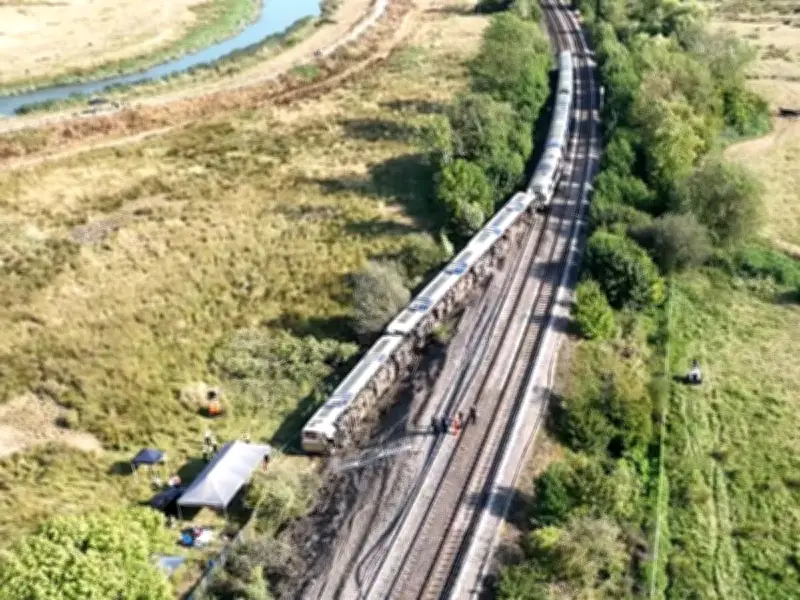
The Rail Accident Investigation Branch (RAIB) has released preliminary findings into the August 13 train derailment near Lewes, East Sussex, which left 30 people injured. The incident occurred on what was the hottest day of 2026 in the UK, with temperatures reaching 38.1C in west London.
The RAIB stated that the crash happened after a track appeared to have buckled, with CCTV images showing a bent rail at the site. Investigators described the fault, recorded by cameras on preceding services, as a "track geometry irregularity." The RAIB noted that there was "a sustained period of hot and dry weather" before the accident, and the investigation will consider the weather conditions as a contributing factor.
Details of the Derailment and Injuries
The Southern train, an eight-carriage service from London Victoria to Eastbourne, was carrying approximately 150 passengers when it derailed at 3:54 PM. Three carriages ended up on their side, trapping passengers. Of the 30 injured, 20 required hospital treatment, according to the RAIB. British Transport Police previously reported that two people sustained serious injuries, but these were not deemed life-threatening.
Preliminary analysis of the train's onboard data recorder showed it was travelling at about 65 mph as it approached the point of derailment. The RAIB also received "several reports of rough riding" from passengers on other trains at the same location after the accident.
Investigation Scope and Industry Response
The RAIB's investigation will examine the weather conditions, the status of the track and embankment, the condition of the train, and the effectiveness of any measures taken to address potential issues caused by hot weather. The risk of rails buckling during high temperatures is well-documented, as rails can reach 50C when the air temperature is 30C.
Lucy McAuliffe, Network Rail's Sussex route director, and John Whitehurst, chief executive at GTR (which operates Southern), issued a joint statement. They insisted that Britain's railway is "one of the safest in the world" and that it is "essential" to understand exactly what happened at Lewes and "identify any lessons that can be learned." They added: "We will carefully consider any recommendations arising from the investigation and work across the industry to implement them."
The railway between Lewes and Haywards Heath will remain closed until at least the end of service on August 26 as the train is recovered and the track repaired.
Political and Government Reaction
James MacCleary, Liberal Democrat MP for Lewes, said the preliminary findings "raise serious concerns." He stated: "A pre-existing irregularity on the track is deeply concerning. I travel this line very regularly and reported to the authorities just how bumpy this section of track had become. We cannot assume that this is related, but that makes the current findings even more troubling. This should also be a wake-up call about the chronic underinvestment in rail infrastructure across the South East."
A Department for Transport spokesperson said: "Safety remains the absolute priority across our rail network, and we will ensure the industry acts on any findings in the Rail Accident Investigation Branch's full report when published. The UK's railways remain among the safest in the world, with the number of delays caused by track faults falling by 45 per cent since the late 2000s. We're investing £29 billion to renew and maintain the network and a further £2.6 billion to improve climate resilience."
Separately, a day after the Lewes incident, the rear carriages of a Greater Anglia train derailed in an upright position south of Wickford station in Essex, with no injuries reported.