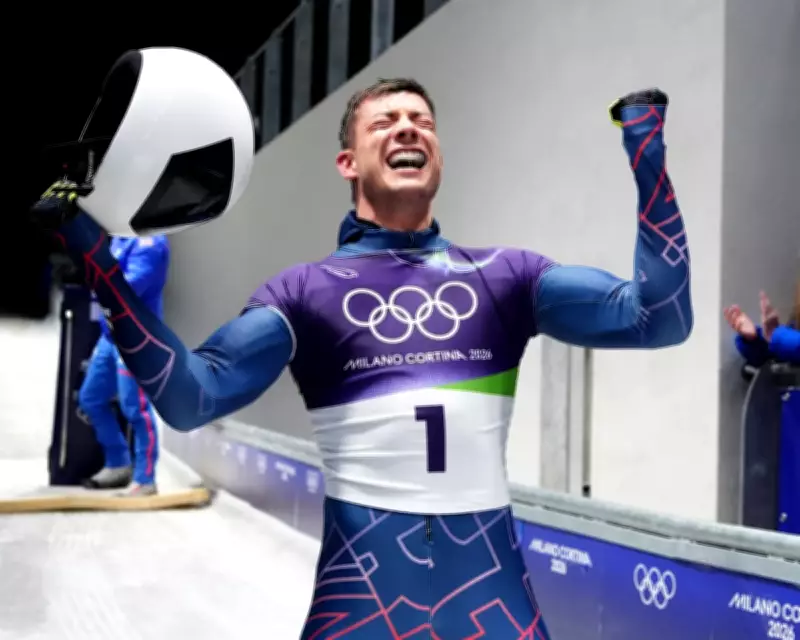
Matt Weston Secures Historic Skeleton Gold for Team GB at Winter Olympics
On the seventh day of competition, Great Britain finally claimed their first medal of the 2026 Winter Olympics in spectacular fashion. Matt Weston, known to his teammates as "Captain 110%", triumphed in the men's skeleton event at the Cortina Sliding Centre, delivering four flawless runs across two days of intense competition.
A Dominant Victory Against All Odds
The 28-year-old Briton shattered the track record four consecutive times during his races, finishing with a combined time of 3 minutes 43.33 seconds. His performance left Germany's Axel Jungk nearly a full second behind, securing Weston's place in history as the first British man ever to win an Olympic skeleton title.
What makes this achievement even more remarkable is that Weston began the year with a significant four-inch tear in his right hamstring, forcing him to miss crucial pre-season training. His victory demonstrates extraordinary resilience and determination in overcoming physical setbacks.
Britain's Skeleton Legacy Continues to Grow
With Weston's gold medal, Great Britain now stands as the most successful Olympic nation in skeleton, a sport originally invented by Englishmen seeking new holiday activities in St. Moritz during the 1920s. The country has now accumulated an impressive total of four gold medals, one silver, and five bronze medals in the discipline.
Eight of these ten medals have been won since the turn of the century, following substantial investment in the sport during the early 2000s. The construction of a practice track at the University of Bath and access to world-class coaching and technical support have clearly paid dividends for athletes like Weston and his teammate Marcus Wyatt, who finished ninth in the competition.
The Mind of a Champion
Weston's approach to skeleton racing reveals the sophisticated mental and physical coordination required for success. "If it looks like I am lying there doing nothing it means I am doing everything right," he explained before the Olympics. While his body hurtles down the track at 80mph, his mind operates in slow motion, making minuscule weight adjustments to maintain the perfect line through every curve.
Much of this precision happens subconsciously, with Weston relying on proprioception—the body's innate ability to sense its position and movement—to navigate the course. He credits his background in martial arts for developing these critical reaction skills, noting that "you have to make sure your reactions are good for that, otherwise you get punched in the face."
From Taekwondo to Skeleton Stardom
Weston's athletic journey has been anything but conventional. As a teenager, he ranked second globally in taekwondo and won silver at the Under-17 World Cup in 2012. He initially envisioned competing in taekwondo at the Summer Olympics in Paris two years ago, but a training accident that fractured his back forced him to abandon that dream.
After playing county-level rugby on the wing, Weston discovered skeleton racing through a talent identification program. "I distinctly remember the first time I tried it," he recalled. "For the first 10 metres I was thinking, 'I've got no brakes so I'm going to the bottom whether I like it or not'. It was terrifying but as soon as I finished I wanted to go back and do it over again. I had the bug."
The Pursuit of Perfection
Weston has spent nearly a decade chasing what he describes as the perfect run. "We work on such fine margins that it's so hard to be perfect," he explained. "It's like floating, it's so smooth it's almost calming, everything fits, everything clicks, like doing a jigsaw puzzle and picking up the right piece every single time."
Despite nine years of dedication, Weston admits he's only experienced one or two runs that approached this ideal. "No one knows if it is possible or not," he mused, though his performance in Cortina suggests he may have come closer than ever before to achieving that elusive perfection.
Looking Ahead to Team Competition
Weston will return to competition in the mixed team event on Sunday, where he'll partner with the fastest British athlete from Saturday's women's skeleton finals. Tabby Stoecker appears the likely candidate, despite dropping from third to fifth place after a mistake in her second run left her half a second behind the leader.
"I think I just need a good meal, a good sleep, some analysing with my coaches, and then to come back tomorrow," Stoecker stated optimistically, "because it's definitely not over."
As Weston celebrated his historic victory with his mother Alison, fiancée Alex, and father Tom watching from the stands, his achievement marked not only a personal triumph but a significant milestone for British winter sports. His gold medal represents the first individual winter Olympic gold for a British man since 1980, cementing his place in the annals of British sporting history.