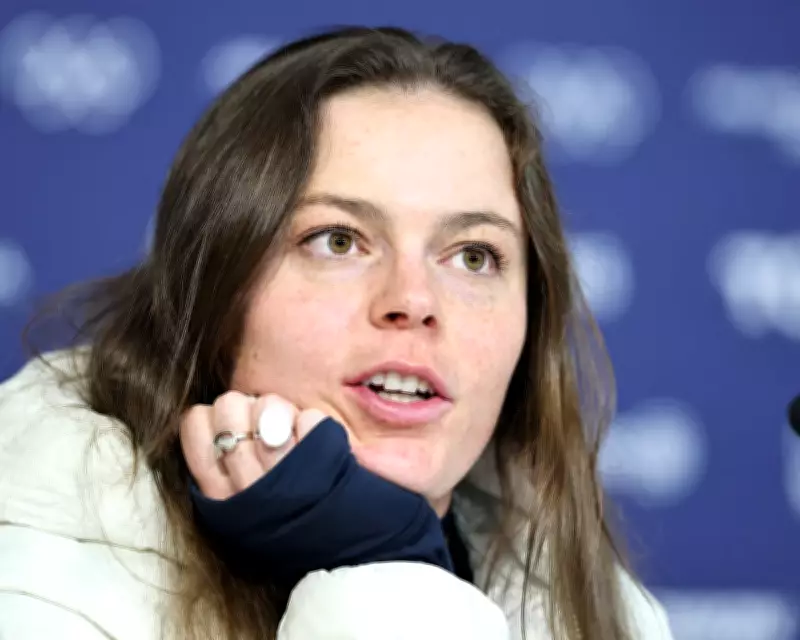
Breezy Johnson: Embracing Anxiety on the Path to Olympic Glory
While much of the pre-Olympic spotlight has traditionally focused on legends like Lindsey Vonn, another American skier has been quietly crafting an extraordinary narrative of resilience and determination. Breezy Johnson, the formidable downhill threat from Team USA, has learned to coexist with the persistent doubts and fears that accompany elite alpine skiing.
The Constant Companion: Performance Anxiety
"The anxiety will always be there until I'm in the downhill gate," Johnson revealed during Team USA's pre-Olympics media summit in October. The 30-year-old athlete from Wyoming, who legally changed her birth name Breanna to her nickname Breezy, acknowledges that confidence never comes easily. "At no point can I tell myself, I've got this thing," she admitted, highlighting the psychological challenges that accompany her physically demanding sport.
This weekend, attention will refocus on Johnson as she competes in the Olympic women's downhill at the Milano Cortina Games. Her journey to this moment has been anything but straightforward, marked by both remarkable achievements and significant setbacks that have tested her mental fortitude.
A Career of Highs and Devastating Lows
Johnson's potential became undeniable during the 2020-21 season when she secured four World Cup downhill podiums, rocketing to second in the world rankings. Her top-14 finishes at the 2018 Pyeongchang Olympics, achieved at just 22 years old, seemed to confirm her status as the natural successor to American skiing greats Lindsey Vonn and Mikaela Shiffrin.
However, the unavoidable hazards of downhill skiing soon intervened. Three years into her World Cup career, Johnson suffered a broken leg, followed within nine months by shredded ligaments in both knees that forced her withdrawal from the 2022 Beijing Winter Games. "As athletes, we're used to really good control over our bodies," Johnson reflected recently in Italy. "We can do extreme athletic events, and then suddenly you can't even turn a muscle on and walk."
The Suspension That Tested Her Resolve
The physical injuries proved merely a prelude to Johnson's most challenging setback - a blow not to her body, but to her reputation. The skier missed three separate random drug testing appointments (once in 2022 and twice in 2023), triggering an automatic World Anti-Doping Agency violation that resulted in a 14-month competition ban.
In a May 2024 Instagram post addressing the situation, Johnson apologized to disappointed fans, calling the missed tests "a human error" while acknowledging she was "paying the consequences." She described the experience to the Washington Post as making her feel "like a criminal" and admitted it was "very lonely." Prior to these incidents, she had never failed a drug test throughout her career.
The Psychological Battle and Comeback Trail
Johnson has been remarkably transparent about skiing's psychological toll, discussing openly the self-doubt, perfectionism, and fear of failure that accompany elite competition. She has spoken about the inner voice that whispers "maybe you suck" during extended periods away from competition and how fear constantly accompanies her on chairlift rides, always threatening to trigger existential crisis.
Rather than allowing her suspension to derail her career, Johnson transformed the time away into fuel for self-improvement. Drawing on mental toughness developed during previous injury rehabilitations, she trained independently while watching rivals improve their performances from afar. "At the end of the day I want to win a gold medal," she declared in October when questioned about the growing field of world-class competitors. "I want to be the best out of everybody, not just in the US."
Triumphant Return and World Championship Success
True to her promise, Johnson made a spectacular return to competition at December's Stifel Birds of Prey downhill in Colorado. Starting as bib No. 32 in a 45-racer field - the first all-women competition in the venue's history - she delivered a solid 13th-place finish on home snow, immediately restarting her World Cup scoring streak.
From there, momentum built steadily. Johnson secured first and third places in super-G at the European Cup in Sarntal, Italy, followed by podium bronze at a World Cup tune-up in Kvitfjell, Norway. Then, just three months after her Beaver Creek comeback, she answered her biggest personal challenge at the 2025 world championships in Austria.
There, Johnson partnered with longtime friend Mikaela Shiffrin to secure the US's first-ever team alpine victory before topping the women's downhill podium for her first individual world championship gold. "I was psyched because I knew that I had skied my best," she reflected afterward. "I'm just going to enjoy this because I've had a lot of moments that weren't like this."
Looking Toward Cortina with Renewed Perspective
These results have firmly reestablished Johnson's position on Team USA and confirmed her role as Shiffrin's speed complement. With Vonn's recent ACL injury adjusting American medal expectations, Johnson now provides valuable insurance for Team USA - an ironic twist given her own extensive medical history.
As she prepares to charge down the Cortina course with everything to ski for, Johnson approaches this Olympic opportunity with hard-won perspective. "At this point, I'm like, you know, your next Olympics is definitely not guaranteed," she acknowledged this week. "You never know when the journey will end, and so you have to seize the opportunities that are in front of you."
For Breezy Johnson, the anxiety may always accompany her to the starting gate, but so too does the resilience forged through injury, suspension, and self-doubt - a combination that makes her one of the most compelling stories heading into the Winter Games.