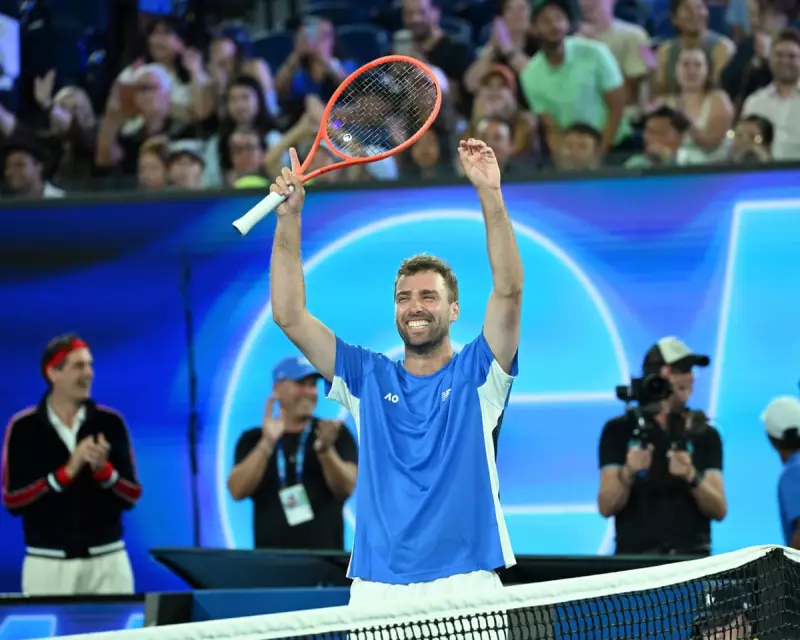
A 29-year-old tennis coach from Sydney has become an overnight millionaire after a stunning victory in a revolutionary new event at the Australian Open. Jordan Smith, a former US college player now working at his family's academy, defeated a field featuring the sport's biggest names to win the inaugural One Point Slam and its A$1 million prize on Wednesday night at Rod Laver Arena.
The Format That Divided and Delighted
The innovative knockout tournament, designed to attract new fans, saw each match decided by a single, high-pressure point. To level the playing field for amateur qualifiers like Smith, professional players such as Carlos Alcaraz, Jannik Sinner, Iga Swiatek, and Coco Gauff were restricted to just one serve. The server for each decisive point was determined by a game of rock-paper-scissors, adding a quirky, unpredictable element to the proceedings.
Despite a format that sometimes confused and a runtime stretching close to three hours, the event succeeded in its primary goal: filling Rod Laver Arena to capacity during the opening week of the Grand Slam. Tennis Australia's bold experiment, offering a prize nearly a quarter of the singles champion's cheque, proved a major draw, blending elite sport with celebrity and viral entertainment.

A Fairytale Run to a Life-Changing Payday
Smith's journey to the million-dollar payday was the stuff of sporting dreams. Having qualified through the Sydney bracket, the world No. 1,141-ranked former player navigated a unique 48-player field. He scored a memorable third-round win over Italian star Jannik Sinner before overcoming Spanish pro Pedro Martínez in the semi-finals.
In the final, he faced Joanna Garland of Taiwan, a world No. 117 who had won a WTA125 event in Canberra just days prior. The softly spoken 24-year-old had charmed the crowd, who initially mistook her for an amateur. Her gracious pre-final comment—"there are three winners here tonight: one is tennis, the others are me and him"—captured the event's spirit. However, it was Smith who held his nerve to claim the monumental prize.
"I can't even speak, it's unbelievable," an overwhelmed Smith said afterwards, his face fixed in a grin for much of the evening. He pledged to use the windfall to invest or buy property in Sydney's expensive market, having earlier joked it might only afford him "an apartment, or half a house."
TikTokification of Tennis: A Hit or a Miss?
The event, described as a 'TikTokification' of tennis, showcased both the potential and the rough edges of such a format. While it generated palpable excitement and jeopardy, a quarter of first-round matches ended with service faults. The evening was heavily produced for television, with commercial breaks leading to player impatience and spectator drift; by the final, nearly a quarter of the seats were empty.
Yet, it broke new ground. Unlike traditional 'Battle of the Sexes' exhibitions, women were given no artificial advantage, and six reached the quarter-finals on merit. A thrilling point between Iga Swiatek and Italy's Flavio Cobolli was hailed as the best tennis of the night.
Most professionals embraced the spectacle. Alexander Zverev called it a "brilliant" thing to try "before it gets serious," while Elena Rybakina marvelled at the crowd size. The biggest winner beyond Smith, however, may be Tennis Australia itself, having successfully drawn a full house with a novel concept that has sparked global conversation about the sport's future.