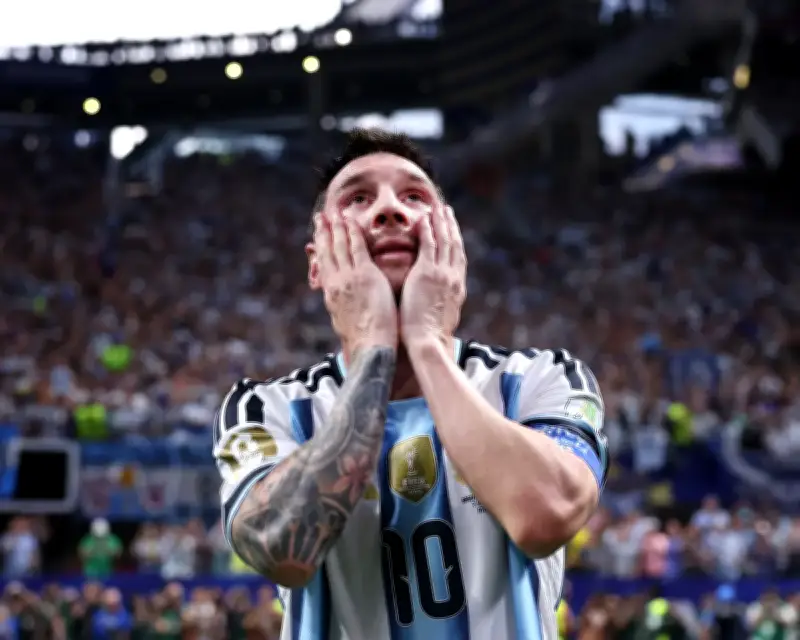
Lionel Messi's announcement that he is retiring from international football has unleashed a barrage of homages, gratitude, and joy across Argentina, with fans and teammates alike expressing their deep affection for the player who led the country to World Cup glory in 2022.
The decision, posted on Instagram on Monday, came with photos of three handwritten sheets of paper and a Harry Potter Time Turner pen, set to the soundtrack of Brindis sung by Soledad Pastorutti. It instantly dominated the news, though it was not entirely unexpected.
Teammates and Fans React with Emotion
Argentina's players were quick to share their feelings. Cristian Romero posted, "How crazy that the day has come, dear Leo," while Giovani Lo Celso echoed, "The day no one wanted to arrive has arrived," adding he had "nine years listening to you, admiring you and learning by your side." Nico Paz recalled that since he was four years old, he "used to watch you play with my dad and we would calculate together whether I would be in time to play with you."
The public's reaction was equally heartfelt. On a Buenos Aires street corner, someone placed a red telephone with a sign asking, "What would you say to Messi?" Passersby picked up the receiver and spoke. One elderly gentleman said, "I'm 86 years old and you have given me the greatest joys in my life. You will be in my heart until the day I die." A young boy admitted he "burst into tears even though I was at school," and a woman said, "we will miss you because you are an extraordinary being."
Public Figures Praise Messi's Legacy
Influencers, journalists, and cultural commentators also expressed their gratitude. Sportswriter Matías Martin wrote, "Messi led by example," while coach and motivational speaker Matias "Coco" Gallo Bevegni posted that the World Cup winner "taught me more in defeat than in victory." Football pundit Morena Beltrán could not hold back tears as she explained that for her generation, there is a sense of mourning and emptiness filled by gratitude, a feeling older colleagues may have experienced with another football great.
Psychoanalyst Milagros Filgueras praised Messi's decision to hand-write the note, saying some goodbyes need the body involved. Journalist Pablo Perantuono devoted his column to the "epistolary genre," noting that a handwritten letter in this day and age is almost a counter-cultural act of originality.
The End of an Era
Writer Andrés Burgo highlighted that in 10 of the past 12 World Cups, either Maradona or Messi played, marking the "end of an era in which grandparents, parents, sons and daughters and grandchildren enjoyed an incredible privilege during almost 45 years. The heir will arrive – we hope – but right now is a time of orphanage. And gratitude."
Messi revealed that the letter was written two days after the final, a cathartic diary-like release, but on Monday, after "[what happened with] my dad," he was more convinced than ever. The note said "it's a decision that hurt and continues to hurt," but he understands this is the moment. Poet Valeria Correa Fiz pointed out that he originally wrote "I think," then crossed it out and replaced it with "I understand." Messi swore he always gave his all, not only these past few years when "everything was won," but he has nothing left to give.
The 39-year-old, however, scored four goals for Inter Miami at the weekend and continues his career at club level, where he clearly still has much to give. He is not retiring from playing football, the thing he loves most. He is retiring from Argentina.
Impact on Argentine Football
With two international dates coming up and no rival agreed, Messi's absence will impact potential fixtures. The country's football is in a bit of turmoil, with scandals surrounding the Argentinian Football Association, pressure by some lobbies to privatise football clubs, and international furore over incidents during the World Cup that resulted in hefty fines, sanctions, and suspensions.
The heaviness of the Argentina flag, which for many years weighed him down, turned idyllic when it became the cloak of victory, mattered very much to his father, Jorge. Messi said he wanted to win another World Cup for him. Perhaps his death has somehow freed him from that aspect of his Argentinianness.
The spontaneous visceral response from the Argentinian people is acceptance and relish at the good times lived. That inexplicable sense of pride that comes from being from the same soil as someone who is very good at something and whose magic is still untarnished by the sordid final match against Spain, or any of the criticisms directed at the squad and fans throughout the tournament. If anything, his final tears in front of the stands, like Scaloni's tears at the press conference, are mirrored in a nation moved profoundly by the generations we have just lived through.
The huge volume of emotive, sentimental outpouring is rather lovely, and amid it all an enduring image of three little boys walking down a Buenos Aires street with No 10 Messi shirts on their backs signals the way forward, towards a future unknown.