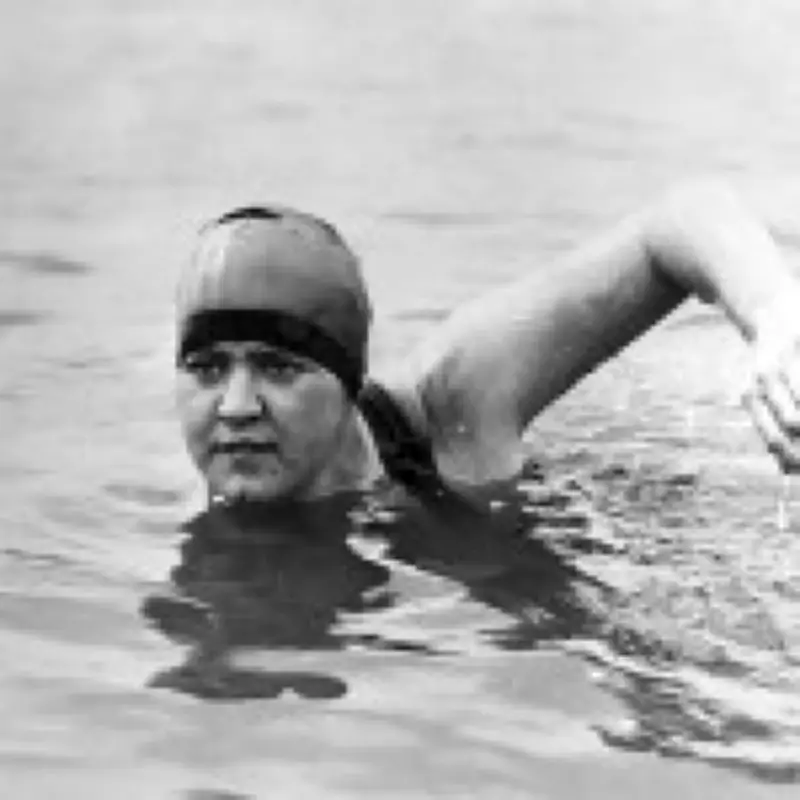
One hundred years ago, on August 6, 1926, Gertrude Ederle, a 20-year-old from Manhattan, became the first woman to swim the English Channel, completing the 35-mile crossing in 14 hours and 34 minutes and shattering the existing men's record by nearly two hours. Her achievement was even more remarkable given that a near-drowning at age seven had almost ended her swimming career before it began.
Born in 1905 to German immigrant parents, Ederle was one of seven children who spent summers in the Highlands on the New Jersey coast. The traumatic childhood accident, instead of deterring her, fueled her determination to master the water. By age 12, she had joined the Women's Swimming Association, a club founded by Charlotte Epstein that championed female athletic training at a time when women's sports were often dismissed. There, she set her first world record in the 880-yard freestyle, becoming the youngest world record holder in swimming.
Olympic Success and the Channel Challenge
By 19, Ederle held 29 amateur US national and international records. At the 1924 Paris Olympics, she brought home three medals: a gold in the 4x100m freestyle relay and bronze in the 100m and 400m freestyle events. Her stellar performance earned her funding from the Chicago Tribune and The New York Daily News to attempt what no woman had done: swim the English Channel.
At the time, the fastest crossing was 16 hours, 33 minutes by Enrique Tirabocchi. Only two women had ever tried: Walpurga von Isacescu in 1900 and Annette Kellerman in 1905, both failing. The swim's difficulty was immense, with distances varying from 21 to over 35 miles depending on tides, plus threats of hypothermia, jellyfish, and rough seas.
A First Attempt Marked by Controversy
Ederle's first attempt on August 18, 1925, ended in failure under mysterious circumstances. Nine hours into the swim, her trainer, Jabez Wolffe, instructed a spotter to pull her from the water, disqualifying her under Channel Swimming Association rules that forbid any physical contact. Rumors swirled: some claimed jealousy, as Wolffe had failed 22 attempts himself; others thought he feared she was unconscious; a few even suggested he drugged her tea. Wolffe denied all allegations, insisting she had cramped and collapsed.
Hanna Hubert of the Trudy Ederle Foundation told Metro, "People make up whether she was sabotaged or not, but that’s not the important question to ask. It’s just one part of the story." Ederle herself "never judged about it," Hubert added. Despite criticism that women lacked the strength for such feats, Ederle returned to New York determined to try again, training under WSA guidance and new coach Bill Burgess, who had swum the Channel in 1911.
The Historic Second Attempt
On August 6, 1926, at 7:05am, Ederle set off from Cap Gris-Nez, France. Over the next 14 hours and 34 minutes, she battled jellyfish, freezing temperatures, and rough weather, swimming 35 miles due to strong currents. When her trainer signaled her to stop, she replied, "What for?" She had made her father, Henry, promise that no one would remove her from the water unless she said so.
At 9:39pm, exhausted and "bleary-eyed," she reached Kingsdown, Kent. A British immigration officer, unaware of her feat, asked for her passport. She finished nearly two hours faster than the five men who had previously completed the swim. Her sister Margaret contributed significantly to her success, suggesting a two-piece bathing suit to reduce chafing and using candle wax as a sealant for her goggles—innovations that reduced injuries and improved performance.
Fame and Its Toll
Upon returning to New York, an estimated 2 million people lined the streets for a ticker-tape parade. President Coolidge dubbed her "America's Best Girl," and she received endorsements, film deals, and even songs named in her honor. Yet Glenn Stout, author of her biography "Young Woman and the Sea," told Metro, "She wasn’t overtly trying to make a statement, but I think you end up making a statement when your motivations are true and genuine. True change comes when you stay in the moment and satisfy yourself first."
Hanna Hubert echoed that sentiment: "She just wanted to swim. Her sister Meg was the one to fill out all the papers for competitions, and to bring her ideas, like swimming the English Channel."
Fame proved difficult for the introverted Ederle. She retreated from public life in 1928 due to stress. Her childhood measles had caused hearing loss, and doctors warned that cold, salt water would worsen it. After her Channel swim, her hearing deteriorated until she was almost fully deaf. In 1933, a fall down 15 steps at her apartment caused a severe spinal injury; doctors said she might never walk or swim again. Yet she recovered enough to swim at the 1939 New York World's Fair, though she never attempted the Channel again.
Legacy and Inspiration
Ederle, who never married or had children, died in 2003 at age 98. Her story continues to inspire. Glenn Stout wrote her biography after learning of her achievements as a sports journalist, noting, "Women’s sports have a lot of stories – and a lot of overlooked stories." Though the book initially sold poorly, a copy found in a second-hand store by filmmaker Jeff Nathanson led to the 2024 film "Young Woman and the Sea," starring Daisy Ridley, which earned an 88% Rotten Tomatoes score.
"Gertrude’s story changed people’s lives and inspired people," Stout said. "I’ve heard from people who have sat with their children and read the book together, and young girls who have done school projects and won competitions on Trudy." The Trudy Ederle Foundation, formed this year, aims to help former professional athletes transition to new careers, inspired by Ederle's later work teaching deaf children to swim at the Lexington School for the Deaf.
"Pioneer is a good word for her," Stout concluded. "Nobody expected her to do it, yet she did."