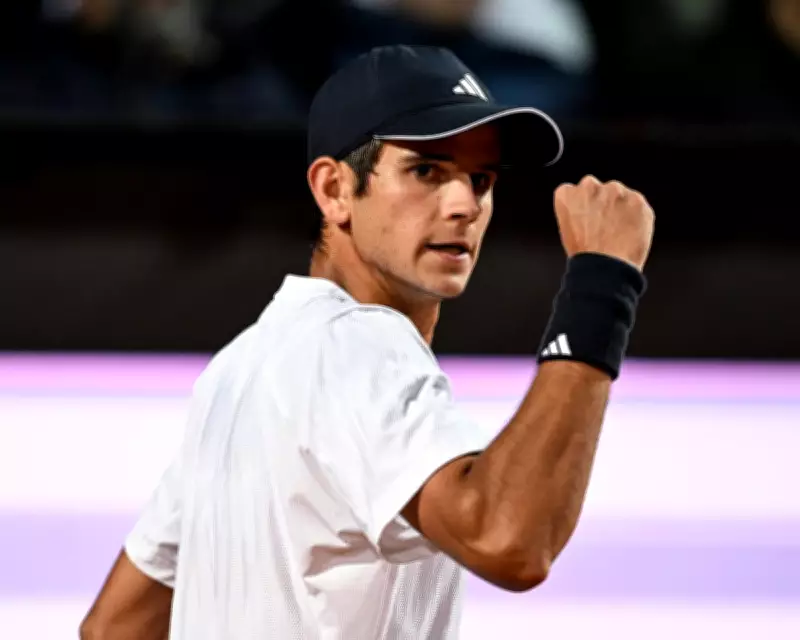
Spain is at it again. A year ago, Rafael Jodar, the teenage sensation from Madrid, was ranked around No. 700 in the world and completing his freshman year at the University of Virginia. After winning several ATP Challenger titles, the Spaniard decided to turn pro and forgo his final three years of college eligibility. Jodar won his first main-level ATP match at this year's Australian Open. Now, after a meteoric rise up the rankings, the 19-year-old will be among the 32 seeds when the French Open commences Sunday.
The 'New Rafa' Emerges
Jodar, nicknamed the 'new Rafa,' has stolen the mantle of the 'next future champion' from Brazilian Joao Fonseca. Ironically, Fonseca, also 19, was committed to play college tennis at Virginia with Jodar but instead turned pro. Jodar's rapid ascent adds to the embarrassment of riches Spain has enjoyed for over three decades.
Starting with Sergi Bruguera's back-to-back French Open titles in 1993 and 1994, Spanish men have dominated with six different grand slam winners, culminating in Rafael Nadal's 22 major titles. Just three months after Nadal's final grand slam at the 2022 French Open, Carlos Alcaraz won his first major at the US Open. Alcaraz now has seven majors but will miss this year's French Open and Wimbledon due to a wrist injury.
The Spanish School of Suffering
How did Spain become such a powerhouse? Many trace the origin to the early 1970s, when dictator Francisco Franco, inspired by Manolo Santana, ordered the construction of thousands of red clay courts. This infrastructure laid the groundwork for future success. Coaches Pato Alvarez and Lluis Bruguera developed a style based on six tenets: movement, footwork, racket speed, consistency, defense, physical conditioning, and the importance of suffering.
This act of suffering—fighting through mini-crises with a positive mental outlook—is a throughline among Spanish champions. Nadal famously said, 'You have to learn how to live with these kind of moments, and also to enjoy this suffering.' Alcaraz echoed: 'You have to find the joy in suffering.' This philosophy has allowed the transition from clay-court specialists like Bruguera to all-court players like Alcaraz and Jodar.
Generational Hand-Off
Jodar embodies this mental fortitude. Speaking of Nadal, he said, 'He was the best mentality wise. He never gave up.' Jodar, like his predecessors, plays with supreme confidence grounded in humility. The Spanish method has inspired others; Andy Murray trained in Barcelona under Alvarez, crediting those years for his development into a three-time grand slam champion.
Former Spanish pro Jose Higueras imported the program to the US, coaching Michael Chang to the 1989 French Open title and working with Jim Courier. However, talent and attitude are crucial. Spain has been blessed with extraordinary athletes like Nadal and Alcaraz, and now Jodar and 20-year-old Martin Landaluce are rising.
The sport has also changed, with slower court speeds favoring the Spanish style. The conveyor belt of champions shows no sign of slowing down.