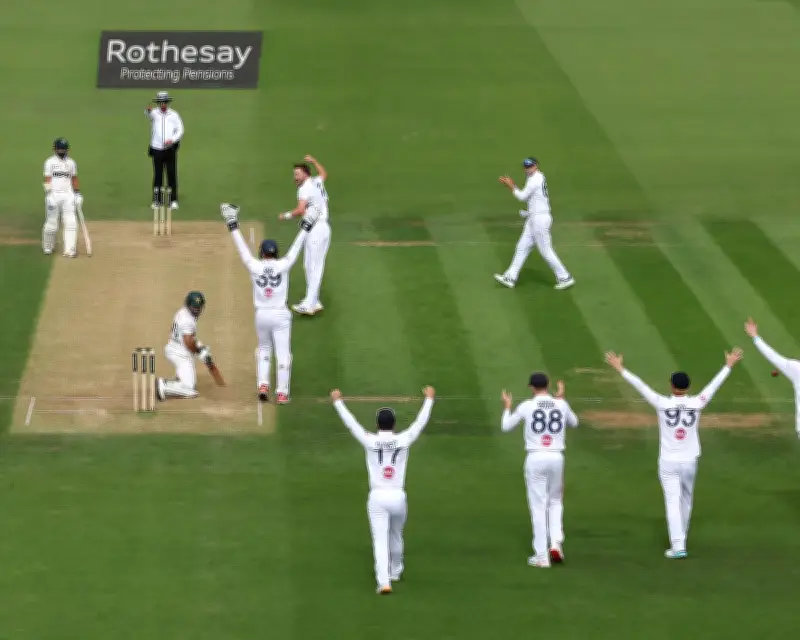
Ollie Robinson took four wickets as England completed a 2-0 series win over Pakistan at Lord's, with the Sussex bowler ending the match with figures of four for 24 and moving to 99 Test wickets at an average of 19. The win was sealed 45 minutes before the close on the final day, with Robinson taking four of the nine wickets needed to finish the job.
Robinson's redemption arc
Robinson was dropped earlier in the summer because Rob Key, the managing director of England cricket, prefers pace and had concerns about Robinson's fitness and attitude. But in this Test, Robinson took the new ball in the fourth innings and repeatedly beat the bat with his metronomic medium-nip, a method that has become increasingly effective in modern Test cricket.
His dismissal of Abdullah Shafique was particularly impressive, with a delivery that nipped back sharply and knocked over the batsman, who was playing for the line. Robinson's send-off was forthright, and at that point he had six for 13 in the match, prompting questions about whether Pakistan would score another run.
The age of Ozball
This summer has been dubbed the age of Ozball, a low-key successor to Bazball, defined by high-craft jag and nip rather than aggressive batting. Robinson, along with Mohammad Abbas and Matt Henry, has been at the forefront of this trend, with the trio taking 45 wickets at an average of 12 across the two home Test series.
According to the article, the dominance of this type of bowling is partly due to data analysis, raised seams, and format confusion for batting techniques. As Ian Chappell said recently on the Grade Cricketer podcast, there is very little financial incentive to become a great Test batsman now, and no chance of another Graham Gooch spending three winter months working out how to defend his front pad.
Pakistan's fightback
Pakistan's total of 194 was built around a splendid 97 from Saud Shakeel, who played beautifully, with swivel-pulls and courtly, kneeling cover drives. Despite the loss, Shakeel's innings was a highlight, and the match was another slow-burn affair in a slow-burn summer.
Earlier in the day, Mohammad Abbas was seen kneeling at the edge of the square and kissing the outfield, a gesture interpreted as thanks to the god of crap Test pitches. Abbas is a brilliant bowler with a Test average of 22, and he has been part of the recent trend of bowlers with low career averages.
Numbers and legacy
Robinson's 99 wickets at an average of 19 place him among the best Test bowlers since the 19th century, with no pace bowler ending their career with 100 wickets at a lower average. The article notes that Robinson is 32 and has not yet entered a decline, suggesting his numbers could improve further.
The article also highlights that four of the top nine lowest career bowling averages since the end of the 19th century have appeared in the past six years: Robinson, Kyle Jamieson, Scott Boland, and Axar Patel. All are brilliant bowlers with the same basic method of bowling fizzed straight stuff to Test batters who cannot deal with it.
As the summer concludes, the Robinson redemption arc stands as the low-key story of a low-key season, with the bowler's metronomic medium-nip representing the new age of Test cricket.