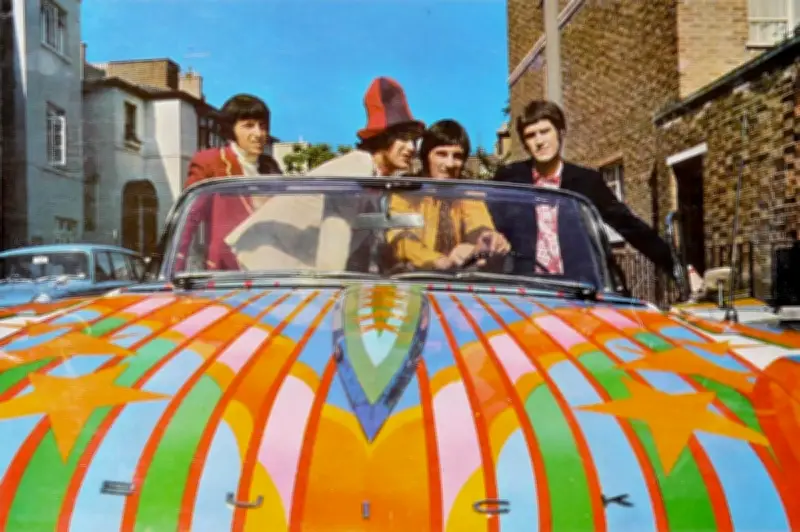
Introduction: A New Exhibition Inspires a Ranking of the Kinks' Finest Work
To coincide with a new London exhibition focusing on the Davies brothers, the Kinks' 40 greatest songs have been ranked, showcasing a band that brought a sociologist's eye to hard rock, gentle pastoralia, and everything in between. The exhibition, titled 'The Kinks: Brothers,' features work by Ray Davies, Dave Davies, and Christian Furr and runs at the Gibson Garage in London until 6 September.
The Kinks, known for classics like 'You Really Got Me' and 'Waterloo Sunset,' produced a vast catalog that often defied easy categorization. From early garage rock anthems to later concept albums, their music captured the complexities of British life with wit and melancholy.
The Bottom of the List: Hidden Gems and Late-Career Highlights
The ranking begins at number 40 with 'Scattered' (1993), a sweet, sad reflection on the Davies family's complexities from the final studio album 'Phobia.' Despite declining album quality in the late 80s, Ray Davies continued to produce gems. At number 39, 'Rosy Won't You Please Come Home' (1966) explores Davies's devastation over his sister Rose's emigration to Australia, a theme that later surfaced in 'Arthur (Or the Decline and Fall of the British Empire).'
Number 38, 'You Can't Stop the Music' (1975), closes the album 'Soap Opera' with a eulogy for rock'n'roll, spiked with personal bitterness. Number 37, 'Two Sisters' (1967), uses harpsichord to contrast domesticity with bohemia, while number 36, 'I Go to Sleep' (1965), a fraught ballad never released by the Kinks, is best known via the Pretenders but shines in a 1967 version by German singer Marion Maerz.
Mid-Range Masterpieces: Social Satire and Personal Turmoil
At number 35, 'Lavender Lane' (1971) attacks gentrification with nostalgic sadness and fury. Number 34, 'I'm Not Like Everybody Else' (1966), shifts between defiance and distress. Dave Davies's 'Living on a Thin Line' (1984), at number 33, offers a pessimistic survey of Thatcher's Britain, famously used in 'The Sopranos.' Number 32, '(Wish I Could Fly Like) Superman' (1979), surprisingly foreshadows Blur's 'Girls and Boys' with its disco beat and Cockney vocals.
Number 31, 'Too Much on My Mind' (1966), is a plaintive depiction of a man on the verge of a breakdown. Number 30, 'Till the End of the Day' (1965), is a thrilling, optimistic garage rock anthem. Number 29, 'Where Have All the Good Times Gone?' (1965), finds Davies in contrarian mode, complaining that things ain't what they used to be.
Top 20: Defining Songs of the Kinks' Legacy
Number 28, 'This Time Tomorrow' (1970), becomes a study of aimless life beyond its original touring context. Number 27, 'Death of a Clown' (1967), is Dave Davies's haunting solo hit. Number 26, 'Sitting in My Hotel' (1972), expresses homesick dislocation. Number 25, 'Mr Pleasant' (1967), wittily attacks middle-class complacency. Number 24, 'Sweet Lady Genevieve' (1973), is a gorgeous ballad from the concept album era.
Number 23, '20th Century Man' (1971), reflects Davies's alienation and mental health struggles, set to charming music. Number 22, 'Victoria' (1969), balances nostalgia and satire on empire. Number 21, 'See My Friends' (1965), innovates with a droning raga sound and oblique treatment of homosexuality. Number 20, 'Come Dancing' (1983), recalls the death of Davies's sister Rene, the Kinks' only UK hit in their final 22 years.
Top 10: The Pinnacle of Songwriting
Number 19, 'Big Black Smoke' (1966), depicts London as a dark nightmare. Number 18, 'Better Things' (1981), offers optimistic reflection on a collapsing marriage. Number 17, 'Celluloid Heroes' (1972), ruminates on celebrity. Number 16, 'Dead End Street' (1966), is a striking social realist protest. Number 15, 'Shangri-La' (1969), explores conformity and limited aspirations. Number 14, 'Picture Book' (1968), interrogates memory. Number 13, 'Oklahoma USA' (1971), mixes Americana with north London roots. Number 12, 'Lola' (1970), controversially depicts a dalliance with a trans woman. Number 11, 'David Watts' (1967), is sprinkled with homoeroticism.
Number 10, 'Dedicated Follower of Fashion' (1966), skewers 60s hipsters. Number 9, 'God's Children' (1971), features a spellbinding melody on a sex comedy soundtrack. Number 8, 'A Well Respected Man' (1965), introduced sharp social satire. Number 7, 'You Really Got Me' (1964), remains a rock landmark with its distorted riff. Number 6, 'All Day and All of the Night' (1964), improves on its predecessor with tougher sound. Number 5, 'The Village Green Preservation Society' (1968), is a masterpiece of funny, sharp, warm songwriting. Number 4, 'Sunny Afternoon' (1966), elicits empathy for a dissipated aristocrat. Number 3, 'Autumn Almanac' (1967), lovingly hymns suburban life. Number 2, 'Days' (1968), is a beautiful, sad masterpiece. Number 1, 'Waterloo Sunset' (1967), is called 'the most beautiful song in the English language' by critic Robert Christgau, balancing love for London, affection for lovers, and aching sadness.
Impact and Legacy
The Kinks' influence extends across decades, with their songs covered by countless artists and their social commentary remaining relevant. The exhibition 'The Kinks: Brothers' celebrates the creative tension between Ray and Dave Davies, whose rivalry and collaboration produced some of the most enduring music of the 20th century.