
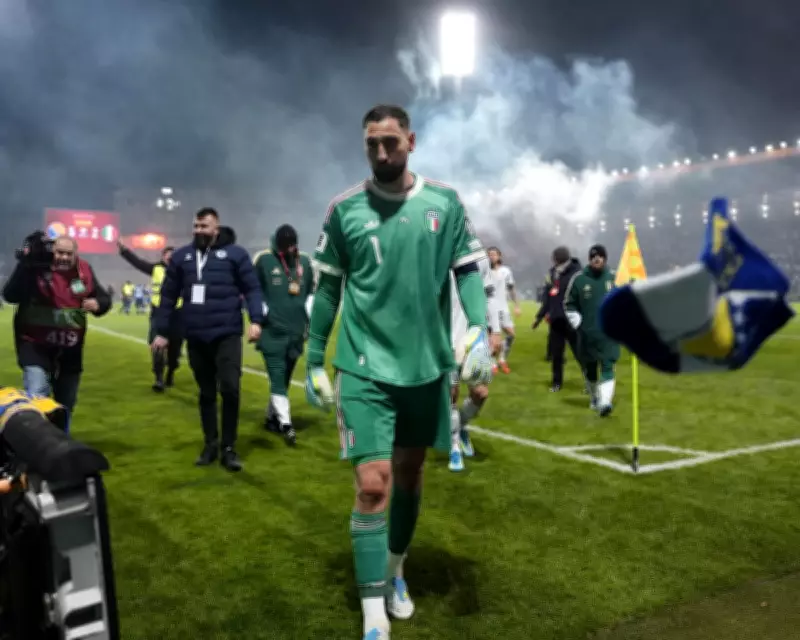
Italy's World Cup Absence Continues: A Third Straight Miss After Bosnia Defeat
Italy's national football team has suffered a devastating blow, missing out on the World Cup for the third successive time following their defeat against Bosnia and Herzegovina. This latest failure marks a profound low for a nation with a rich footballing history, raising urgent questions about the direction and management of Italian football.
The Decline of Italian Football Expectations
The gradual erosion of Italy's footballing ambitions can be traced through the headlines that have accompanied each World Cup qualification failure. When the Azzurri lost their playoff against Sweden in November 2017, La Gazzetta dello Sport declared it "The End" and an "Apocalypse." After defeat by North Macedonia in 2022, Il Corriere dello Sport described a country sinking "Into Hell."
Following Wednesday's elimination by Bosnia and Herzegovina, both newspapers adopted a simpler, perhaps more poignant headline: "Tutti A Casa" – Everybody Go Home. This resignation reflects a growing understanding among Italians that the 2018 failure was not an isolated incident but part of a troubling pattern, with the team having also failed to reach the tournament's knockout stage in both 2010 and 2014.
Missed Opportunities for Reform
After the initial disappointment of 2010, there was recognition that significant changes were necessary. In August 2010, weeks after Italy finished bottom of a group featuring Paraguay, Slovakia and New Zealand, Arrigo Sacchi was appointed as coordinator of the national youth teams and Roberto Baggio as president of the Italian Football Federation's technical sector.
Sacchi, a two-time European Cup winner as manager of Milan who also led Italy to the 1994 World Cup final, pushed Italian clubs to invest in their academies while attempting to shift focus in younger age groups away from results and tactical rigidity toward allowing individuals more space to develop their instincts and enjoy the game.
Baggio, one of Italy's greatest footballers, collaborated with approximately 50 experts to produce a comprehensive 900-page document titled "Renewing the future." This ambitious proposal outlined a complete overhaul of the federation's talent development pathways, reportedly including standardized coaching methods, a more structured scouting network, and a shared digital database for tracking player progress.
He presented this groundbreaking document in December 2011, then resigned in January 2013, lamenting that the project had been "literally dead" for a year. "I don't like to sit on the sofa while I could be doing other things," Baggio stated at the time. Sacchi also stepped down in 2014, citing stress as his reason for departure.
Partial Progress Amidst Continued Struggles
While it's tempting to speculate how different outcomes might have been if Baggio's proposals had been fully implemented, some changes to the structure of national youth sides did occur during this period, albeit falling short of his comprehensive vision. These modifications have yielded some positive results, with Italy winning the European Under-19 Championship in 2023 and the under-17s championship in 2024.
The persistent frustration for Italian football remains that modernization consistently arrives later and more laboriously than necessary. The senior national team's decline has paralleled worsening results for Serie A clubs in European competitions, largely attributable to a failure to keep pace with the commercial revenues of continental rivals.
One significant factor in this commercial lag is the continued use of communally owned, often outdated stadiums by most Italian teams. While there has been progress – Milan and Inter reached an agreement to purchase their San Siro home last year with plans to build a new arena on the same grounds, and Fiorentina secured a long-term leasehold of their Stadio Artemio Franchi allowing renovations to begin – these developments have taken many years and numerous failed proposals under different ownership groups to materialize.
Contradictory Realities in Italian Football
Each aspect of Italian football's struggles carries its own complexities and nuances. On the pitch, it would be simplistic to portray Italian football as irredeemably broken, incapable of fielding competitive teams in either international or club competitions. While Atalanta, the only Serie A side to reach the Champions League last 16 this season, suffered a 10-2 aggregate defeat by Bayern Munich, Inter reached the Champions League final in two of the past three years.
Three core members of that Inter team – Nicolò Barella, Alessandro Bastoni and Federico Dimarco – started for Italy against Bosnia and Herzegovina. The lineup also included Riccardo Calafiori and Gianluigi Donnarumma, regulars for Premier League title contenders, and Sandro Tonali, who has thrived at Newcastle United.
Two contradictory realities can coexist: Italian football standards have declined significantly since their last World Cup victory in 2006, yet the nation's talent pool remains sufficiently strong that qualification should be expected. Portraying this latest failure as the inevitable consequence of falling standards risks absolving responsible parties of avoidable mistakes.
Leadership Questions and Management Decisions
Serious questions surround recent managerial appointments and federation leadership. Was Gennaro Gattuso, who had largely underperformed across nine club management roles, truly the appropriate choice when Italy dismissed Luciano Spalletti last June? Should Spalletti have been replaced sooner, before the start of this qualifying campaign, following underwhelming performances and uncomfortable media interactions at Euro 2024?
When Italy failed to qualify for the 2018 World Cup, then-president of the Italian football federation Carlo Tavecchio resigned. His successor, Gabriele Gravina, did not follow this precedent after Italy's defeat by North Macedonia four years ago and stated on Tuesday that he would await opinions from the governing body's board when they convene next week. In the interim, he has asked Gattuso to continue in his role.
Change for its own sake rarely provides solutions. Removing Gravina would not resolve Italian football's systemic problems any more than Tavecchio's departure did previously. However, there is profound futility in repeating the same approaches while expecting different outcomes.
While we can never know whether Baggio's 2011 proposals might have produced different results, the current approach is demonstrably ineffective. Perhaps the most disheartening aspect of Italy's latest World Cup qualification failure is that it no longer feels like a catastrophic ending, but rather the same melancholy refrain playing endlessly on repeat.