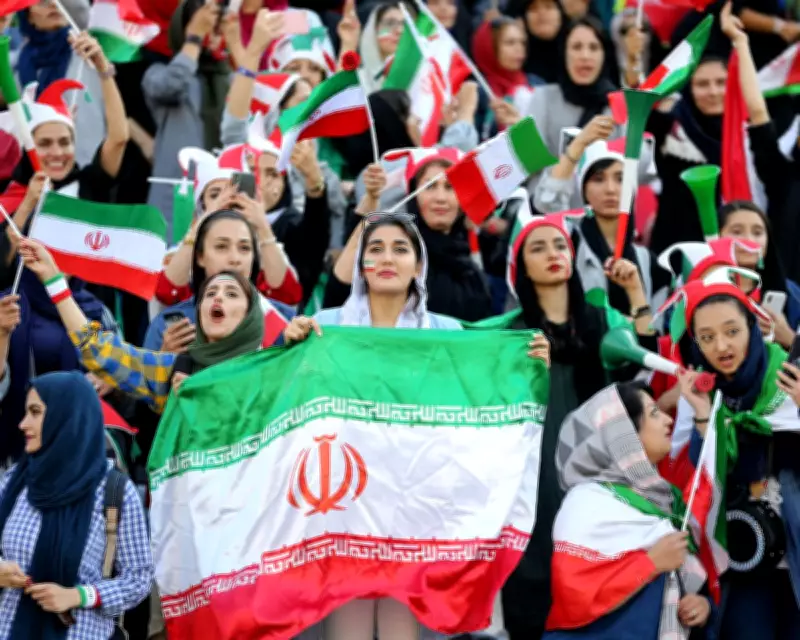
Iran's Women's Football Team Confronts Emotional Strain Amid Home Turmoil Ahead of Asian Cup
This week, Iran's women's national football team is set to arrive in Australia for their second appearance at the Women's Asian Cup, but their preparations have been overshadowed by troubling events back in their homeland. Amid ongoing anti-government protests and violent crackdowns by authorities over recent months, the team's top players are grappling with significant emotional challenges as they gear up for one of the most important tournaments of their careers.
Growing Concerns Over Player Welfare and Communication Blackouts
The prevailing mood among the Iranian players is one of anxiety and emotional strain, according to Raha Pourbakhsh, an Iranian sports journalist based in London. Many athletes are balancing their professional duties as national representatives with deep personal worries about safety, family well-being, and potential repercussions from the regime. As the tournament approaches—with Australia's Matildas kicking off on Sunday and Iran scheduled to play their first match a day later on the Gold Coast—concerns about the team's welfare have intensified.
Due to an internet blackout imposed by the government during the crackdowns, contact with players and staff in Iran has become nearly impossible. The absence of a players' union has further complicated matters, leaving even Fifpro, the global players' association, unaware of the team's exact location or status. Requests for information from FIFA and the Asian Football Confederation (AFC) have gone unanswered, adding to the uncertainty.
Player Withdrawals and Risks of Expression
While all members of the Iranian team and staff have reportedly been issued visas by the Australian government, two players have already withdrawn from the squad. Defender Kousar Kamali expressed her decision on Instagram, stating, "When the heart is wounded and the soul is tired, football is no longer a refuge. I can't pretend everything is normal." Her post, which has since been deleted, highlighted the emotional toll of the situation, as she bid farewell to the national team in hopes of a future return with a calm heart.
Others may follow suit, but doing so carries major risks. Pourbakhsh notes that even minimal social media activity, such as posting an Instagram story or leaving a supportive comment, can lead to serious consequences. These include pressure on family members, contractual penalties or termination, exclusion from team activities, and warnings of legal repercussions. Players' phones are reportedly being monitored, and some have been incentivized to report on teammates' anti-regime views, creating an atmosphere of distrust.
Historical Context and Recent Struggles
This uncertainty marks a stark contrast to the team's tournament debut in 2022, when their qualification for the Asian Cup in India made them national heroes. Their success symbolized the extraordinary barriers Iranian women have overcome to participate in sports and public life. Before the Islamic Revolution of 1979, women's football flourished in Iran, with Tehran hosting a women's national league and the national team founded in 1971—earlier than many other Asian nations, including Australia.
However, from 1980 onward, as conservative Islamic leadership took hold, women's football and all women's sports collapsed. It took decades for women to gradually regain permission to participate, albeit under strict supervision and dress codes, including mandatory hijabs that led to a FIFA ban in the 2010s. To this day, women are still barred from entering most stadiums in Iran, yet female athletes continue to persevere.
Current Protests and Calls for Action
Iran's presence at the 2022 Women's Asian Cup resulted from a generational struggle for freedom and resistance against an oppressive regime. Now, as the team enters the 2026 edition, another revolution is unfolding that could reshape their future once again. In late 2025, protests erupted across Iran in opposition to the regime, citing decades of repression, worsening living conditions, and economic decline. Authorities responded with lethal crackdowns and massacres, according to Amnesty International, and cut off phone and internet services nationwide.
Among those arrested and killed have reportedly been dozens of athletes, including at least one professional women's footballer. This has prompted former men's national team players to issue an open letter calling on FIFA to condemn the government's actions and protect athletes under its human rights policy. As Iran's women's team steps onto the field in Australia, they carry not only the hopes of a nation but also the weight of a turbulent home front, making their journey at the Asian Cup a poignant testament to resilience in the face of adversity.