The Making of a Coach: Mikel Arteta's Early Years
In the lead-up to the Champions League final, Arsenal manager Mikel Arteta's first footballing steps in the Basque Country and Barcelona are recalled by those who shared them. Santi Cazorla, laughing, describes Arteta as the worst person to watch a match with, because he constantly pauses and rewinds to analyze positioning and tactics. Cazorla recalls telling Arteta to become a coach, convinced of his gift for seeing the game differently.
Born in Gipuzkoa, Spain's smallest province, which has produced an unusually high number of elite managers, Arteta always stood out. Those who knew him as a youth saw not a coach but something special. Jon Ayerbe says, 'Mikel caught your attention very young. The word I'd use is alive; you saw it in his eyes. He grasped everything fast, had character and was so competitive.' Álvaro Parra adds, 'Above all, he was the most intelligent.' Mikel Yanguas recalls, 'You looked at him and thought: "Bloody hell, he's got something special."'
Early Promise at Antiguoko
Arteta played at Antiguoko, a youth club in San Sebastián that competed with professional academies. He was also a talented tennis player but chose football. Coach Roberto Montiel remembers a goal against Real Sociedad that reminded him of Lionel Messi. Arteta was two-footed, tiny, and a born sportsman. Parra says, 'He was always clear he would make it and sacrificed his life for it. He went to Barcelona, leaving everything behind.'
At 14, Arteta trained at Athletic Club, where coach José Luis Mendilibar was struck by his intelligence and ball retention. Mendilibar later wrote, 'What you could imagine was that someone with that intelligence would also develop an ability to explain it to others.' Luis Fernández, who signed Arteta for PSG, echoes this: 'When you told him what you wanted, he did it first time.'
Life at La Masia
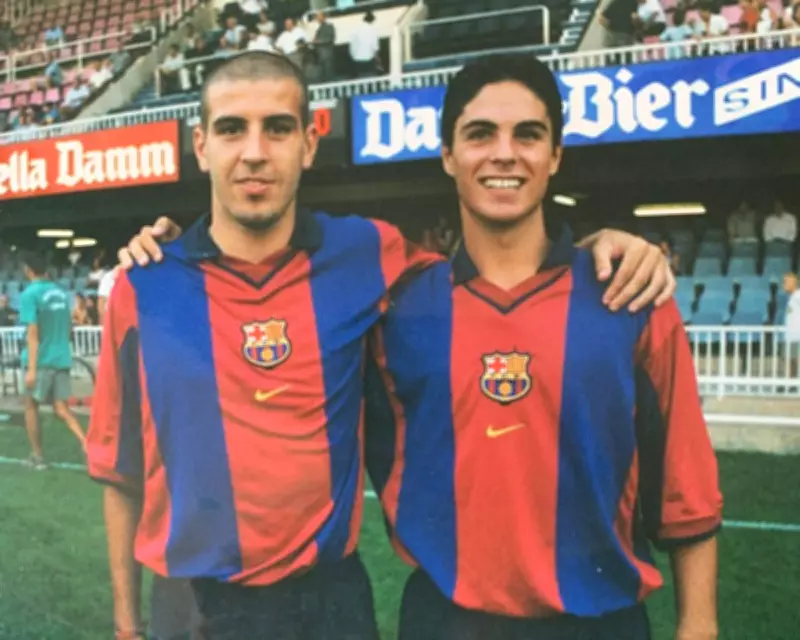
In 1997, Arteta moved to Barcelona's La Masia. Yanguas recalls, 'We left that summer: 17 August, the day of San Sebastián's fiestas.' They lived in dorms with four bunks, seeing the pitch where Bobby Robson's team trained. Roberto Trashorras says, 'It was just us, the cooks, the security guard. We sorted things out among ourselves. Mikel was funny, extroverted, but we were the victims usually.'
Arteta adapted well. Yanguas says, 'Mikel was different, better prepared: more outgoing, more adaptable. On the pitch, he would demand the ball. It's hard to do that: "Give it to me, I'll sort this." He was surrounded by great players but had the confidence.' Jofre Mateu recalls Arteta crashing his car into the Masia wall but notes his responsibility: 'He was super-responsible, he had something.' Another incident defined him: when Thiago Motta fought in training, Arteta stepped in to calm him, earning respect.
Football Education and Beyond
Barcelona's style was a new education. Luis Carrión says, 'The players who arrive are the best, but Barcelona make you think about tactics, space. Mikel learned to play one, two touches, not lose his position.' Trashorras adds, 'They would say: "Don't go looking for the ball, the ball will come to you." Mikel was sharp.'
Arteta didn't make it at Barcelona due to Xavi and Iniesta, but his career took him to France, Scotland, and England. Fernández says, 'On the pitch you see Mikel's intelligence. He had the perfect attitude to coach: professionalism. I think he learned with Pep. I went to see him do a session and thought: "Bloody hell, look at Mikel."'
Yanguas suggests Arteta always saw spaces naturally. Jofre says, 'If you asked me about Xavi, I would have said zero. Luis Enrique, zero. Guardiola... OK, yes. But we were kids.' Trashorras agrees: 'With Pep, you saw it; with Mikel I couldn't claim to have done, but you can't argue with what he's done.'
Ultimately, Arteta chose to become Pep Guardiola's assistant before taking the Arsenal job. Cazorla recalls, 'He said: "What should I do, Santi? Keep playing or take the opportunity as Pep's assistant?" I said: "Go for it." I would watch him pausing games and think: this guy is already a coach.'