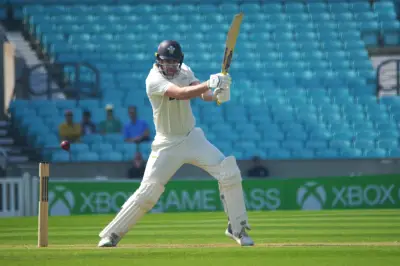
Mark Cooper, who is still playing at 73, has savoured the privilege of playing for Millfields CC with his children. Photograph: Courtesy of Mark Cooper
Within days of new parenthood, cricket tragics often find themselves mapping out futures for their offspring in the game. I’m no different.
Every cricket-loving parent will know the feeling. Not a feeling, exactly, more a tiny flicker of hope. A ridiculous, irrational hope that the gods who once reached down and gently kissed the likes of Sachin Tendulkar and Ellyse Perry might one day do the same to your little sprog.
You hold your breath the first time you wrap their chubby hands around a plastic bat. You start dreaming absurd dreams when you softly lob a tennis ball in their direction and they accidentally smoke one into the couch.
Maybe, despite all available evidence, despite the fact that you were, at best, a middling club cricketer with an exaggerated pull shot and a weakness against anything spinning away, maybe your child will be different.
In all likelihood they won’t become the next superstar. And that’s fine. Because what you’re really hoping for has little to do with fame or contracts or Test caps. What you’re really hoping for is that they fall in love with the game.
My youngest son was born last week. I’ve convinced myself that he has long fingers, the sort of fingers that lend themselves to mystery spin bowling. My five-year-old boy has relatively broad shoulders. Perhaps he’ll hit a hard length and give it a whack in the middle order. Perhaps there’s a club out there that will one day refer to them as “the Gallan-Cohen lads”.
This is how cricket gets you. It turns otherwise rational adults into talent scouts studying toddler anatomy. It colonises the brain.
Cricket parents start relating everything back to the sport. During labour, I was essentially Jack Leach to my wife’s Ben Stokes at Headingley in 2019: anxious and sweating, operating the TENS machine with the same awkward determination Leach showed in handling the Australian quicks, desperately trying not to let my teammate down while she produced something miraculous.
Now, a week into life with two children, we strategise meal times and bedtime routines like captains discussing bowling changes. We position furniture and childproof the living room as though we’re setting fields. Once cricket embeds itself deeply into your life, it becomes less a sport than a language through which everything else is understood.
But these fantasies and metaphors are secondary to the real dream – sharing a field with my boys one day. “I got to do exactly that with my dad in my second ever senior game,” says Sheahan Arnott, a handy club bowler in London whose father remains the record run-scorer at Bentley Cricket Club in Perth. “We’ve played hundreds of games together. I captained him in his 500th game when he hit a ton. I remember welling up when I gave the pre-match speech that day. The thing I’ve wanted most in cricket was to play with my dad.”
There is, of course, a danger of wanting this too much. Every cricket parent probably walks this line. The temptation to project your unfinished dreams on to small children is as precarious as driving on the up. The trick, I suppose, is to pass on the obsession without passing on the burden. This is where the game’s intricacies can lend a hand.
There’s joy to be found in a properly filled-out scorecard. There is an art in precisely packing a cooler box for a full day’s play. There is a skill in caring for an ageing ball. Cricket’s grand tapestry is made with a million tiny stitches and sharing this wisdom with the next generation is both a responsibility and a privilege.
I inherited cricket in exactly this way. I was about six when my parents first took me to the Wanderers. My dad was motivated partly by the on-field action, and partly by Friday night beers with his mates. My mum – and she will tell you herself – was drawn by the outline of Richard Snell’s backside. Whatever their motivations, they both completely invested in my love for the game.
My mum drove me to endless coaching sessions. My dad offered infinite throwdowns in the garden, despite possessing the shoulders of a man who had worked a full week. Every scratchy knock on an artificial pitch felt, to them, like a Test hundred. And every time I spooned a gentle off-spinner to midwicket they absorbed my disappointment. Even now, as a 38-year-old father playing at a gloriously low level, they are still the first people I want to tell when I’ve scored a few runs.
“Sharing a life in cricket with your children is a gift,” says 73-year-old Mark Cooper, who has played alongside his three sons and his daughter with the nomadic Millfields CC since the 1990s. “You watch them go from children, to teenagers you have to drag out of bed, to adults with their own lives. Cian [now 37] was 11 when he started, fielding fine leg to fine leg. Once I ran him out on 96. Another time we walked off together having hit the winning runs. That was magical.”
Which is why I’m holding on to the dream. Even if my boys inevitably scoff and roll their eyes whenever I begin a sentence with: “When I played …” For now the eldest hasn’t shown an inkling of interest and my youngest can’t yet hold up his head, let alone a bat. But I’m a cricket tragic. I understand the value of patience. More importantly, I believe in the power of hope.
This is an extract from the Guardian’s weekly cricket email, The Spin. To subscribe, just visit this page and follow the instructions.