
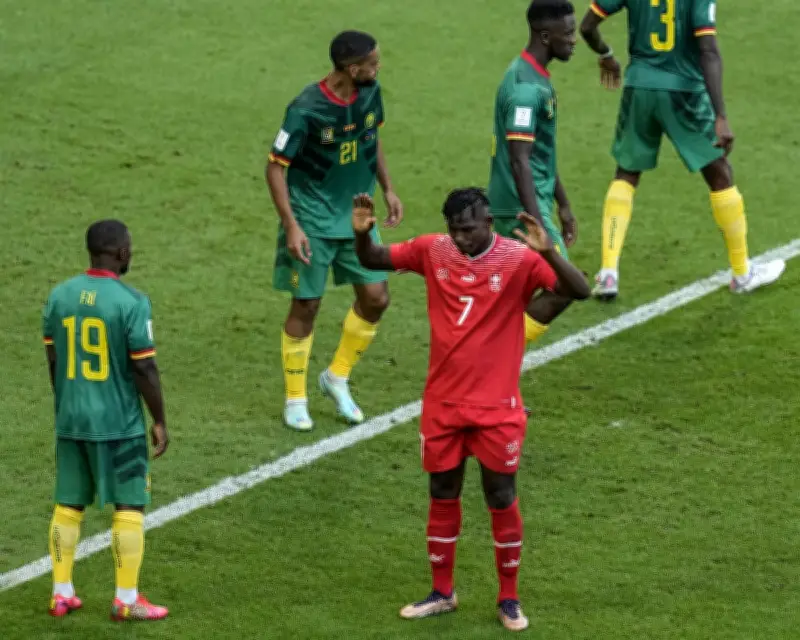
Swedish midfielder Yasin Ayari, born to a Tunisian father, chose not to celebrate his first goal against Tunisia in a 2024 friendly, though he later celebrated a second goal. Similarly, Declan Rice did not celebrate after scoring against the Republic of Ireland in 2024. But what is the earliest example of a player refraining from celebrating an international goal due to a connection to the opposition?
Filippo Varanini recalls Breel Embolo, the Swiss international born in Cameroon, who did not celebrate after scoring against Cameroon at the 2022 World Cup. During a 2010 European Championship qualifier, Mesut Özil, born in Germany to Turkish immigrants, showed restraint after scoring for Germany against Turkey. However, the earliest known example is Lukas Podolski, who scored twice for Germany against Poland, his country of birth, at Euro 2008. Podolski told FourFourTwo in 2022: 'This was a difficult and emotional game for me. Both the German and Polish press focused on me before it, building the pressure, and there were so many Polish fans in the ground. I didn’t celebrate, but I’m a professional and had to do what was expected of me. I support Poland on every other occasion.'
Coaches with Multiple National Team Jobs
Luke Carruthers asks whether Dick Advocaat, who has coached eight different men's international teams, holds a record, and whether managing both a country's men's and women's senior teams is rare. The record for most international men's teams managed belongs to Rudi Gutendorf, who managed 17 national teams over 53 years, including Chile, Bolivia, Australia, and Zimbabwe. However, Christoph Arlick notes that several of Gutendorf's teams did not play official matches under him; he actually managed 77 games across nine countries, beating Advocaat by at least one.
Other managers with eight or more international jobs include Bora Milutinovic (eight: Mexico, USA, Nigeria, etc.), Claude Le Roy (nine: Cameroon, Senegal, DR Congo, etc.), Danny McLennan (10), and Tom Saintfiet (12). Regarding managing both men's and women's senior teams of a country, John Herdman is a notable example. He led Canada's women's team to bronze medals at the 2012 and 2016 Olympics, then took over the men's team in 2018 and guided them to the 2022 World Cup, their first in 36 years.
Longest Wait Between World Cup Appearances
Alexander Scott asks if New Zealand's Chris Wood and Tommy Smith, playing at their second World Cup 16 years after their first, have the longest gap. Dirk Maas confirms that Wood equalled Faryd Mondragón's record (Colombia, 1998 to 2014). Previously, the longest wait was 12 years, shared by players like Alfred Bickel (Switzerland, 1938-1950), Erik Nilsson (Sweden, 1938-1950), and Michael Laudrup (Denmark, 1986-1998). Others with 12-year gaps include Edin Džeko and Sead Kolašinac (Bosnia, 2014-2026), and Nabil Bentaleb, Aïssa Mandi, and Riyad Mahrez (Algeria, 2014-2026).
Dave Beasant Penalty Myth
George Jones asked in 2018 whether England should have brought on penalty-save specialist Dave Beasant for the shootout against West Germany at Italia 90. The Knowledge busts this myth: England had not used all their substitutes (only Trevor Steven replaced Terry Butcher), but in those days, teams named five subs per match. England's other subs were Chris Woods, Tony Dorigo, Steve McMahon, and Steve Bull, so Beasant was not on the bench.
Reader Questions
Roger Kirkby asks which countries have never earned a World Cup point, like a UK Eurovision entry. Rob Davies wonders how many FIFA-recognized leagues have never had a player at the World Cup, noting that Thailand finally got one via Rebin Sulaka of Iraq, who plays for Port FC. Chris Carter asks if any team's first World Cup win had a larger margin than Canada's 6-0 victory over Qatar in 2022. Tony Marsden notes the Netherlands started a game against Japan with no Eredivisie players, while Japan had two Feyenoord players, asking if a country ever had more players from the opposition's league. Lars Bøgegaard questions why some national teams' colours don't match their flags, like the Netherlands in orange, Australia in yellow and green, and Japan in blue and white.