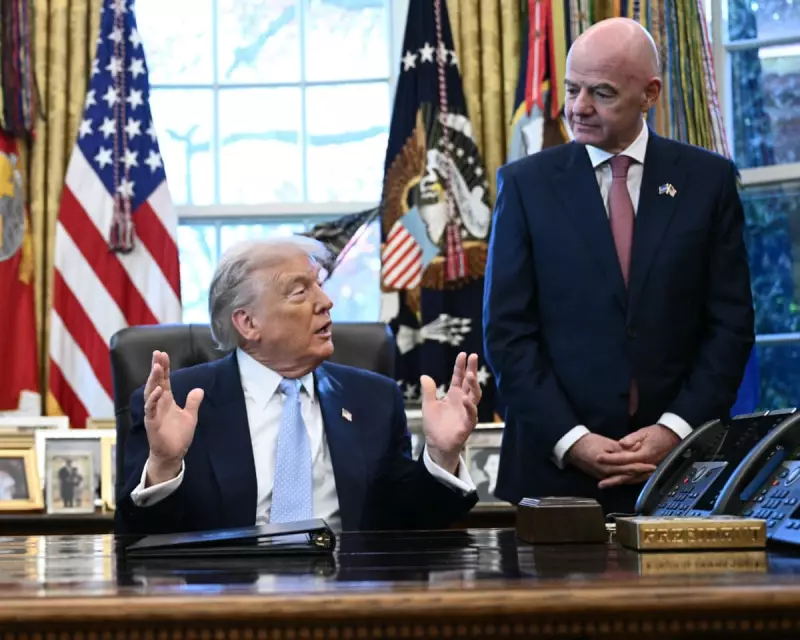
The president of world football's governing body, Gianni Infantino, stands accused of violating FIFA's strict neutrality rules through his dealings with former US President Donald Trump, as details emerge of a controversial new FIFA peace prize.
A Prize Announced Amid Political Controversy
The timing of the announcement raised immediate concerns. Last month, just before a scheduled meeting with Donald Trump in Miami, and as the former president reportedly lamented his lack of a Nobel Peace Prize, Gianni Infantino took to Instagram to unveil FIFA's own annual peace award.
Infantino stated the prize would honour individuals who "help unite people in peace through unwavering commitment and special actions." The inaugural winner is set to be announced on 5 December 2024 during the World Cup draw in Washington for the 2026 tournament, jointly hosted by the USA, Mexico, and Canada.
This move followed an earlier incident where Infantino was accused of breaching FIFA's political neutrality. In October, he appeared alongside Trump at a Gaza peace summit in Sharm el-Sheikh, Egypt, publicly praising his "friend," saying, "I think we should all support what he’s doing because I think it is looking pretty good."
The Controversial Committee Behind the Process
Internal sources suggest the FIFA prize is viewed as the global body's equivalent of UEFA's president's award, indicating Infantino's personal influence will be decisive. Further unease stems from the committee tasked with designing the selection process for future winners.
The key role has been given to FIFA's Social Responsibility Committee, which will not convene until after this year's recipient is named. The committee's chairperson is Zaw Zaw, the 59-year-old president of the Myanmar Football Federation for the past two decades.
Zaw Zaw and his company, Max Myanmar, have been subject to EU and US economic sanctions. In 2009, the US State Department labelled him one of the "cronies" of Myanmar's brutal military junta, which was suppressing democracy and committing severe human rights abuses at the time.
Leaked US diplomatic cables from 2009 described Zaw Zaw as "one of Burma’s up-and-coming cronies" with interests in gems, cement, and bottling plants. The cables also alleged he hired the grandson of the then-dictator, Senior General Than Shwe, to play for his professional football team, Delta United.
When questioned in the past about his ties, Zaw Zaw told the South China Morning Post his only crime was that "in this poor country, I have become rich," adding, "Only the government has projects. If I don’t do projects with them, who will I do projects with?"
Structural Problems and a 'Reverse-Engineered' Process
Nick McGeehan, co-director of the human rights advocacy group FairSquare, said Infantino's solo announcement of the prize was typical but pointed to deeper issues. "These developments certainly suggest that this peace prize award process is being reverse-engineered to ensure the favoured result of President Infantino," McGeehan stated.
He argued that promised reforms from FIFA's 2016 overhaul, voted in 176 to 22 by members after a massive corruption scandal, have not been fully realised. Instead of reducing committees, their number has increased—a move FIFA says improves oversight, but critics claim expands opportunities for patronage.
McGeehan highlighted the inherent tension in Infantino's 2016 election platform, which promised both institutional reform and significantly increased revenue for member associations. "The only year FIFA makes money is in a men’s World Cup year," he explained, noting this creates a structural incentive to align closely with powerful, wealthy hosts like the USA for the 2026 World Cup and Saudi Arabia for 2034.
Stephen Cockburn, Amnesty International’s head of labour rights and sport, commented that despite structures suggesting otherwise, "finance and power" often remain FIFA's priority over human rights considerations.
FairSquare has prepared a formal complaint regarding a potential breach of FIFA's Code of Ethics, ready to submit should Donald Trump be awarded the peace prize. A FIFA spokesperson responded by saying, "only FIFA could be criticised for recognising those who want world peace," and that the body should be recognised "for what it is – a global governing body that wants to make the future a brighter place."