
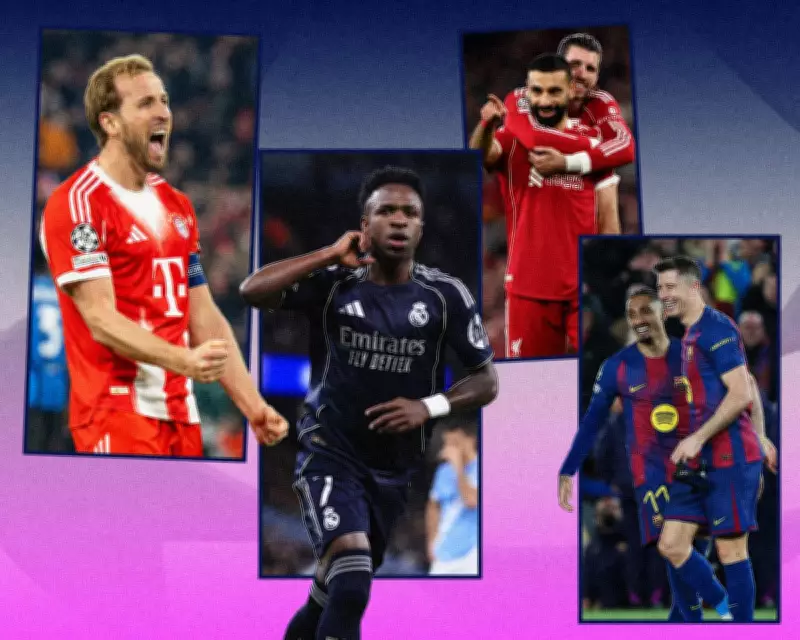
Champions League Knockout Stage Sees Unprecedented Goal Surge
The UEFA Champions League knockout phase has become a goal-scoring spectacle, with the last 16 matches producing a remarkable 68 goals. This represents an average of 4.25 goals per game, marking a significant departure from recent seasons and sparking intense debate among football analysts about what's driving this offensive explosion.
Historical Context Reveals Dramatic Shift
This season's goal surge represents a dramatic reversal of recent trends. Between 2020 and 2023, the knockout phase averaged between 2.34 and 2.72 goals per game, continuing a gradual decline that began in the 2019-20 season. The current average of 4.25 goals per match is particularly striking when compared to the Premier League's consistent 2.7-2.8 goals per game average over the past decade.
The playoff round this season produced 3.94 goals per game without any Premier League involvement, suggesting this phenomenon extends beyond English football's current defensive struggles. This statistical anomaly in Europe's premier club competition has analysts searching for explanations beyond simple narratives about Premier League deficiencies.
Premier League Tactical Evolution Under Scrutiny
One prominent theory focuses on the tactical evolution within English football. Many Premier League clubs have embraced a more cautious, structured approach influenced by Mikel Arteta's principles at Arsenal. This "shit-at-the-back-stick" era, as analyst James Horncastle memorably described it, emphasizes defensive organization, set-piece efficiency, and controlled buildup over expansive attacking football.
"The widespread adoption of Arteta-inspired principles has potentially left Premier League sides unprepared for opponents who prioritize direct counter-attacking football," notes football analyst Jonathan Wilson. This tactical homogeneity may have created vulnerabilities that European opponents are exploiting with devastating effect.
Structural Factors and Individual Circumstances
Several structural factors unique to knockout football contribute to higher scoring. Teams trailing by multiple goals have little incentive to protect goal difference and must commit to attacking regardless of the scoreline. The possibility of extra time also encourages offensive play, with both the playoff round and last 16 seeing matches extended by 30 minutes, resulting in additional goals.
Individual circumstances have certainly played their part. Several matches featured significant mismatches, such as Bayern Munich's dominant performance against Atalanta and Liverpool's comprehensive victory over Galatasaray at Anfield. Tottenham's defensive collapse against Atlético Madrid, stemming from their goalkeeper selection crisis, contributed to the goal tally, while Newcastle and Chelsea both suffered heavy aggregate defeats after chasing games that had slipped away from them.
The End of Positional Play Dominance?
Some analysts suggest we're witnessing the end of Pep Guardiola's positional play (juego de posición) as football's dominant tactical paradigm. With no clear successor emerging, many Premier League managers appear to be following Arteta's blueprint rather than developing their own tactical identities.
This tactical uncertainty has created opportunities for European sides employing more direct, counter-attacking approaches. Teams like Paris Saint-Germain and Barcelona have demonstrated that running directly at opponents and exploiting space behind defensive lines can yield spectacular results against Premier League opposition accustomed to more congested midfield battles.
Looking Beyond Simple Explanations
While Premier League defensive struggles provide part of the explanation, the goal surge appears more complex. The abolition of the away goals rule in 2021 was initially thought to reduce scoring, but its impact appears to have been temporary. The current season suggests that rule change may have actually encouraged more attacking football in knockout ties.
The sample size remains limited at 32 matches, but the statistical deviation from recent norms is significant enough to suggest something fundamental may be changing in European football. Whether this represents a temporary anomaly or the beginning of a new high-scoring era in the Champions League remains to be seen, but the evidence from this season's knockout stage suggests attacking football is enjoying a dramatic resurgence at Europe's highest level.