
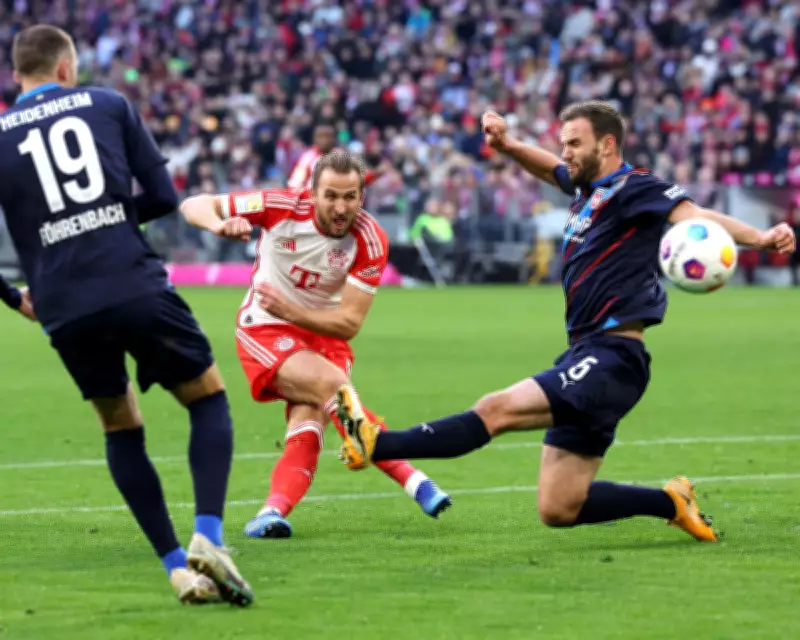
Bayern Munich's Statistical Dominance in Bundesliga
Bayern Munich's current Bundesliga campaign has produced extraordinary statistical achievements that merit closer examination. With 70 points accumulated and a staggering goal difference of +72, the German giants are demonstrating offensive prowess rarely seen in top-flight European football. Their record stands at 22 victories against a single defeat, a 2-1 loss to Augsburg that barely tarnishes their otherwise perfect campaign.
The mathematics behind Bayern's success reveals even more impressive details. Their 22 victories have generated a goal difference of +73, translating to an average margin of victory exceeding three goals per match. This statistical dominance raises intriguing questions about historical comparisons across European football.
Historical Goal Difference Records
When examining clubs that have won league titles with goal differences exceeding their point totals, Hearts' 1957-58 Scottish First Division campaign emerges as the benchmark. The Edinburgh club achieved a remarkable +103 goal difference while accumulating just 62 points under the two-points-for-a-win system. Their season included victories of 9-0, 9-1, 8-0 and two 7-2 results, creating a goal difference to points (GDP) differential of +12 that remains unmatched.
Other notable historical examples include Rangers' 1898-99 season with a +7 GDP from just 18 matches, Liverpool's 1895-96 Second Division campaign at +6, and multiple Ajax teams in the Eredivisie. Bayern Munich's current Bundesliga season projects to a +2 GDP, placing them among these statistical anomalies.
When adjusting for games played, Rangers' 1898-99 season produces the highest GDP per game ratio at 0.388, followed by Hearts at 0.353. Bayern's current ratio stands at 0.074, demonstrating how historical contexts create different statistical landscapes.
European Goal Difference Milestones
Bayern Munich's pursuit extends beyond GDP statistics to absolute goal difference records in Europe's top five leagues. With seven matches remaining, they trail Torino's 1947-48 Serie A record of +92 achieved over 40 games. Bayern already holds the record for a 34-game season in major European leagues, having achieved +80 during their 2012-13 treble-winning campaign.
Other notable goal difference achievements include Real Madrid's +89 in La Liga (2011-12), Barcelona's multiple seasons exceeding +80, and Paris Saint-Germain's Ligue 1 records. These statistics highlight how dominant teams across eras have rewritten what constitutes exceptional defensive and offensive balance.
World Cup Qualification Anomalies
Sweden's recent qualification for the World Cup despite winning only two matches represents another statistical curiosity in international football. Their path involved failing to win any group stage matches but advancing through Nations League ranking before playoff victories against Ukraine and Poland.
Historical precedents for limited-win qualifications include France's 1978 qualification with two wins from four matches in a three-team group. More remarkably, Switzerland qualified for the 1934 World Cup without winning any matches, drawing both qualification games against Yugoslavia and Romania. Belgium achieved similar qualification that year with just one draw from two matches, benefiting from complex group dynamics.
Identical Half Scoring Records
Bulgaria's recent 10-2 victory over Solomon Islands, featuring identical 5-1 scores in both halves, prompts investigation into similar symmetrical results. The record for such matches belongs to Kuwait's 20-0 victory over Bhutan in 2000 Asian Cup qualification, with exactly 10 goals scored in each half.
While Borussia Mönchengladbach's 12-0 Bundesliga victory over Borussia Dortmund in 1978 featured a 6-0 halftime lead, the search continues for higher-scoring matches where both teams scored in identical halves.
Managerial Returns and Historical Context
Roy Hodgson's return to Bristol City after 44 years highlights football's cyclical nature and managerial longevity. Such returns prompt examination of other British managers who have revisited former clubs after extended absences, though historical records suggest mixed success in these scenarios.
The timing of this analysis coincides with April Fools' Day, recalling football's history of elaborate hoaxes and fabricated stories that have occasionally confused even dedicated followers of the sport.
Unanswered Football Questions
Several intriguing questions remain open for investigation, including identifying the greatest footballer never to appear in England, clubs featuring famous artworks on their badges, dramatic final-day relegation escapes, derby match naming conventions, and longest unbeaten runs in local rivalries.
These statistical inquiries demonstrate football's endless capacity for generating numerical curiosities that transcend simple win-loss records, revealing deeper patterns in how the game evolves across eras and competitions.