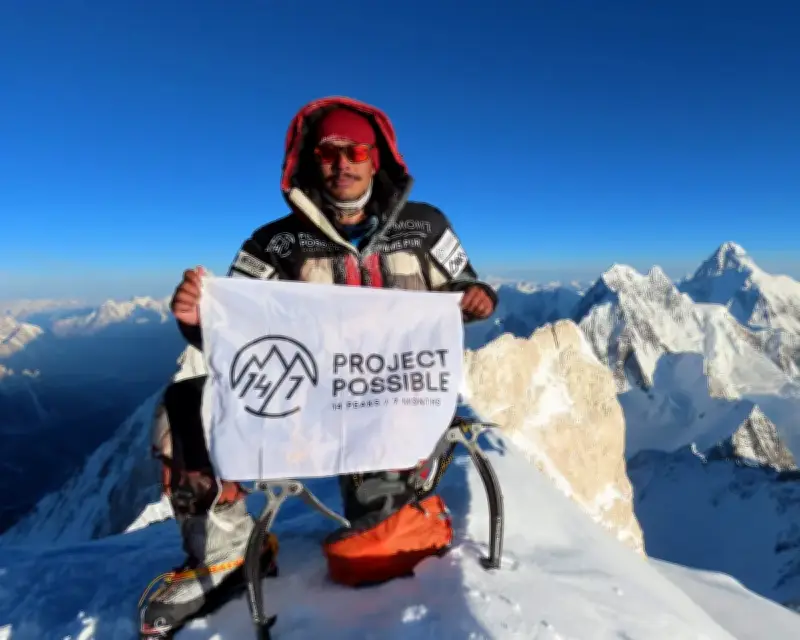
Nirmal Purja, the former Gurkha soldier who became one of the most celebrated and controversial mountaineers of his generation, died in an avalanche on Broad Peak, an 8,051-metre mountain in Pakistan, at the age of 43. Purja made his name in environments where life is reduced to its most elemental, and dangerous, terms. He believed, with an almost evangelical fervour, that “with relentless self-belief, anything is possible”. He spent his life testing the limits of that belief, first in military service and later on the world’s highest and most dangerous mountains.
A career of records and controversy
Purja was the most celebrated and controversial mountaineer of the past decade. His ambitious, no-holds-barred approach to high-altitude climbing brought a new emphasis to the world’s highest peaks, prioritising speed, visibility and multiple back-to-back ascents within a single season. His methods helped propel Himalayan mountaineering into the influencer age, reshaping the way people saw, and climbed, the world’s tallest mountains. He was also an astute self-promoter, frequently broadcasting his climbs and exploits from the high camps themselves.
In a relatively short climbing career, Purja amassed a remarkable collection of records. Among them were fastest ascents of multiple 8,000-metre peaks, the highest number of ascents of the world’s 8,000-metre mountains by a single climber (57), and the highest number of 8,000-metre ascents without supplemental oxygen (29). In 2021, he also achieved one of mountaineering’s most coveted feats: the first winter ascent of K2, the world’s second-tallest peak, alongside nine fellow Nepali climbers who sang the Nepali national anthem together as they reached the top. Purja was the only member of the summit team to climb K2 without supplemental oxygen.
Military background and early climbs
In 2018, Purja was appointed MBE after helping lead 13 fellow Gurkha soldiers to the summit of Everest, rescuing an ailing climber from high in the death zone, and breaking three world records for speed ascents on Everest and the nearby peaks of Lhotse and Makalu.
Purja achieved global fame for his audacious 2019 project, titled Project Possible, where he summited all 14 8,000-metre peaks in a record six months and six days. The previous record had been nearly eight years. The feat was immortalised in the hit Netflix documentary 14 Peaks: Nothing Is Impossible (2021) and his 2020 autobiography, Beyond Possible. The attention around his climbs brought his flamboyant, highly commercialised style of high-altitude mountaineering to a mainstream audience and propelled him into a rarefied circle of celebrity climbers that included Reinhold Messner, Sir Chris Bonington and Sir Edmund Hillary.
Early life and military service
Nirmal – also known as Nimsdal or Nims – was born in the remote village of Dana in Nepal’s Myagdi district. His father, Nanda Bahadur Purja, served as a Gurkha soldier in the Indian army, while his mother, Purna Kumari, cared for the household and the family farm. When Nims was four years old, his family moved to the Chitwan district in Nepal’s verdant southern plains, far from the mountains where he would eventually make his name.
Nims was the youngest of four sons, followed by a younger sister. For many poor families in rural Nepal, service in the Gurkha regiments of foreign militaries offered a rare lifeline out of poverty. Following in the footsteps of his three older brothers, Nims joined the 1st Battalion of the Royal Gurkha Rifles in 2003 after passing a gruelling exam that included running with heavy sandbags in a bamboo basket suspended from his forehead by a tumpline.
Purja excelled at military service and was deployed in Afghanistan. After six years with the Royal Gurkha Rifles, he was accepted into the Royal Navy’s elite Special Boat Service (SBS) in 2009. The following year, he was wounded in action in an undisclosed location when a sniper’s bullet struck the butt of his rifle, sending shrapnel into his face and neck. During his service in the British military, Purja obtained British citizenship.
He made his first forays into mountaineering while he was active with the SBS, climbing Ama Dablam (6,812 m) and Lobuche East (6,119 m) in Nepal. In 2014, he summited Dhaulagiri, his first 8,000-metre peak, in just 15 days. The experience convinced him that he possessed an unusual strength and resilience at altitude. After his celebrated Everest ascents, Purja decided to leave the SBS and pursue his 14 peaks project full time. In his autobiography, he described the decision as “the latest in a long line of baffling career developments”.
Commercial ventures and legacy
By the time Purja completed his 14 peaks record, he had progressed from paying client to company owner and guide. His expedition company, Elite Exped, quickly became a prominent player in the high-stakes Himalayan guiding industry. Purja leveraged his experience and growing fame to bring a new generation of aspiring mountaineers, many with little previous experience, to summits that would have been unthinkable for them only a few years earlier.
He also launched a mountaineering gear brand, Nimsdai Store, and a skydiving outfit, Skydive Nimsdai. He invested in a helicopter charter company in Nepal, which provides basecamp services and high-altitude rescues using a jet-black Eurocopter B3e emblazoned with his personal logo in bold white lettering across the side.
Purja also established the Nimsdai Foundation, with the mission of “giving back to the mountain communities of his homeland”. In May, Nims inaugurated a new porter shelter built by the foundation in the small trekking village of Lobuche, about five miles south of Everest base camp. The project was intended to provide safe, comfortable lodging for the mountain workers who ferry supplies throughout the Everest region.
Controversies and final project
In May 2024, the New York Times published an article in which two female climbers accused Purja of sexual assault. Through his lawyer, Purja “unequivocally denie[d] the allegations of wrongdoing,” calling the allegations “false and defamatory”.
Others in the mountaineering industry alleged that Purja’s aggressive, self-promotional approach to climbing placed himself and his clients at undue risk, and that it ran counter to the more measured ethos traditionally associated with high-altitude mountaineering. Bonington, leader of the successful 1975 British first ascent of Everest’s south-west face, was quoted in the Times in 2019 as saying: “What he has done is quite extraordinary, but it isn’t mountaineering.”
When describing his motivations for Project Possible, Purja wrote in his autobiography: “I loved the thought of ripping up the rule book. If I could show kids and adults alike what was humanly achievable, then my far-fetched ambitions might inspire others to think big and push themselves in ways that they previously considered unimaginable. I also liked that it would give the world a crazy story to remember.”
The avalanche on Broad Peak that claimed Purja’s life also took the lives of nine other climbers and guides, several of whom were pursuing their own personal 14 peaks records. Purja himself was attempting his “hat-trick” project: becoming the first person in history to climb all 14 of the world’s 8,000-metre peaks three times, including twice without supplemental oxygen.
Had he reached the summit of Broad Peak, only one mountain would have remained between him and a record that experts in the industry described as “nearly impossible” to surpass. Purja is survived by his wife, Suchi, whom he married in 2006, and their daughter, Himani.