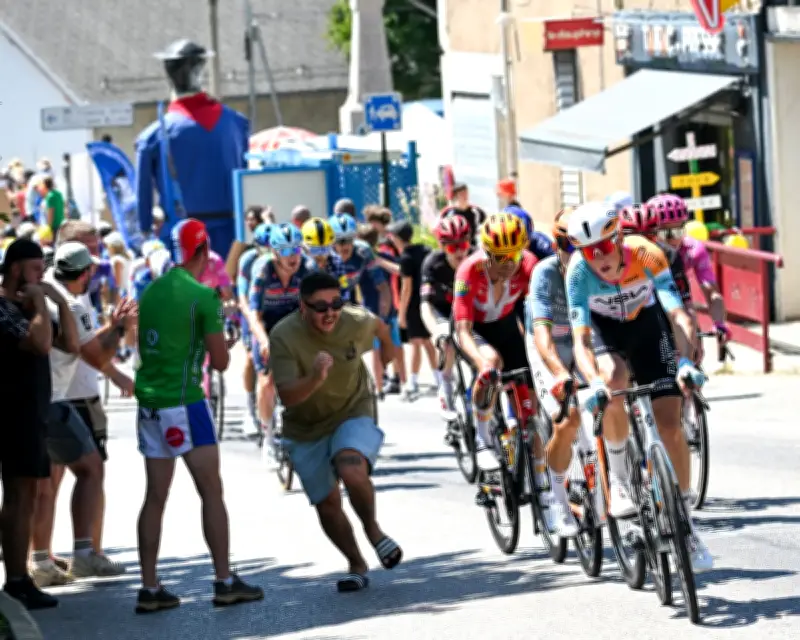
Veteran photographer Pete Goding has spent 20 years capturing the Tour de France. His first Tour was in 2005, when Lance Armstrong's empire began to wobble. Today, he reflects on the people, mishaps, and friendships that define the race.
Twenty Tours and Counting
Goding's first Tour saw him photograph Armstrong on the Champs-Élysées with a film SLR, unaware that both film cameras and Armstrong's reputation would not age well. Now, he sits outside a cafe near the Place de la Concorde, watching Paris go about its Sunday morning before the world's biggest bike race thunders through.
The Tour arrives like a travelling circus, creates chaos for a few hours, then disappears. Before Covid, 18 accredited in-race photography motos weaved through the Tour. Now there are just nine, with smaller agencies pooling allocations. Goding works with a small Belgian-Italian collective.

Barcelona: Heat, Water, and Generosity
This year's opening stage in Barcelona offered little drama from the bike, so Goding let the Sagrada Família tell the story. Using a 400mm lens, he picked riders from the cathedral's shadows, then switched to 24mm as they swept past. Between runs, an older man with professional cameras entertained him, claiming to have photographed everyone from Reagan to Obama. A quick Google search confirmed he wasn't lying.
Dehydrating on the baking tarmac, Goding was adopted by a group of Danish fans who kept him supplied with ice-cold water until the final team rolled through. 'It's about the people you meet,' Goding said.
Alpine Drama: Carapaz's Attack
Stage 18 from Voiron to Orcières-Merlette contrasted sharply with Barcelona. Narrow Alpine roads left barely enough room for riders, support cars, and motorcycles. The moto spent the afternoon leapfrogging between the breakaway and the peloton. With three kilometres remaining, Richard Carapaz attacked on Goding's side of the road. The driver grabbed throttle as Goding swung his camera round, photographing one-handed while hanging on for dear life. 'The sharpest thing about some of those pictures was the memory,' he said.
Pogacar's Record on Alpe d'Huez
Stage 19 belonged to Tadej Pogacar. On Alpe d'Huez, he eclipsed Marco Pantani's longstanding climbing record. Goding's role was to wait at the finish. Recent Tours have tightened access around the winner, so positioning becomes everything. He positioned himself on the back line of photographers with a wide-angle lens, ducking and weaving to find his angle. 'Records have a habit of sounding abstract until you're standing 20 metres away when they fall,' he noted.
The Galibier and a Rookie Photographer
On the final Alpine stage, stationed on the Galibier, Goding set up a remote camera on a tripod with a cable release. He enlisted Ryan, a cycling journalist with no photography experience, to trigger it. 'See man on bike: press button!' Goding instructed. Ryan nailed it. 'Chapeau, Ryan,' Goding said.
Paris: Barriers and Mishaps
On the final day, security was tighter than ever, with officers stationed every few metres. Goding recalled an American photographer who spent an afternoon in a police van after hopping a barrier. As he stepped over a low plastic barrier on the Champs-Élysées, his camera broke his fall. 'My pride took almost as much damage as the camera,' he said. A fellow photographer helped him up, and a TV camera operator tried not to laugh. He called Jim, his travelling companion, who appeared with a spare camera body. 'Disaster averted,' Goding said.
The People Behind the Race
Twenty Tours later, Goding has realised the race isn't really about yellow jerseys or mountain stages. 'It's about the people you meet, the mishaps you survive, and the friends who quietly rescue you when everything goes wrong. That's what keeps me coming back,' he said.