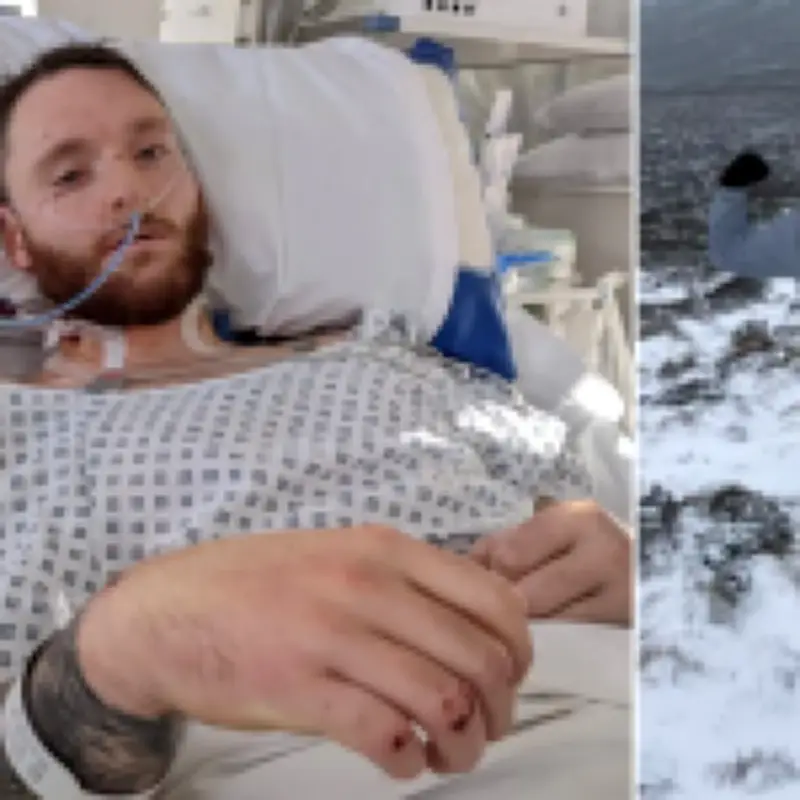
Tommy Price, a fit and experienced fell runner from Huddersfield, was clinically dead on a Cumbrian mountain in January 2022 after profound hypothermia stopped his heart. Rescuers performed manual CPR for an hour and a half before a mechanical device took over, and he was flown to hospital where he was placed on an ECMO life-support machine. He regained consciousness after five days in an induced coma, with no brain damage, and nine months later completed the London Marathon in three hours and 10 minutes, raising £10,000 for Keswick Mountain Rescue.
The fatal run that nearly ended his life
Tommy, then 26, set out with his friend Max to run the Bob Graham Round, a legendary fell-running trail over Skiddaw and Great Calva in the Lake District. The day was grey and snowy, with temperatures around 0°C in Cumbria, but between minus 15°C and minus 20°C higher up with wind chill. The pair had also run through a river, making them much colder.
Tommy remembers nothing of the run. His last memory is parking in Keswick. He told Metro: "I can't remember anything of the run. The mountain rescue doctor said it was like a Word document that doesn't have autosave when there is a power cut. He thinks I will never remember the day of the accident."
As they climbed Blencathra, Tommy began dropping to his knees, saying he couldn't carry on. Max kept picking him up, but Tommy was delirious with hypothermia. His legs stopped working and he slid down the mountain, "ripping my bum open," as he later recounted. Doctors later told him he was lucky not to need skin grafts.
Rescue and the fight to restart his heart
With both mobile phones out of battery, they were about a mile from a farm when Tommy's legs seized up completely. Max wrapped him in an emergency survival bag and ran downhill to call 999 and Mountain Rescue. When rescuers reached Tommy, the bag was empty and he was 100 metres up the mountain, face down in the snow. They rolled him over and started CPR. Another responder arrived with a defibrillator, and Tommy received three electric shocks. He was in ventricular fibrillation, meaning his heart had stopped.
Keswick Mountain Rescue Team volunteers Donald Ferguson and Jonny Hume led the rescue, with team doctor John Ferris. Dr Ferris later said that becoming so cold before his heart stopped probably helped save Tommy's life, as the freezing temperatures protected his brain and other organs. Rescuers carried out manual CPR for 90 minutes before paramedics used a LUCAS machine, which provides mechanical chest compressions. Tommy was flown by helicopter to the Royal Victoria Infirmary in Newcastle, where life support was prepared. As they arrived, the machine ran out of battery, and Dr Ferris had to resume manual CPR.
ECMO, coma, and the slow road to recovery
At hospital, Tommy was placed on an ECMO machine, which temporarily takes over the function of the heart and lungs by pumping blood outside the body, adding oxygen, removing carbon dioxide, and returning the blood, allowing organs to rest. His family gathered at his bedside, including his brothers David and Gareth. Doctors warned them about the risks of ECMO: "It will save his life, but it could also kill him." Tommy explained: "It was torture for my family because if I survived, they didn't know if I would have brain damage."
A CT scan on the third day showed no blood clots in his brain, which doctors called a good sign, but the only real test would be when he woke up. After five days in an induced coma, he regained consciousness. His earliest memory was of a male nurse feeding him water with a sponge. He had a tube down his throat, and his swallow reflex was off. He assumed he had been in a car crash until his family and Max explained what had happened. There was no brain damage.
Tommy had nerve damage in his hands and feet, leaving him unable to grip or pinch. He could just about brush his teeth, but couldn't tie shoelaces, open a can, turn on the shower, or drive. He described it as "like being a baby again." The nerve damage, which felt like constant pins and needles, is permanent, though symptoms have disappeared and he has full mobility. The only lasting effect is that his hands get cold much more quickly than before. After three weeks, he left hospital.
Return to running and a new outlook
Psychologically, Tommy says he is unscarred. "I just don't let it get me down," he said. "I look at life positively. It has changed my outlook a little bit. I'm not scared of death. It happens." He has returned to fell running, though he avoids bad weather. A year after the accident, he completed a 120km race in the Brecon Beacons and has entered other ultra-endurance events. He credits his fitness for saving him: "The month before my accident we did a 56-mile run and I completed an Ironman that summer, so I was at peak fitness."
Tommy now runs his own dog-walking business, covering around 100km every week. He said: "I can't thank John Ferris, Jonny and Donald enough. They saved my life – and they are all volunteers. If it weren't for them, I wouldn't be here today."