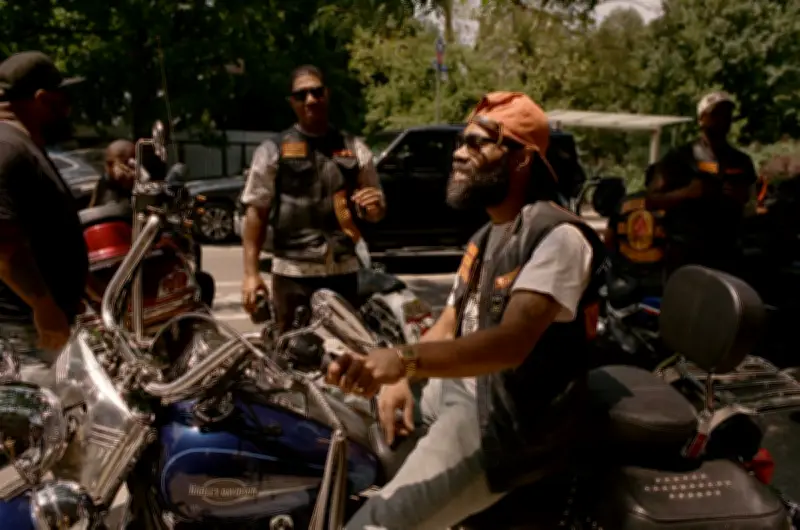
Black motorcycle clubs come alive in the summer, with rides, picnics, and social gatherings nearly every weekend across the US. These events, rooted in decades-long traditions, celebrate community and freedom of movement, a response to exclusion from white clubs and Jim Crow-era discrimination.
History on Wheels
Patrice “Foxy” Johnson, a leader in multiple Black motorcycle organizations, discovered her passion during a Memorial Day weekend trip to Myrtle Beach, South Carolina, about 30 years ago. Watching women ride on the backs of male motorcyclists, she decided she wanted to ride herself. She enrolled in a foundational bike riding class at Johnston Community College in Raleigh, North Carolina, and has since become a staple in the community.
Johnson invests time in Black Girls Ride (BGR), founded in 2011 to support women of color in motorsports. The group meets several times a year in cities like Houston, Daytona Beach, and Los Angeles, publishes a digital magazine and podcast, and participates in the Essence festival in New Orleans each July. About 250 to 300 BGR members typically attend. “The police officers will clear the street for us to walk down Bourbon Street with a second line band,” Johnson said. “We’re chanting: ‘Black Girls Ride! Black Girls Ride!’ We’re dancing in the street.” BGR also raised more than $30,000 for the Boys and Girls Club of New Orleans.
Military Roots and Community Building
The Buffalo Soldiers Motorcycle Club, one of the largest with roughly 5,000 members, is named after all-Black military units established by Congress in 1866. Member Randy Hayward, also known as Detroit Randy, recalled a memorial ride called The Buffalo Thunder from Washington DC to Detroit: “We rode through communities and everybody had their flag out … Black soldiers may not have been celebrated when they came home.” The club holds a July convention in cities like Tampa, Florida; Concord, North Carolina; and Mobile, Alabama, featuring safety training, rides, cookouts, and community outreach. “The best way to fellowship is on two wheels,” Hayward said.
Black motorcycle culture is linked to Black military service. After World War II, Black soldiers sought community and adventure. Tuskegee Airmen, unable to get pilot jobs due to racism, turned to motorcycling. Military motorcycles flooded the market after the war, but many dealers refused to sell to Black people. Former US marine Cliff Vaughs built his own motorcycles and used riding as organizing with the Student Nonviolent Coordinating Committee (SNCC) between 1963 and 1964. He said, “I wanted to be a visible example to them; a free Black man on my motorcycle.”
Cost and Membership
Joining a club requires financial investment. Anthony “Zeke” Settle, national president of the Black Stallions Motorcycle Club, said members must be 21, own a motorcycle bigger than 600 cubic centimeters, complete a three-month probation, cross four state lines, and attend events. “A basic, say 600 sports bike motorcycle – that’s at least [$10,000]. That’s a good used one. The top-of-the-line sports bike – Kawasaki has one that’s $30,000,” Settle explained.
Photographer Alvin C Jacobs Jr, author of Chrome, spent over $50,000 on his most recent bike. He noted challenges in recruiting younger riders: “It’s an expensive hobby and the average millennial is broke.” His son, Hassan Jacobs, a millennial rider and military veteran, is not in a club but values the freedom: “I feel like when I’m on the open road, particularly on a bike, I am able to move freely at speeds that don’t constrain me.”
Shanika “Tru” Beatty, founder and president of Caramel Curves, an all-Black women’s motorcycle club, said members finance, buy used, or save for bikes. “We share maintenance tips, and help new riders navigate the process. We want riding to be accessible, not intimidating. At the end of the day, motorcycling isn’t just an expense to us. It’s an investment in experiences, friendships, personal growth and freedom.” Since 2005, Caramel Curves has grown to 31 members across chapters in New Orleans and Atlanta.
Lifestyle and Misconceptions
Phillip “Dutch” Boyd joined The Flaming Knights, a predominantly Black club founded in 1968, after discovering his love for riding during the pandemic. “My friends rode back in the day and they would always crash! I didn’t think bikes were safe until I did some research during the Covid lockdown.” He earned his patches and became a member. The club recently attended Bike Week in Crown Heights, Brooklyn, with about 200 bikers mingling, shopping, and enjoying music.
Beatty of Caramel Curves addressed misconceptions: “One of the biggest misconceptions is that Black motorcycle culture is only about clubs, leather and looking tough. In reality, it’s about community, family, freedom and giving back.”