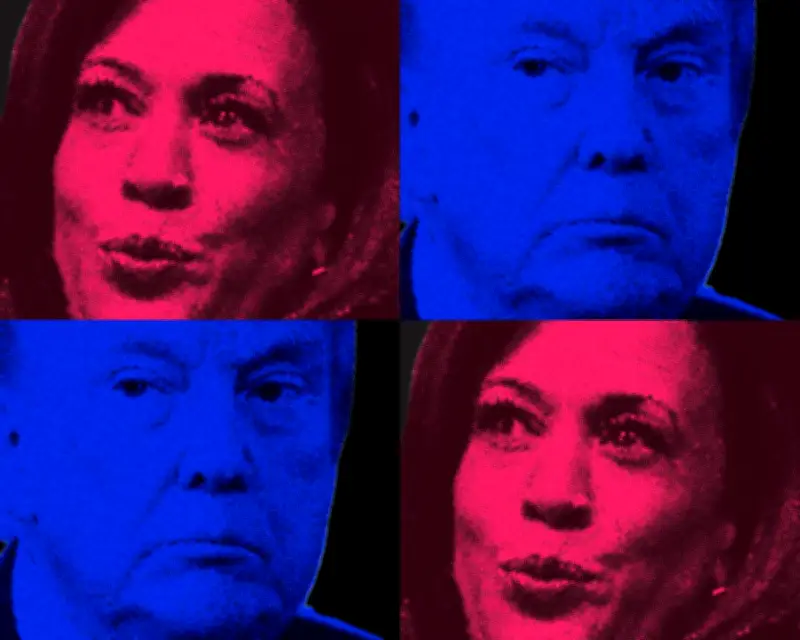
The association of red with Republicans and blue with Democrats is a surprisingly recent tradition in American political symbolism, solidifying only in the 2000 presidential election. This color-coded system, now seemingly permanent, oversimplifies the diversity of Americans' beliefs and may exacerbate political polarization.
Historical use of colors in politics
Color has long played a role in US politics. In 1867, suffragists Susan B. Anthony and Elizabeth Cady Stanton adopted yellow—the color of Kansas's state flower, the sunflower—during their campaign for women's voting rights. By the 20th century, suffragists added white and purple to their political uniforms; white dresses, symbolizing purity and moral authority, became a notable marker of the movement. Later, the Black Panthers donned black leather and berets, while queer Americans adopted the rainbow as a symbol of diversity. Conservative women used pink in the 1970s to oppose the Equal Rights Amendment, and contemporary feminists reclaimed pink through the 2017 pussy hat marches.
From animals to colors
For most of US history, political parties used patriotic red, white, and blue without assigning particular ideological weight. In the 19th century, animals distinguished parties: Democrats adopted the donkey, reclaiming Andrew Jackson's reputation as a "jackass," while Republicans became associated with the elephant after cartoonist Thomas Nast's depictions in the 1870s–1880s. If any color link existed, Democrats were more likely tied to red, mimicking the British Labour Party's red symbol, to connect with labor movements. By the 1930s, red was an effective nod to the working class under Franklin D. Roosevelt. Republicans leaned into blue, evoking Union army uniforms and Abraham Lincoln.

The 2000 election and the shift
The 2000 presidential election cemented red and blue affiliations. TV networks used color-coded maps in election night coverage, marking states won by George W. Bush in red and Al Gore in blue. As these maps were broadcast for months during the contested election, the color associations became seared into voters' minds. In 2004, then-Illinois state senator Barack Obama addressed this emerging binary in his Democratic National Convention speech, criticizing "pundits who like to slice and dice our country into blue states and red states." He argued that both religious prayer and small government ("red" values) and gay rights and civil liberties ("blue" values) exist across the nation, stating, "We are one people."
Entrenchment and impact
Despite Obama's call for unity, the colors' political association deepened. By 2010, Republicans launched the Redmap gerrymandering campaign, an acronym for "redistricting majority project," which seized control over state legislatures and redrew districts in red. By the 2012 elections, state colors became cultural designations; although Obama carried Ohio and Iowa, Republican state victories made them reliably "red states." Some pundits argue all states are inherently purple, mixing varied electorates, but red and blue dominate political debates, erasing nuance.
This color scheme impacts not only electoral maps but also perceptions of the opposing side. Instead of denoting policy differences, colors become stereotypical labels, fostering an in-group/out-group mentality that precludes collaboration. The binary also creates an illusion of greater division than exists: on issues like abortion, immigration, and democracy, Americans' positions show far more gradations and agreement than two-color thinking allows.
Flattening of voting reality
When states are painted red or blue, minority voices are silenced and complex political landscapes ignored. For instance, Kamala Harris received almost 5 million votes in "red" Texas, while 43% of votes in "blue" New York went to Donald Trump. The framework forgets that people—not land—vote, and those people contain multitudes, not conformity. The red/blue system may be an effective shorthand for party identification, but not everyone with a red hat supports MAGA, and not every blue-haired person is a liberal. Expanding the color palette or treating it as a spectrum might better represent America's political diversity.