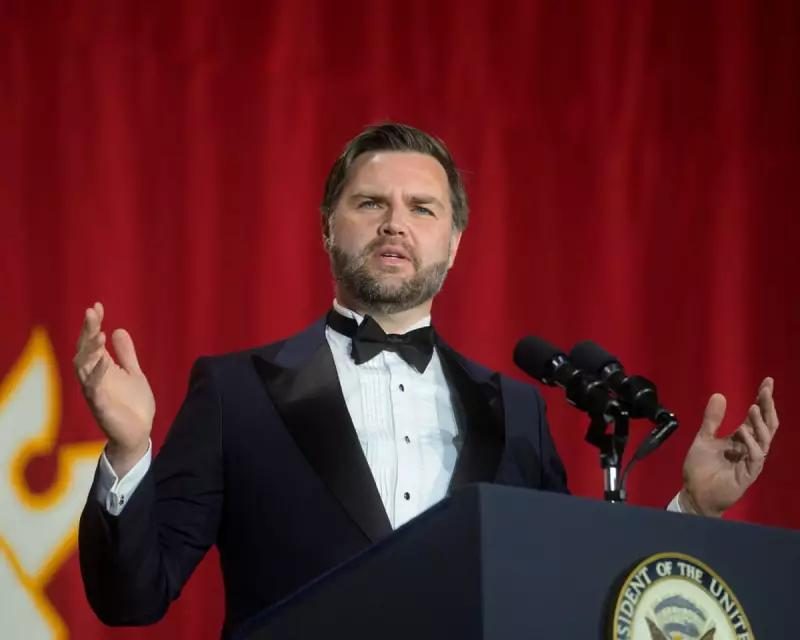
While America has barely settled into Donald Trump's second term, political circles are already buzzing about the 2028 presidential election, with Vice President JD Vance emerging as the clear frontrunner for the Republican nomination.
The Shape-Shifting Politician
Vance's political trajectory reveals a remarkable capacity for transformation. The former atheist converted to Catholicism in 2019, shortly before launching his political career. Even more strikingly, the man who once labelled Donald Trump "America's Hitler" now proudly serves as his second-in-command.
Trump himself has fuelled speculation about Vance's future, suggesting that a presidential ticket featuring Vance and Secretary of State Marco Rubio would be "unstoppable." Meanwhile, Rubio has reportedly told his inner circle he would support Vance for the top job.
Despite his current position, Vance faces significant challenges as he eyes the presidency. His personality often comes across as smug and obnoxious to critics, though this is something he could potentially address through coaching and media training.
The Palantir Problem
One liability that may prove much harder to shake is Vance's deep connection to Palantir, the $450 billion technology company co-founded by billionaire Peter Thiel. This relationship represents what could become a major political vulnerability as the 2028 election approaches.
Thiel's influence on Vance's career cannot be overstated. The billionaire encouraged Vance's hiring at his investment firm Mithril Capital in 2016 and later poured $15 million into Vance's Senate campaign. Many political observers see Vance as essentially serving as Thiel's avatar within the White House.
This connection becomes particularly concerning given Thiel's controversial statement that he doesn't "believe that freedom and democracy are compatible."
Palantir's Controversial Operations
Palantir's business activities have drawn increasing scrutiny from across the political spectrum. The company holds a multimillion-dollar contract with US Immigration and Customs Enforcement to improve "deportation logistics" and is developing an "ImmigrationOS" system that would provide "near real-time visibility into instances of self-deportation."
The technology firm, often described as "the AI arms dealer of the 21st century," also maintains close ties with Israel's military. A June report from UN special rapporteur Francesca Albanese indicated there are "reasonable grounds to believe Palantir has provided automatic predictive policing technology" to Israel, alongside "core defence infrastructure."
When confronted by pro-Palestine protesters in May who accused him of killing Palestinians, Palantir co-founder Alex Karp shrugged off the allegations with the comment: "Mostly terrorists, that's true."
Growing Backlash from Conservative Circles
Perhaps most worrying for Vance's political prospects is that criticism of Palantir isn't limited to progressive circles. Prominent conservative voices have begun expressing alarm about the company's growing influence within the Trump administration.
During a 9 September episode of his massively popular podcast, Joe Rogan referenced a Benzinga article about the administration using Palantir to gather the "personal data of American citizens" and described the situation as "kinda creepy." Rogan expressed particular concern about reports that Palantir was creating "detailed profiles of American citizens," asking pointedly: "Who signed off on this?"
He's not alone in his concerns. Over a dozen rightwing influencers, including Tucker Carlson, have publicly questioned Palantir's capabilities and objectives within the United States.
Vance himself acknowledged the growing scrutiny during a recent address to university students, noting: "I get asked about Palantir a lot because there's this internet meme out there that somehow I am super in bed with Palantir."
As the 2028 election cycle inevitably gains momentum, Vance's connections to Thiel and Palantir will likely face even greater examination. For a politician who has demonstrated remarkable ability to reinvent himself, this particular association may prove the most difficult to distance himself from as he makes his case to American voters.